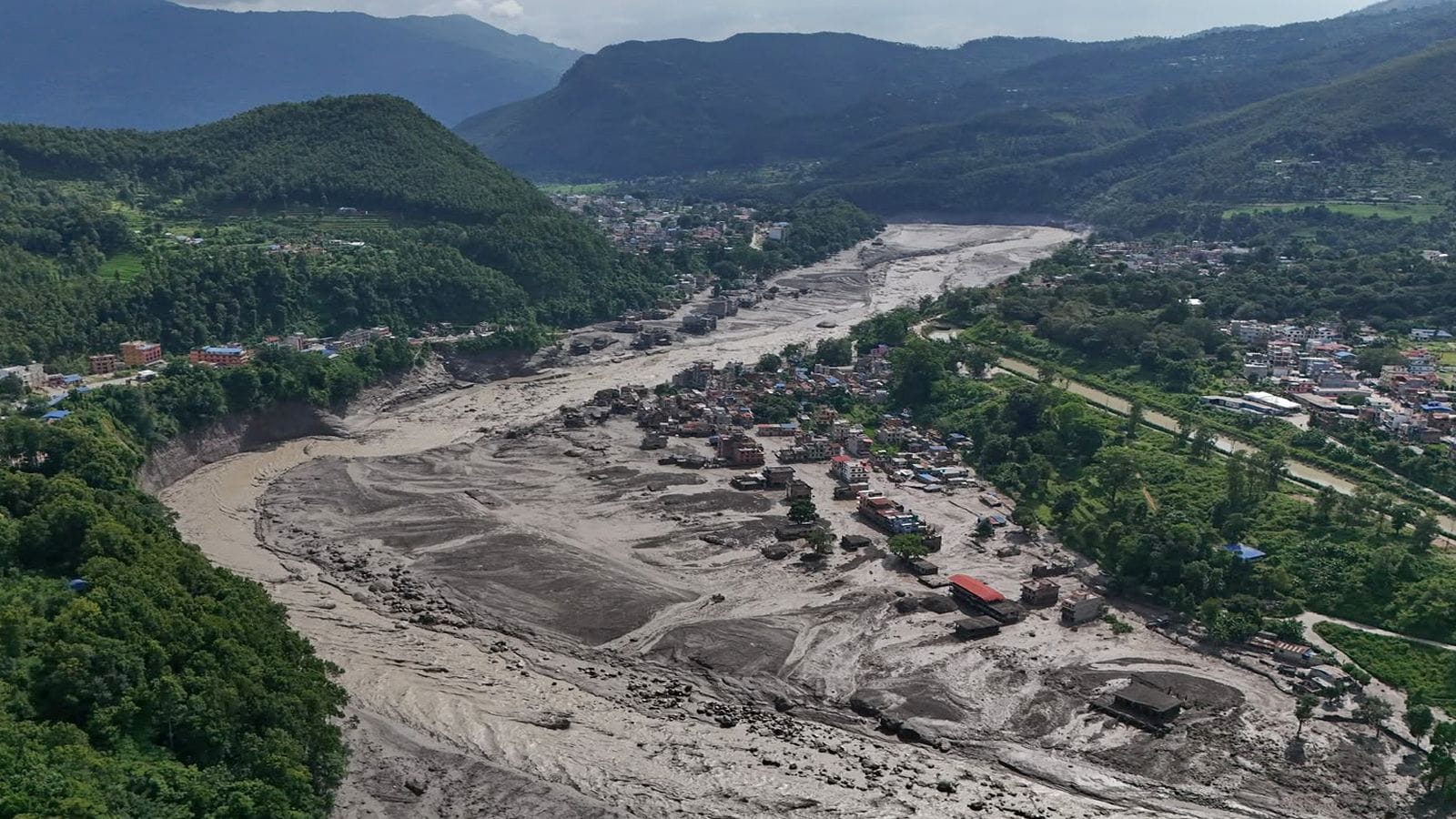
Macroeconomic damage calculations following high-altitude natural disasters typically suffer from immediate information vacuums, forcing policymakers to rely on top-down macro approximations rather than bottom-up asset inventories. When initial assessments project a four to five billion dollar reconstruction bill—equaling roughly ten percent of Nepal's gross domestic product—evaluating the structural integrity of that estimate requires examining the mechanics of capital destruction in extreme topography.
The disaster, triggered by an ice-and-rock avalanche along the northern border corridor, compromised fixed assets far more capital-intensive than standard residential housing. Dissecting the financial recovery requires mapping three primary structural vectors: energy infrastructure replacement, logistical corridor rehabilitation, and localized economic multiplier losses.
The Energy Infrastructure Shock
Hydropower assets form the backbone of the national electricity grid, representing over ninety percent of installed generating capacity. Flash floods through narrow mountain gorges exert extreme hydrodynamic pressure, stripping riverbed installations, choking penstocks with silt and debris, and shearing transmission towers.
Initial reports indicate that damaged generation projects account for more than twelve percent of national capacity. Replacing these assets involves long-lead-capital items. Turbines, heavy-duty switchyards, and high-voltage cabling cannot be sourced off the shelf.
The economic fallout extends beyond the direct capital expenditure required for civil reconstruction. Losing a tenth of generation capacity forces reliance on high-cost thermal power imports or induces chronic load-shedding. Industrial output contracts when manufacturing and processing facilities face erratic power availability, compounding the baseline fiscal deficit required for physical repairs.
The Logistical Cost Function of Himalayan Topography
Reconstruction expenditure scales non-linearly with altitude and isolation. Standard civil engineering cost-per-kilometer metrics break down entirely when heavy machinery, structural steel, and cement must be moved across washed-out bridges and unstable mountain tracks.
The geography of the northern border region creates severe logistical bottlenecks. When arterial roads and bridge networks collapse, the supply chain for basic construction inputs halts. Transporting materials via air carriage or manually cutting temporary bench roads through vertical rock faces exponentially increases operational overhead.
This explains why reconstruction timelines routinely extend across multiple years. Labor deployment is restricted by seasonal weather windows, high-altitude operational hazards, and the sheer challenge of staging heavy equipment in remote river corridors. Every day a valley remains isolated, the indirect economic contraction compounds the initial capital shock.
Comparative Fiscal Strain Versus Historical Precedent
Finance Minister Swarnim Wagle noted that the projected four to five billion dollar recovery requirement remains lower than the nine billion dollar cost of the 2015 seismic disaster. Understanding this delta requires analyzing the asset footprint of each event.
The 2015 earthquake caused widespread structural failure across hundreds of thousands of residential masonry buildings distributed densely across urban and rural settlements. By contrast, the flash flood vector is geographically linear, concentrated primarily within drainage basins and river corridors.
While the absolute capital requirement is lower than a major tectonic event, its concentration within strategic sectors like energy and transport creates a severe liquidity squeeze. The state must direct domestic capital reserves and foreign concessional financing toward high-value nodes just as tourism revenues and local commerce face temporary contraction.
Financing a recovery equivalent to ten percent of national output demands a structured capital allocation framework. The primary strategic priority is ring-fencing critical energy assets to restore grid stability, followed by the systematic contracting of engineered-grade corridor repairs capable of withstanding future glacial lake outburst events. International development partners must coordinate concessionary credit lines specifically targeted at capital-goods imports, mitigating the balance-of-payments pressure while domestic productive capacity is offline.