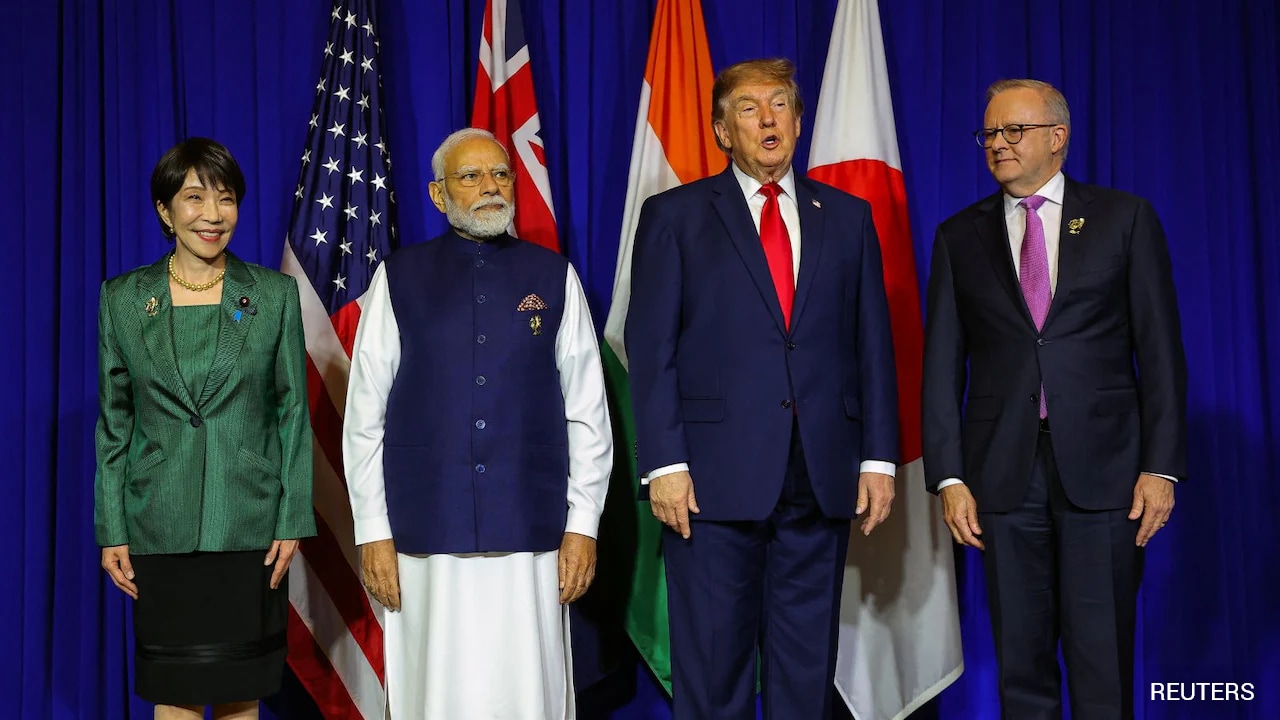
Most foreign policy analysts still treat the Quadrilateral Security Dialogue like a brand-new invention from the 2020s, yet the real turning point happened in a noisy Manila hotel corridor back in November 2017. That was the weekend Indian Prime Minister Narendra Modi and U.S. President Donald Trump sat down during the ASEAN summits and quietly resurrected a diplomatic grouping that had been left for dead for nearly a decade. If you want to understand why Beijing spent the next nine years complaining about an "Asian NATO," you can't skip those forty-eight hours in the Philippines.
Diplomacy rarely looks dramatic in real time. There were no treaties signed on gilded tables, no joint press conferences with flags snapping in the breeze, and no formal leaders' summit on the official schedule. Instead, mid-level diplomats from India, the United States, Japan, and Australia met in Manila on November 12, 2017, right before Modi and Trump held their own bilateral talks on November 13. By the time the leaders flew home, the Quad had a brand-new strategic direction centered on a "free and open Indo-Pacific"—a phrase that immediately rewrote the security playbook across Asia.
Why the Manila Meeting Changed Everything for the Indo-Pacific
To appreciate why Manila mattered, you have to remember how badly the first version of the Quad failed. Japanese Prime Minister Shinzo Abe originally pitched the idea of an "Arc of Freedom and Prosperity" in 2007, bringing together the four democracies after they had cooperated effectively during the 2004 Indian Ocean tsunami relief effort. Then domestic politics and Chinese economic pressure killed it within months. Australian Prime Minister Kevin Rudd pulled Canberra out in early 2008 to appease Beijing, India grew hesitant about provoking its northern neighbor, and the Bush administration moved on to other crises.
For nine years, the Quad was practically a dirty word in New Delhi and Canberra. Nobody wanted to be the first to stick their neck out while China's Belt and Road Initiative was pouring billions of dollars into ports, railways, and telecommunications across South and Southeast Asia.
Then 2017 arrived, and the ground shifted beneath everyone's feet. India had just endured the tense 73-day Doklam military standoff with Chinese troops on the Bhutanese border. Trump had entered the White House ripping up the old Washington consensus on trade and engagement with China, formally replacing the geographic label "Asia-Pacific" with "Indo-Pacific" during his November 2017 tour. Abe was back in Tokyo pushing hard for democratic coordination, and Australia was waking up to foreign interference scandals at home.
When Modi and Trump met at the Sofitel Philippine Plaza in Manila, they weren't starting from scratch. They were aligning four separate national anxieties into a single strategic framework. Trump praised India's growth and its role in regional stability, while Modi emphasized that the relationship between New Delhi and Washington was moving far beyond bilateral trade into global security responsibilities.
What Modi and Trump Actually Agreed On Behind Closed Doors
If you read the four separate readouts issued after the November 12 diplomatic meeting in Manila, you notice something fascinating. The four countries didn't even publish a joint statement—a deliberate choice that revealed just how sensitive the reboot still was, especially for India. Yet behind the diplomatic caution, Modi and Trump locked in four concrete priorities that defined the Quad from 2017 onward.
Maritime Security and Freedom of Navigation
China had spent the years between 2013 and 2017 dredging reefs and building military runways across the South China Sea, ignoring a 2016 international tribunal ruling in favor of the Philippines. In Manila, Washington and New Delhi agreed that international law—specifically the United Nations Convention on the Law of the Sea—had to mean something in practice. For India, watching Chinese submarines dock in Sri Lanka and Pakistan made maritime domain awareness in the Indian Ocean an urgent national survival issue rather than an abstract legal principle.
An Alternative to Belt and Road Debt Traps
By late 2017, Sri Lanka was preparing to hand over a 99-year lease on the Hambantota port to a Chinese state firm after struggling to service its loans. Modi had boycotted Beijing's Belt and Road Forum earlier that May, arguing that connectivity projects must respect sovereignty, transparency, and financial sustainability. In Manila, Trump and Modi aligned on offering high-standard infrastructure financing so smaller nations wouldn't be forced to mortgage strategic ports just to build basic roads and power grids.
Counter-Terrorism and Supply Chain Coordination
Trump's South Asia strategy, announced in August 2017, had already called out Pakistan over terrorist safe havens while asking India to do more economically in Afghanistan. In their Manila bilateral meeting, the two leaders doubled down on intelligence sharing and defense interoperability. That quiet groundwork directly paved the way for Washington renaming its Pacific Command to U.S. Indo-Pacific Command in May 2018 and signing the COMCASA secure communications pact with India later that year.
Keeping ASEAN at the Center
A common mistake commentators make is assuming Modi and Trump tried to steamroll Southeast Asian nations into picking sides. Actually, both leaders spent their Manila speeches reassuring the Association of Southeast Asian Nations that ASEAN centrality remained the bedrock of regional architecture. They knew perfectly well that countries like Indonesia, Vietnam, and Singapore wanted American and Indian counterweights to China without being dragged into a Cold War-style military bloc.
What Most People Get Wrong About the Quad's Evolution
Whenever I talk to observers who only started paying attention to the Quad after the first leader-level virtual summit in March 2021, I hear the same three myths repeated over and over.
First, people assume the Quad is a formal military alliance with a mutual defense clause like Article 5 of NATO. It isn't, and it never was. Even during the darkest days of border clashes in the Himalayas, India consistently rejected turning the Quad into a treaty alliance because New Delhi guards its strategic autonomy fiercely. Instead, the Manila reboot created a flexible coalition that conducts joint naval exercises like Malabar while also tackling non-military issues such as vaccine distribution, critical minerals, and submarine fiber-optic cables.
Second, critics often claim Trump's "America First" worldview was incompatible with multilateral coalitions. Manila proved the opposite. Trump disliked sprawling, bureaucratic multilateral bodies where Washington paid the bills and got lectured on climate rules, but he enthusiastically backed tight, transactional groupings of strong states willing to carry their own weight. Modi fit that mold precisely. Their personal chemistry—later seen on full display at the "Howdy, Modi!" rally in Houston in 2019 and the "Namaste Trump" event in Ahmedabad in 2020—started gaining real policy traction in Manila.
Third, many analysts assumed the Quad would collapse once administrations changed in Washington, Tokyo, Canberra, or New Delhi. Look at what happened instead. When Joe Biden took office in 2021, he didn't scrap Trump's Indo-Pacific framework—he elevated the Quad from a ministerial meeting to a full leaders' summit. When Trump returned to the White House in 2025, Secretary of State Marco Rubio hosted the Quad foreign ministers in Washington on his very first full day on the job, confirming that the Manila consensus had become permanent bipartisan orthodoxy.
How the Manila Blueprint Still Shapes Geopolitics Today
Walk through any diplomatic briefing in Washington, New Delhi, Tokyo, or Canberra right now, and you're still looking at the house built in Manila. Every major Quad initiative of the past several years traces straight back to the priorities Modi and Trump hashed out in November 2017.
Take the Indo-Pacific Partnership for Maritime Domain Awareness, which uses commercial satellite data to track dark shipping and illegal fishing across the Pacific Islands and the Indian Ocean. That's the direct operational descendant of the maritime security discussions in Manila. Take the Quad Infrastructure Fellowship and subsea cable investments across the Pacific—those exist because Modi and Trump recognized early on that whoever lays the physical and digital pipes in Asia sets the rules for the next fifty years.
Even Beijing's reaction validates how effective that weekend in the Philippines turned out to be. In March 2018, Chinese Foreign Minister Wang Yi dismissed the Quad as "headline-grabbing ideas" that would dissipate like "sea foam" in the Pacific or Indian Ocean. Within three years, Beijing was treating the Quad as its primary strategic headache in Asia, complaining loudly whenever the four leaders met. Sea foam doesn't make a superpower rewrite its diplomatic talking points.
How to Track What Comes Next for the Quad
If you follow Asian geopolitics, defense policy, or global supply chains, don't get distracted by whether a particular summit produces splashy headlines. The real story of the Quad has always been in the operational plumbing—the exact kind of quiet groundwork laid in Manila.
Watch three concrete indicators over the coming months to see where the grouping is heading:
- Follow the defense logistics agreements and joint exercises. Pay attention to how often Indian P-8I maritime patrol aircraft operate alongside U.S., Japanese, and Australian forces in the Bay of Bengal and the South China Sea. Interoperability tells you far more than summit communiqués ever will.
- Track critical mineral and semiconductor supply chain deals. Look at bilateral and Quad-backed investments in lithium processing, rare earth refining, and chip packaging across India and Australia, which aim to break single-country monopolies before the next global crisis hits.
- Read the official White House and Ministry of External Affairs readouts side by side. Whenever Modi and Trump—or their foreign ministers—meet, compare what Washington emphasizes against what New Delhi highlights. The subtle gaps between those two texts will show you exactly where the next diplomatic push is happening.