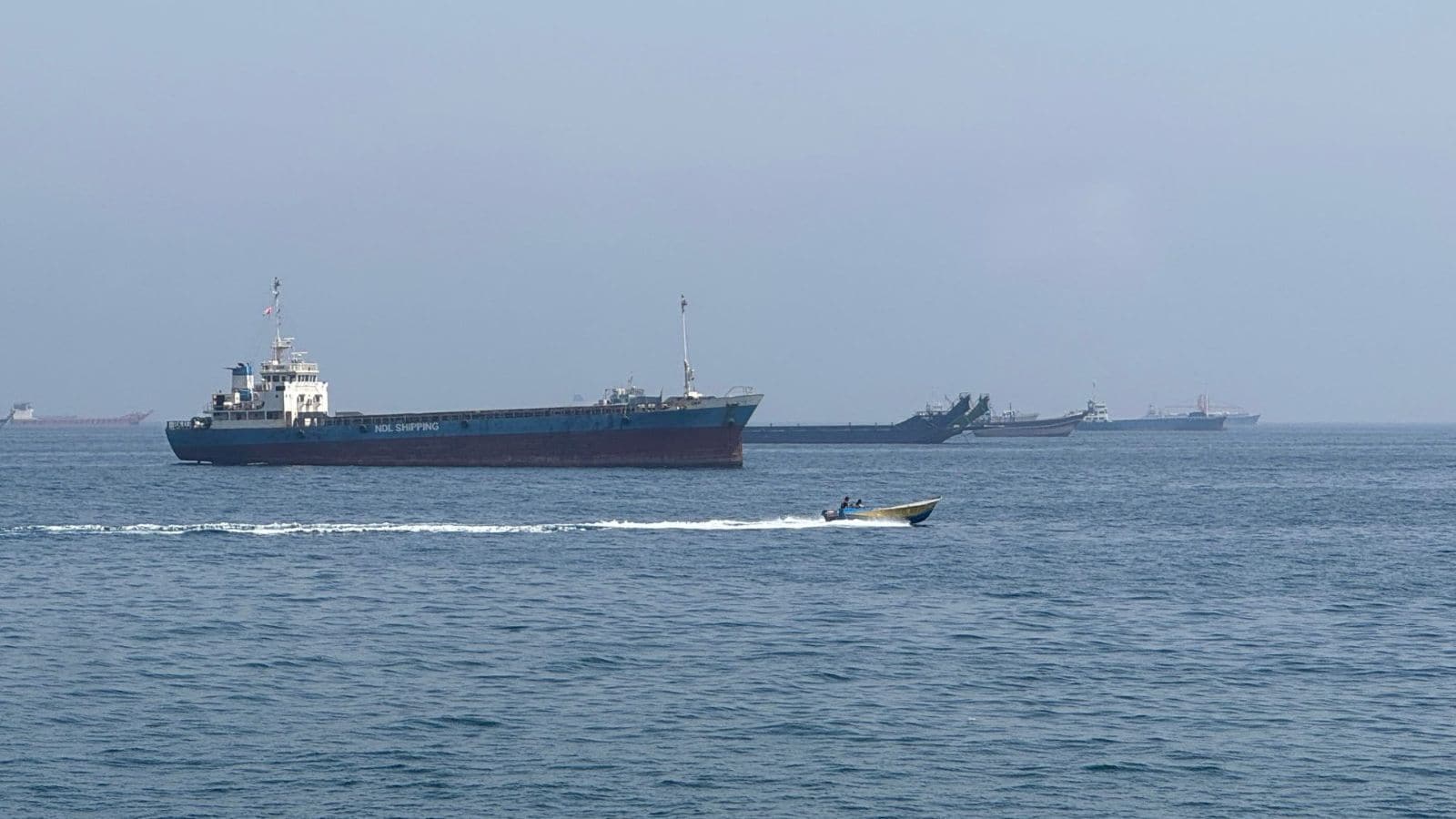
Twenty-one Indian sailors made it safely to shore at Khasab, two landed in the hospital, and one vanished into the waters off Oman. That's the stark human tally from the November 16, 2026 strike on the Panama-flagged liquefied petroleum gas tanker MT Tara Gas in the Strait of Hormuz. Most news reports treated this Oman vessel attack like a routine maritime wire update, burying the real story under boilerplate diplomatic statements.
They missed what actually went wrong on the water. For an alternative look, check out: this related article.
When an LPG carrier takes a direct hit seven nautical miles north of Oman's Musandam coast, you aren't dealing with a minor fender-bender at sea. You're dealing with a floating bomb. And the timeline of how this incident unfolded—from premature "everyone is safe" government updates to a devastating second strike—exposes a massive communication and security gap that puts Indian seafarers directly in the crosshairs.
The Two-Stage Strike Near Khasab That Changed Everything
Let's strip away the official jargon and look at the sequence of events. On November 16, 2026, MT Tara Gas was transiting the Strait of Hormuz with 25 crew members aboard. Twenty-four of them were Indian nationals. Further insight on this matter has been published by Al Jazeera.
An unknown projectile—identified by maritime security firm Vanguard Tech as a missile—slammed into the tanker roughly seven nautical miles north of Khasab, Oman. That initial blast crippled the ship's propulsion and ignited a fire in the engine room.
Here's the part most surface-level summaries gloss over.
A disabled tanker in a hostile chokepoint doesn't just sit quietly waiting for a tugboat. According to the Joint Maritime Information Center (JMIC), the drifting, crippled vessel came under attack a second time on November 17. That follow-up hit sparked another fire, forced the crew to abandon ship entirely, and left the vessel with extensive structural damage.
Between the first blast, the engine room fire, and the chaotic abandonment after the second strike, third officer K. Subramanian from Aruppukottai in Tamil Nadu went missing.
Why Initial Official Updates Got It Wrong
If you followed this story in real time, you probably noticed glaring contradictions in the early reporting.
Union Shipping Minister Sarbananda Sonowal initially posted on social media that all 24 Indian nationals and the entire 25-person crew were completely safe with zero injuries. Hours later, the Ministry of External Affairs had to issue a sobering correction. Out of the 24 Indians aboard:
- 21 seafarers were evacuated ashore at Khasab port by the Royal Navy of Oman and Omani coastguard units.
- 2 crew members suffered injuries serious enough to require hospital admission.
- 1 Indian officer remained unaccounted for as search and rescue teams combed the waters.
Even the ship's registry sparked confusion. While New Delhi and international shipping monitors confirmed MT Tara Gas flew the Panamanian flag, Oman's Maritime Security Centre initially logged it as Comoros-flagged.
Why does this confusion happen during every single maritime crisis? Because when a commercial ship takes fire, initial distress relays come from fragmented radio bursts before lifeboats are even accounted for. Politicians rush to share reassuring news based on first-wave headcounts, only to walk it back once shore authorities actually tally survivors at the dock.
Why Indian Seafarers Bear the Brunt of Gulf Chokepoint Attacks
You can't look at the MT Tara Gas incident in isolation. It's part of a brutal, escalating pattern along Oman's coastline and the wider Persian Gulf.
India supplies over 12% of the world's merchant shipping workforce—roughly 312,000 sailors out of 2.57 million globally, second only to the Philippines. Whenever missiles, drones, or naval mines start flying in the Strait of Hormuz, Indian crews are statistically guaranteed to take the hits.
Look at the recent toll off Oman alone:
- September 13, 2026: The Panama-flagged oil tanker MT El Gaia was struck off Oman's coast. Thirteen Indian sailors were rescued, while one vanished.
- October 11, 2026: The tanker MT Petro Dolphin was hit at the Sohar port anchorage in northern Oman, leaving nine Indian crew rescued and two missing. That same day, the Marshall Islands-flagged M/T Valthera took projectile fire in the Strait of Hormuz.
- November 2, 2026: An unidentified aerial object struck the Indian vessel MSV Al Jusufi near Oman. Thirteen crew survived, while Gujarat seafarer Gandhar Nahim Ajij died from his injuries.
- November 16–17, 2026: MT Tara Gas suffered its double strike near Khasab, alongside hits on On Phoenix and an ADNOC Logistics vessel in the same corridor.
By the time MT Tara Gas burned off Musandam, maritime monitors counted at least 17 regional shipping incidents in a single month. Earlier government disclosures confirmed India had already lost more than a dozen seafarers in the regional conflict.
The Flag-of-Convenience Trap
Here's an uncomfortable truth the shipping industry rarely advertises. MT Tara Gas carried an almost exclusively Indian crew, yet it sailed under a Panama flag.
When a tanker uses a flag of convenience, legal responsibility fragments across three or four jurisdictions overnight. The ship is registered in Panama. The crew comes from Tamil Nadu, Kerala, Maharashtra, or Gujarat. The management company sits in Dubai or Singapore. The attack happens in Omani territorial waters or adjacent transit lanes.
New Delhi can—and did—issue sharp diplomatic condemnations demanding safe navigation. The Indian Embassy in Muscat can coordinate hospital beds and emergency travel documents. What India cannot easily do is force a foreign-flagged vessel owner to reroute around a war zone before a missile hits.
What Actually Happens During a Musandam Search and Rescue
When an attack happens seven miles off Khasab, geography dictates survival.
Oman's Musandam Governorate juts like a jagged spear straight into the narrowest throat of the Strait of Hormuz. The waters there are deep, fast-moving, and crowded with supertankers trying to squeeze through a shipping lane barely two miles wide in each direction.
When MT Tara Gas caught fire, Omani naval and coastguard boats launched rapidly from Khasab. Getting 21 sailors off a burning LPG tanker without a catastrophic BLEVE—a boiling liquid expanding vapor explosion—is nothing short of a miracle. Liquefied petroleum gas is stored under pressure. If intense engine-room heat compromises the cargo tanks, the resulting blast radius vaporizes everything nearby.
That extreme explosion hazard is exactly why rescue boats have to balance speed against standoff distance, and why drifting vessels like Tara Gas become sitting ducks when secondary strikes hit the next day.
What Needs to Change for Seafarers and Families
Hand-wringing over freedom of navigation doesn't bring K. Subramanian home to Aruppukottai, and it doesn't protect the next crew steaming past Musandam tonight. If you're a seafarer, a shipping manager, or a family member with loved ones working Gulf routes, passive waiting isn't a strategy.
1. Verify War-Risk Clauses Before Signing On
Under International Bargaining Forum (IBF) and maritime union rules, seafarers have the legal right to refuse sailing into designated High-Risk Areas or Warlike Operations Areas without losing their jobs or paying repatriation costs. Many junior officers sign contracts without checking whether the Strait of Hormuz or Gulf of Oman has been freshly upgraded on the Joint War Committee's listed areas. Check the vessel's exact charter route before boarding.
2. Demand Verified Crew-List Transparency
Families shouldn't have to refresh social media feeds to guess whether their relative is on a burning ship. Insist on having the direct 24/7 emergency hotline for both the Directorate General of Shipping (DG Shipping) in Mumbai and the ship's Manning Agent (RPSL license holder) written down offline before departure.
3. Push for Mandatory AIS and Citadel Upgrades
Notice how JMIC warned that disabled, drifting vessels remain prime targets for follow-up strikes. Modern commercial tankers transiting Hormuz need hardened safe rooms (citadels) below the waterline, thermal firefighting gear rated for gas carriers, and immediate tug-escort protocols the second propulsion fails—not 24 hours later.
4. Diversify Energy Supply Chains
India imports the vast majority of its liquefied petroleum gas through this exact maritime bottleneck. Until New Delhi aggressively expands strategic domestic LPG storage and alternative sourcing outside the Persian Gulf, Indian crews will keep riding high-value targets through a live-fire corridor to keep domestic kitchens running.
Monitor official updates directly through the Ministry of External Affairs press portal and UKMTO maritime advisories rather than unverified social media posts, and ensure any family member currently serving on Gulf-bound tankers registers their vessel details with the nearest Indian consular mission immediately.


