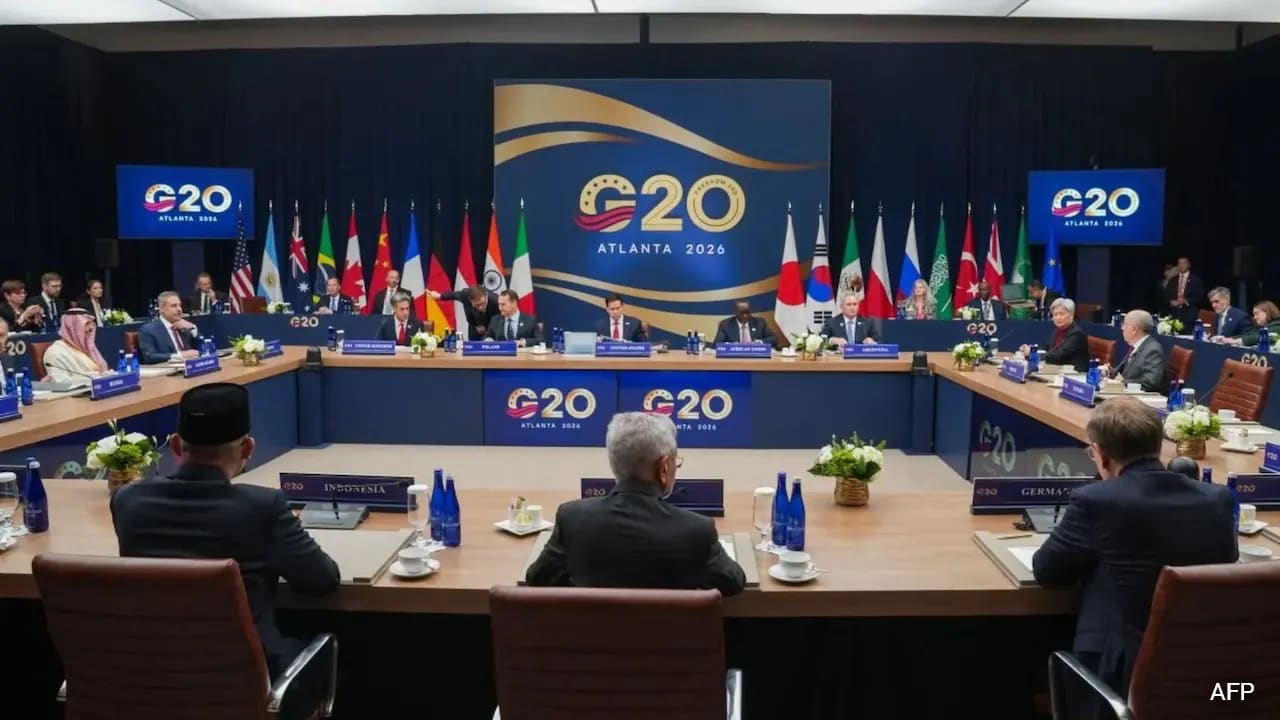
Diplomacy usually runs on polite fictions, and nothing captures that better than the traditional G20 "family photo." You line up the world's top ministers, everybody forces a smile for sixty seconds, and the cameras capture an illusion of global unity before everyone goes back to arguing behind closed doors.
In late October 2026, that illusion broke completely in Atlanta, Georgia.
When top diplomats gathered for the G20 Foreign Ministers' Meeting on October 30 and 31, the United States had to pull the plug on the traditional group photograph altogether. Why? Roughly a third of the countries in the room—led by European Union members, Australia, Canada, and the UK—flatly refused to stand next to Russian Foreign Minister Sergey Lavrov. Meanwhile, escalating conflict involving Iran, maritime chokepoints, and bitter disputes over who even deserved a seat at the table turned what was supposed to be an economic summit into a diplomatic standoff.
If you've seen headlines mentioning a "photo op in Iran" or garbled summaries of the Atlanta boycott, you're looking at a classic game of geopolitical telephone. Iran wasn't hosting the summit—the United States was. Iran was, however, one of the primary powder kegs tearing the consensus apart inside the room.
Why the Atlanta Photo Op Collapsed
Let's be clear about what actually went down in Georgia. U.S. Secretary of State Marco Rubio hosted the meeting with a specific goal in mind. Washington wanted to strip away the ideological baggage and drag the G20 back to its original 1999 mandate—macroeconomic stability, supply chains, critical minerals, and trade.
That plan lasted about five minutes.
Russian Foreign Minister Sergey Lavrov showed up in Atlanta, marking one of his rare visits to a NATO country since Moscow's full-scale invasion of Ukraine in February 2022. While European ministers—including German Foreign Minister Johann Wadephul, British Foreign Secretary Ed Miliband, and Polish Foreign Minister Radoslaw Sikorski—were willing to sit in the same plenary hall to argue policy, posing for a smiling portrait was a hard red line.
"In no case will there be a family photo with European partners and Mr. Lavrov together because there is no normalcy with Russia," Wadephul told reporters before the sessions even got rolling.
The Two-Photo Compromise That Failed
Behind the scenes, European officials actually floated a workaround. They suggested taking two separate group pictures. One would include Lavrov alongside nations willing to stand with Moscow, and a second would feature everyone else without him.
Washington rejected the split-screen optics. Canceling the photo shoot entirely was less embarrassing for the host than publishing two competing portraits of a fractured world order. Rubio defended inviting Moscow by arguing that you can't negotiate an end to a war if you refuse to talk to the belligerents. European allies saw it differently. To them, rolling out the welcome mat in Atlanta—and floating an invitation for Vladimir Putin to attend the December leaders' summit at President Donald Trump's Miami golf club—weakened Western leverage without extracting a single concession from the Kremlin.
How the Iran Crisis Split the Room Further
The Russia-Ukraine war wasn't the only fault line ruining the optics. The worsening crisis involving Iran and Middle Eastern maritime security injected immediate economic panic into the discussions.
You can't talk about global inflation or supply chains in 2026 without talking about the Strait of Hormuz and the Bab al-Mandeb Strait. Escalating military friction with Iran has turned those waterways into high-risk zones for commercial shipping and energy tankers.
Here's where the G20 fractured along regional and strategic lines:
- The U.S. and Western stance: Washington pushed hard to frame maritime security in the Persian Gulf and Red Sea as a core economic survival issue, pressing allies on energy diversification and deterrence against Iranian disruption.
- Asian economic anxiety: Major energy importers like India, Japan, and South Korea—alongside Southeast Asian economies—watched the Iran escalation with deep alarm. Any full-blown blockade or prolonged conflict in the Strait of Hormuz hits Asian refineries and manufacturing networks within days, not months.
- Middle Eastern balancing acts: Saudi Arabia and Turkey, represented by Foreign Ministers Faisal bin Farhan and Hakan Fidan, had to navigate between preserving regional stability, managing oil market volatility, and avoiding open entanglement that could invite retaliation on their own soil.
Because members couldn't agree on who bore responsibility for the regional escalation—or what diplomatic and military steps were justified—the Iran crisis became another wedge blocking any unified statement.
The Guest List Drama Nobody Expected
If Russia and Iran weren't enough to derail the summit, Washington's handling of the invitation list poured gasoline on the fire.
First, there was South Africa. Despite being a full, permanent member of the G20, South Africa wasn't invited to the Atlanta ministerial meeting by the Trump administration. South African International Relations Minister Ronald Lamola's spokesperson, Phindile Kunene, made it blunt that their absence wasn't a boycott. "We have consistently maintained that our nonparticipation is not voluntary," Kunene stated. Several G20 nations objected to Washington unilaterally sidelining an existing member.
Then came the fight over Poland. Warsaw attended as a guest and has been actively campaigning for permanent G20 membership on the back of its rapid economic growth and defense weight in Europe. Lavrov used the floor in Atlanta to publicly oppose Poland's bid while doubling down on Moscow's maximalist security demands regarding Ukraine.
When a summit host excludes a full member while inviting a sanctioned adversary—and allies fight over who gets admitted next—consensus dies on arrival.
What No Joint Communique Actually Means
By the time the ministers wrapped up on October 31, the G20 failed to produce a joint communique. Instead, the United States had to settle for issuing a unilateral "chair's statement" summarizing Washington's view of the talks.
Does the lack of a communique matter in the real world, or is it just diplomatic theater? Honestly, it matters quite a bit—just not for the reasons pundits usually cite.
A joint communique requires unanimous sign-off from every member in the room. In past years, diplomats stayed up until 4:00 AM haggling over single adjectives to keep the G20 functioning as the world's premier crisis-management forum. Walking away without one proves that the G20 can no longer pass even basic resolutions on war, trade tariffs, or shipping lanes.
Instead, real power is migrating into smaller, sharper blocs. During the exact same weekend in Atlanta, Rubio pulled aside his counterparts from Australia, India, and Japan for dedicated Quad talks focused on critical minerals and Indo-Pacific maritime security. When the big room deadlocks, the real deals happen in the hallways.
How to Read Geopolitical Headlines Without Getting Misled
If you're tracking global markets, energy prices, or foreign policy, chaotic summits like Atlanta's G20 meeting generate a ton of noisy, inaccurate clickbait. Use these filters the next time a major diplomatic boycott hits your feed:
- Separate symbolic snubs from policy shifts. Skipping a group photo is great television, but look at who stayed in the room. European ministers still sat across from Lavrov during plenary sessions. When diplomats walk out of the actual working meetings—or get barred from attending, like South Africa—that's when structural damage is happening.
- Watch the chair's statement, not the press conference. Press conferences are aimed at domestic voters back home. Read the official chair's summary to see what survived the argument—in October 2026, that meant maritime chokepoints like Hormuz and critical mineral supply chains.
- Follow the side meetings. Whenever a G20 or UN summit ends without a communique, look at the bilateral and minilateral pull-asides (like the Quad meeting in Atlanta). That's where actual capital, sanctions enforcement, and defense commitments are moving.
- Verify host locations and timelines. Automated news aggregators frequently mash together separate crises—turning a U.S.-hosted G20 meeting about Russia and Iran into a fictional "meeting in Iran." Always cross-check primary wire reports from Reuters or the Associated Press before acting on breaking geopolitical news.
Watch G20 representatives skip 'family' photo with Russian foreign minister to see the exact diplomatic standoff in Atlanta that forced U.S. officials to cancel the traditional group portrait.