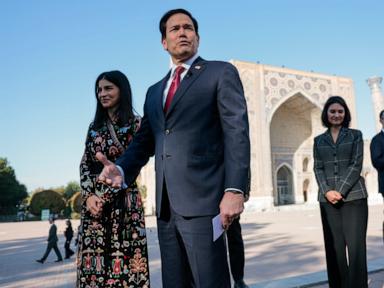
When U.S. Secretary of State Marco Rubio landed in Samarkand with nearly 300 American executives in tow, public diplomatic statements framed the visit as a routine push for Central Asian market access. The underlying reality is far sharper. Washington is executing a transactional shift in Eurasia to secure non-Chinese critical mineral supply chains, even as Cold War-era trade legislation and entrenched regional dynamics threaten to stall those deals before ground is broken.
The headline total out of Samarkand sounded impressive: $12 billion in non-binding commercial agreements and investment frameworks signed across energy, technology, and mining sectors. Tashkent signed onto the U.S.-led Artemis Accords for space exploration and joined the C5+1 ministerial lineup to signal a desire for broader Western capital. Yet behind the photo opportunities at Registan Square, the strategic framework driving Washington’s foreign policy in the region has been overhauled. Building on this idea, you can find more in: The Limoges Fire and the Anatomy of a Broken Social Contract.
┌────────────────────────────────────────────────────────────────────────┐
│                   WASHINGTON'S CENTRAL ASIA SHIFT                      │
├───────────────────────────────┬────────────────────────────────────────┤
│ Traditional Foreign Policy    │ Current Transactional Model            │
├───────────────────────────────┼────────────────────────────────────────┤
│ • Human rights mandates       │ • Commerce & supply security first     │
│ • Governance conditionality   │ • Critical mineral access prioritization│
│ • Multilateral institutionalism│ • Direct corporate deal-making         │
└───────────────────────────────┴────────────────────────────────────────┘
The Critical Minerals Calculus
Washington's renewed interest in Central Asia is not an act of spontaneous economic goodwill. It is a calculated hedge against Beijing.
China currently controls over 70 percent of global rare earth extraction and upwards of 90 percent of its processing capability. Tashkent and its neighbors sit atop vast, underdeveloped deposits of tungsten, lithium, uranium, molybdenum, and copper—the essential raw inputs required for modern defense hardware, grid-scale batteries, and advanced electronics. Experts at USA Today have shared their thoughts on this matter.
For American manufacturing, gaining direct equity and processing access in Central Asian mineral fields is a matter of national security.
       CENTRAL ASIAN CRITICAL MINERAL RESERVES

  Uranium     [████████████████████████] High Global Share
  Tungsten    [██████████████████] Medium-High
  Lithium     [██████████████] Emerging Reserves
  Copper      [████████████████████] Large Scale Production
The C5+1 joint statement explicitly prioritized expanding local mineral processing within Central Asia. Washington wants to avoid shipping raw ore straight into Chinese refineries, which would defeat the entire purpose of diversification. Instead, the strategy aims to establish refined processing infrastructure directly on Central Asian soil, linking those nodes to Western markets through alternative transit networks like the Trans-Caspian Trade Route.
Execution, however, remains vulnerable to logistics.
Landlocked Uzbekistan depends heavily on foreign transport networks. Transporting refined products west requires navigating the Caspian Sea, crossing Azerbaijan and Georgia, and connecting to European ports. It is an expensive, multi-modal obstacle course that pales in comparison to the direct rail lines China has built straight into the region under its Belt and Road Initiative.
Transactional Realpolitik Replaces Ideology
The diplomatic tone in Samarkand highlighted a clear tactical evolution. Historically, American engagement in Central Asia was heavily conditioned on governance reforms, political open-access mandates, and human rights benchmarks.
That framework has been laid aside. Washington has adopted an explicitly pragmatic, economic-first posture.
Regional capitals welcome this shift. Central Asian governments have spent decades managing pressure from Moscow while absorbing capital from Beijing. Russia has increasingly relied on moralizing political rhetoric and security leverage to keep its former Soviet sphere aligned. Beijing, meanwhile, offers massive infrastructure loans that often carry quiet sovereign debt risks.
A transactional, commercial-focused American presence offers Central Asia a third counterweight. It provides investment without heavy-handed political demands or sovereign debt traps.
                  REGIONAL POWER BALANCING

   RUSSIA ◄─────── Security & Historical Ties ───────► CENTRAL
   CHINA  ◄─────── Belt & Road Infrastructure ───────►   ASIA
   U.S.   ◄─────── Commercial & Mineral Capital ─────►STATES
Yet Washington’s new posture creates its own friction points. By stripping away structural governance criteria, the U.S. risks tying major corporate investments to centralized political networks. In Uzbekistan, key economic reform efforts and business summit engagements are led directly by top presidential administration officials, including Saida Mirziyoyeva, the president's daughter. While this concentration of authority speeds up preliminary deal-making, it exposes American capital to regulatory instability if internal leadership dynamics shift.
The Statutory Barrier in Capitol Hill
While executive branch officials pitch multi-billion-dollar trade visions in Samarkand, the legal architecture governing U.S.-Uzbek trade remains stuck in 1974.
The primary domestic hurdle is the Jackson-Vanik amendment, a Cold War statute originally designed to restrict trade with non-market economies that restricted emigration. Though Uzbekistan has been declared fully compliant regarding emigration freedoms for years, Congress has failed to grant the country Permanent Normal Trade Relations (PNTR).
  1974: Jackson-Vanik Passed ──► Cold War trade restriction
  2026: Annual Waivers Used  ──► Temporary fixes, high risk
  FUTURE: PNTR Repeal Needed ──► Unlocks long-term institutional capital
As long as Jackson-Vanik applies, trade status relies on recurring executive waivers. American corporate legal departments treat these temporary extensions as political risks. Large-scale mining, energy infrastructure, and industrial processing projects require decades-long capital commitment. A financial model dependent on annual congressional waivers struggles to clear internal corporate risk committees.
During press availability in Samarkand, regional officials pushed hard on why Congress has not formally repealed the amendment. The response was telling: the executive branch supports repeal, but legislative priorities in Washington lie elsewhere.
Until Congress formally grants PNTR, the headline $12 billion figure will exist mostly as non-binding memorandums of understanding rather than deployed capital.
The video below highlights Secretary Rubio's delegation tour through Uzbekistan, illustrating the high-visibility diplomatic push behind these commercial talks.
Structural Reality Versus Diplomatic Theater
A serious analysis of American strategy in Central Asia must separate initial press releases from long-term execution. High-value international deals face three immediate structural tests:
- Capital Conversion Rate: Non-binding MOUs signed during trade missions historically convert into real-world projects at a rate well below 30 percent. Without repeal of Cold War trade penalties, that conversion rate will sit even lower.
- Logistical Viability: Mining critical minerals in Central Asia requires reliable export routes that bypass Russian state rail networks and Chinese-controlled ports. The Trans-Caspian route requires massive, continuous port and maritime infrastructure upgrades across multiple transit countries.
- Local Processing Rights: The C5+1 nations no longer want to act as simple raw-material exporters. If American firms refuse to fund complex smelting, refining, and industrial processing inside Uzbekistan and Kazakhstan, regional leaders will continue turning to Chinese firms willing to build those facilities directly.
Washington has correctly identified Central Asia as the crucial battleground for raw material independence and strategic supply chain diversification. The commercial appetite from corporate executives is real, and regional capitals are eager for options beyond Moscow and Beijing.
However, signing memorandums in ancient Silk Road cities is the easy part. Until Washington aligns its domestic trade laws with its strategic ambitions, its grand plan for Eurasia will remain constrained by legislative inertia on Capitol Hill.


