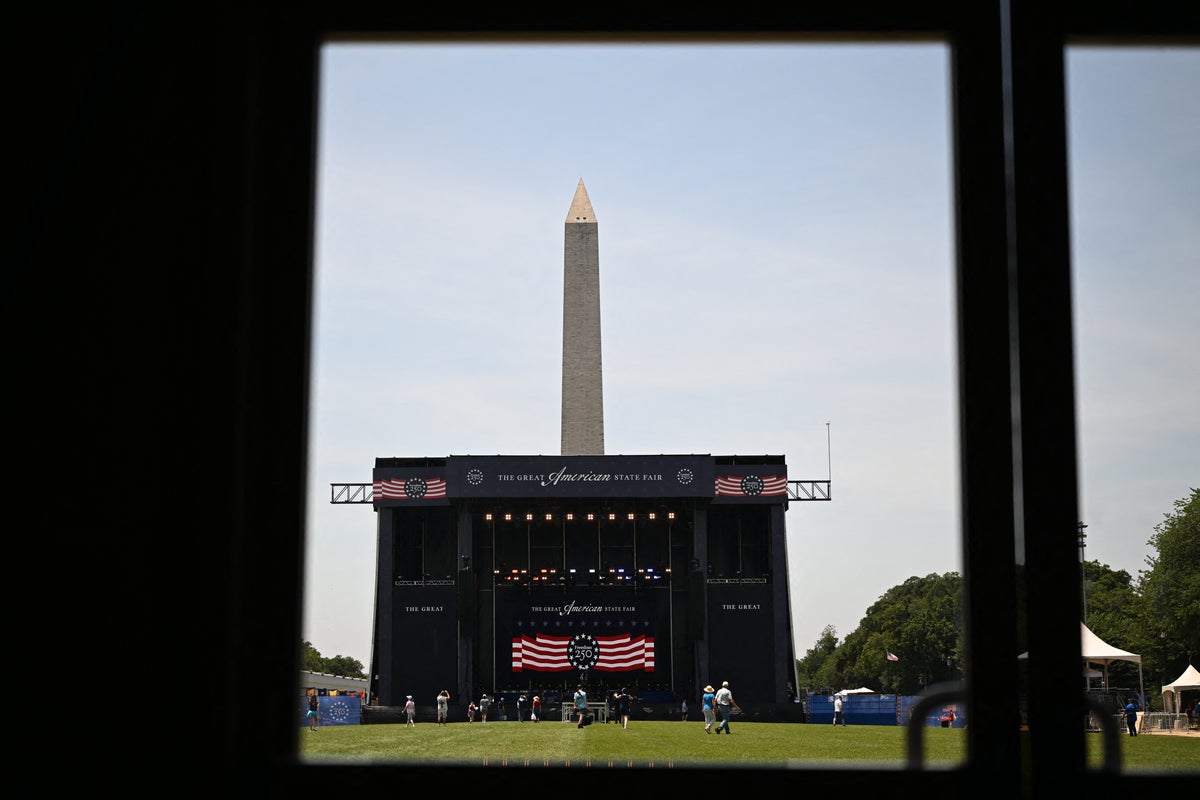
The empty space stretching across the National Mall reveals exactly why President Donald Trump’s Great American State Fair is failing to draw the massive crowds its organizers promised. While internet commentators laugh at viral videos of a youth brass band playing Beyoncé to an audience of five people on a Tuesday morning, the true crisis of this event cuts far deeper than a single poorly attended time slot. The fair is buckling under a total misalignment of culture, location, and logistics. It attempted to force a rural, partisan spectacle into a highly strategic, politically cynical city center, and the results have been disastrous.
Organizers from Freedom 250, the group tasked with managing this celebration of the American semiquincentennial, claim that more than 150,000 people arrived during the first three days. The visual reality on the ground contradicts those statistics completely. Walk past the national monuments on any given afternoon and you see vast patches of dead grass where thousands of spectators should be standing. The administration insists that the event is packed, pointing to indoor exhibition booths and brief spikes in attendance during evening speeches. But anyone who has spent decades watching political stagecraft in Washington knows the difference between a thriving public gathering and an artificial assembly.
To understand this collapse, look at the fundamental nature of a state fair. The traditional state fair relies on deep community roots, local pride, agriculture, and a shared sense of regional identity. It is an event built from the ground up. The Great American State Fair was dropped from the top down. By bringing a hyper-commercialized, heavily branded spectacle to the National Mall, the organizers alienated the local population of Washington and failed to incentivize out-of-state supporters to make the expensive trek to the nation's capital.
The Cultural Disconnect of the National Mall
Washington is a city built on administrative routine and political warfare. The National Mall serves as America's premier civic stage, a place reserved for historic protests, national mourning, and presidential inaugurations. Transforming this solemn space into a carnival midway with deep-fried food stands and amusement attractions was always going to create friction.
Local residents have largely boycotted the event. The surrounding metropolitan area leans heavily democratic, creating an immediate cultural barrier for an event so closely tied to the Trump administration's brand. For these residents, the fair is not a neutral celebration of America's 250th anniversary. It represents a partisan occupation of public space. Democratic Representative Sean Casten summarized this sentiment openly, pointing out that the Mall during the summer usually naturally fills with tourists, office workers on lunch breaks, and locals playing sports. The presence of the fair has actually cleared those regular crowds away, leaving the space emptier than it would be during a normal summer week.
Out-of-state supporters have also failed to arrive in the numbers needed to fill a venue of this scale. Traveling to Washington in the middle of summer requires significant financial investment, flight bookings, and hotel reservations. For the average family living in the American heartland, spending thousands of dollars to see a state fair in a distant city makes little sense when they can attend their own superior local fairs for a fraction of the cost. The event lacks the authentic cultural pull required to justify national tourism.
A Logistical Nightmare of Cancellations and Weather
The failure of the fair is not merely a product of cultural division. Terrible operational planning and bad luck played massive parts in the unfolding disaster. A successful multi-day outdoor festival requires airtight logistical execution, secure backing from talent, and contingencies for severe summer weather. Freedom 250 failed on all three fronts.
A string of high-profile musical acts backed out of their scheduled performances in the weeks leading up to the opening night. Some artists cited scheduling conflicts, while industry insiders whispered about intense pressure from management teams worried about political blowback. When headline talent disappears from promotional flyers, ticket sales plummet. The remaining lineup consists largely of regional acts, military ensembles, and youth bands. While these performers are talented, they do not possess the drawing power required to pack an outdoor venue that spans multiple city blocks.
The weather has also been entirely unforgiving. A brutal summer heat dome settled over the Mid-Atlantic region just as the fair opened its gates, sending temperatures soaring well past comfortable levels. Walking across the unshaded asphalt and open lawns of the National Mall in oppressive humidity is a miserable experience. Thunderstorms have repeatedly forced organizers to clear the grounds, turning the festival site into a muddy, uninviting swamp. When the gates reopen after a storm, the crowds simply do not return.
The Illusion of Attendance and the Propaganda War
The administration is fighting a fierce public relations battle to hide the low turnout, creating a stark contrast between what officials say and what the public can see with their own eyes. This gap between rhetoric and reality is an old story in politics, but the ubiquity of smartphone cameras makes the deception impossible to maintain.
President Trump took to Truth Social to claim the fair was full of happy people, repeating his regular assertion that his opening night speech brought in tens of thousands of attendees. Conservative media outlets have attempted to validate these claims by using tight camera angles and specific framing. Fox News reporters broadcasting from the site have argued that wide-angle photos do not capture the true story, claiming that hidden pockets of hundreds of people are moving through various indoor exhibition halls representing the 50 states.
Fair Attendance Claims vs Visual Reality
+-------------------------+-----------------------------------+
| Official Claims         | Observed Reality on the Ground    |
+-------------------------+-----------------------------------+
| 150,000+ opening crowds | Vast empty lawns during peak hours|
| Packed indoor exhibits  | Sparse foot traffic in pavilions  |
| Weather-proof success   | Flooded grounds and early closures|
+-------------------------+-----------------------------------+
These explanations fail to hold up under scrutiny. Even if the indoor tents are moderately full of people seeking air conditioning to escape the heat dome, the outdoor spaces remain undeniably quiet. A few hundred people scattered across a venue designed for hundreds of thousands looks like an abandonment. The decision to use tight close-ups on television only emphasizes the emptiness surrounding the reporters when the camera accidentally pans too wide.
Structural Lessons for Future National Events
This ongoing situation offers serious warnings for anyone planning massive public celebrations in the future. The failures of the Great American State Fair show that political enthusiasm cannot override basic geographic and economic rules.
First, you cannot easily transplant a specific regional tradition into a completely different environment. The magic of a state fair belongs to places like Iowa, Minnesota, or Ohio, where agricultural heritage is real and deeply respected. Trying to recreate that atmosphere on the doorstep of the federal government feels artificial and corporate. The public senses that lack of authenticity immediately.
Second, staging an event on the National Mall demands a bipartisan approach if you want broad public participation. By framing the celebration through a specific political lens, the organizers guaranteed that half the country would ignore it entirely. A true national anniversary should unite people across political boundaries, drawing on shared history rather than dividing the audience into competing camps.
The youth band playing on Tuesday morning did everything right. They brought a fantastic brass section and performed with high energy despite the empty space in front of them. The musicians were not the problem. The failure belongs entirely to the organizers who built a massive stage in a place where nobody wanted to watch the show.
The fair is scheduled to continue through the upcoming holiday weekend, but the financial and reputational damage is already done. No amount of social media spin or creative camera work can alter the truth written across the empty grass of the National Mall. The event will be remembered as a case study in executive overreach, where the desire for a grand political spectacle blinded planners to the plain realities of audience demand, local culture, and basic logistics. The empty stands stand as a quiet testament to a simple truth of public relations. You can command an official event to happen, but you cannot force the American public to show up for it.