The Line in the Swiss Sand
The Society of St. Pius X has officially severed its remaining diplomatic ties with Rome. By consecrating four new bishops without papal approval at its seminary in Econe, Switzerland, the ultratraditionalist group has triggered an automatic excommunication under Catholic canon law. This open defiance marks the first major structural crisis for Pope Leo XIV, the first American pontiff, who was elected just last year. While the Vatican viewed the ceremony as an intentional act of schism, the society framed it as a sacred obligation to preserve the true Catholic faith from modern errors.
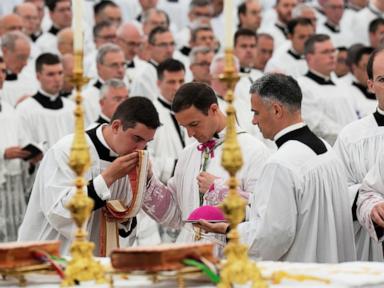
The ceremony unfolded before thousands of the traditionalist faithful gathered in the Swiss Alps. Incense hung heavy over an altar where ancient Latin liturgies were spoken with deliberate, unyielding precision. The four new bishops—Pascal Schreiber of Switzerland, Michael Goldade of the United States, Michel Poinsinet de Sivry of France, and Marc Hanappier of France—knelt to receive the laying on of hands. They did so knowing that the law of the church they claim to defend immediately cast them out for the act.
This is not a sudden flare-up of theological temper. It is the culmination of a multi-decade drift that has turned a small pool of disaffected traditionalists into a highly organized international entity. By bypassing the authority of Pope Leo XIV, the society has sent a clear message to Rome. They no longer care about validation from the modern hierarchy.
A Parallel Empire in Plain Sight
The popular perception of traditionalist Catholics often involves small, isolated chapels filled with elderly observers mourning the loss of the pre-1960s church. That image is dangerously outdated. What transpired in Econe was not a quiet act of underground resistance but a highly coordinated, multi-day media operation.
The event featured high-definition livestreams, online carpooling coordinates from over a hundred locations, and pre-paid festival wristbands for lunch catering. Attendees could even purchase a commemorative souvenir wine set to mark the occasion. Scholars tracking the movement have termed this phenomenon Traditionalism 2.0. The group has embraced digital infrastructure to build a highly visible brand, using the internet to gather a younger, fiercely loyal demographic that feels alienated by modern society.
The numbers reveal the scale of this parallel ecclesiastical ecosystem. According to internal statistics, the group now commands two older bishops, over 750 priests, and upwards of 260 seminarians studying across five global institutions. Their network includes hundreds of religious brothers, sisters, and schools spread across 50 nationalities. They have built an alternative church infrastructure that operates entirely outside the legal jurisdiction of the Holy See.
This growth explains why the current Superior General, the Reverend Davide Pagliarani, felt comfortable forcing the Vatican’s hand. During his homily in Switzerland, Pagliarani rejected the accusation of simple disobedience. He argued that their actions were driven by love for the papacy, claiming they chose to act so that the vicar of Christ would no longer be humiliated by false shepherds representing false religions. The logic is circular but highly effective for an audience that believes the mainstream church has compromised its identity.
The Ghost of 1988 and the State of Necessity
To understand the mechanics of this rupture, one must look back nearly four decades. In 1988, the French Archbishop Marcel Lefebvre, a fierce opponent of the modernizing reforms of the Second Vatican Council, performed an identical act of defiance. He consecrated four bishops without the permission of Pope John Paul II. The resulting excommunications threw the traditionalist world into chaos, creating a wound that Pope Benedict XVI later tried to heal by lifting those specific penalties in 2009.
That historical fracture was driven by a rejection of the 1960s council meetings, which altered how the Catholic Church interacted with other religions and permitted the celebration of Mass in local languages rather than Latin. Lefebvre viewed these shifts as a betrayal of dogma.
Today, the society relies on a canonical defense known as the state of necessity. Under church law, an illicit action can be excused if the perpetrator genuinely believes it is required to address a grave crisis or ensure the salvation of souls. The society argues that the current church is so riddled with theological confusion, liberalism, and ecumenism that ordinary Catholics are being starved of authentic doctrine.
The immediate catalyst for the current crisis is simple biology. The surviving bishops from the original 1988 consecrations are aging and can no longer keep up with the demands of an expanding global network of chapels. For Pagliarani, waiting for Rome's permission was an existential risk. If the remaining bishops died without transmitting their lineage, the society's ability to ordain new priests would vanish. They chose survival over compliance.
The Delicate Failure of Papal Pacification
The timing of this rebellion is a bitter pill for the Holy See. Pope Leo XIV took office with an explicit desire to calm the internal warfare that characterized the previous decade. His predecessor, Pope Francis, had executed a severe institutional crackdown on traditionalists within the mainstream church, restricting the celebration of the old Latin Mass through strict administrative decrees. That approach created a deep well of resentment among conservative Catholics.
Leo, a seasoned canon lawyer and Augustinian friar who spent years managing complex dioceses in Peru, tried a different path. He sought a quieter, more diplomatic approach to internal unity. Even as he issued his first major encyclical regarding the ethical implications of artificial intelligence, his theological staff was quietly trying to keep the traditionalist factions from spinning entirely out of orbit.
The Vatican even invited Pagliarani for private discussions after the initial threat of consecrations was made public. Leo publicly expressed a desire to avoid further division, noting to reporters that while he deeply regretted their rejection of the Second Vatican Council, the church had to move forward. The soft-spoken approach yielded nothing.
The failure of this diplomacy demonstrates the limits of papal leverage over a group that has spent 50 years building its own financial and institutional self-reliance. Rome could threaten to revoke the pastoral concessions granted by Pope Francis, who had allowed the society's priests to validly hear confessions and perform marriages under specific mercy initiatives. But for a group that already believes the mainstream hierarchy lacks moral clarity, the removal of those concessions carries very little practical weight.
The Selective Blindness of the Holy See
The current crisis exposes a glaring double standard that threatens the internal credibility of Vatican governance. Traditionalists are quick to point out that while the Holy See moves with absolute canonical severity against those who deviate toward the theological right, it treats left-wing defiance with extraordinary patience.
For years, bishops in Germany have openly advanced a progressive project known as the Synodal Path. This movement has pursued reforms that directly contradict established Catholic doctrine, including the blessing of same-sex unions and discussions regarding the ordination of female clergy. Despite repeated warnings from Roman dicasteries, the German hierarchy has continued its trajectory with minimal canonical consequences. No automatic excommunications have been handed down to the German innovators.
This asymmetry leaves a massive segment of moderate conservative Catholics in a difficult position. They do not support the illegal consecrations in Switzerland, and they view the society's actions as a genuine tragedy for church unity. Yet they look at the situation in Germany and conclude that Rome applies its laws based on political expediency rather than doctrinal consistency.
The automatic excommunication of the four Swiss bishops will stand under canon law. The Vatican does not need to issue a formal decree for the penalty to take effect; the law executes itself the moment the forbidden act occurs. But a penalty that is viewed as weaponized factionalism loses its moral authority. By cracking down on Econe while tolerating Munich, the Vatican risks signaling that institutional loyalty matters far more than shared belief.
The Society of St. Pius X has made its choice. They have secured their succession, insulated their chapels from Roman interference for another generation, and locked in their identity as an independent entity. Pope Leo XIV must now govern a church where the edges are fraying faster than his diplomacy can mend them. The administrative lines have been drawn, but the deeper battle for the institutional authority of the papacy has entered a far more volatile phase.