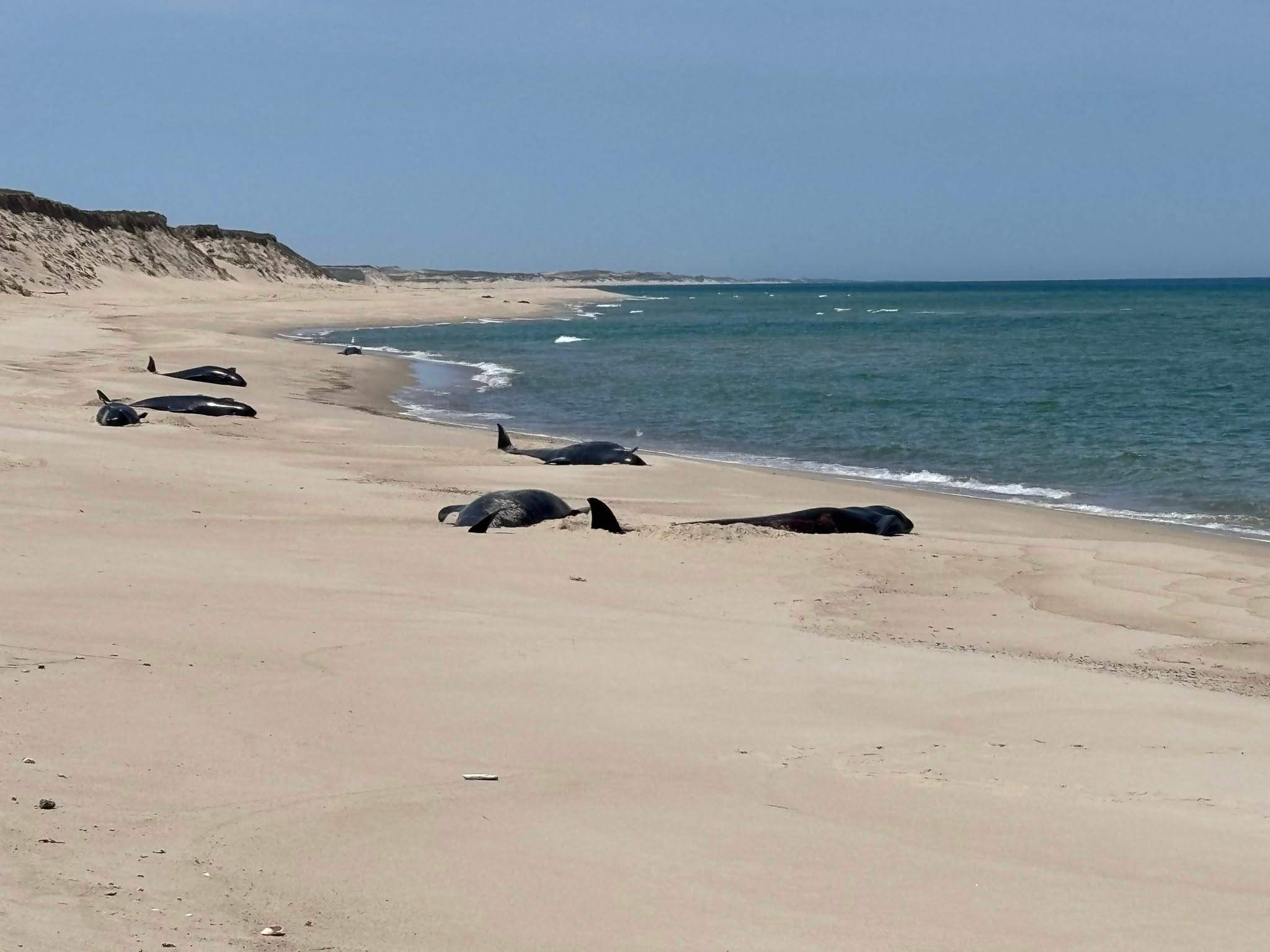
Sixteen pilot whales just died on the shores of Sable Island, a remote crescent of sand sitting nearly 290 kilometers off the coast of Halifax. It is a tragedy, but it is not a new story.
The Marine Animal Response Society (MARS) confirmed the mass stranding after Parks Canada workers found the pod. By then, it was too late. The remote geography of the island meant human intervention simply was not an option. The animals died right there on the sand.
Every time this happens, the same frantic questions flood the public consciousness. Why do they do it? Is it human sonar? Is it climate change? Are they committing suicide?
The truth is much more complex, deeply rooted in the evolutionary biology of these animals, and honestly, kind of heartbreaking.
The Acoustic Trap of Sable Island
Sable Island is famous for its wild horses and shipwrecks, but for deep-diving cetaceans, it is a giant geographical trap.
Pilot whales are not coastal creatures. They are pelagic. They spend their lives out past the continental shelf, hunting squid in pitch-black depths. They navigate almost entirely through echolocation, sending out clicks and reading the bounce-back to build a mental map of their environment.
That system breaks down on a gently sloping sandy beach.
When a pilot whale clicks toward a steep rock wall, the sound bounces right back. Clear signal. Deep water. But when they enter shallow, sandy waters like those surrounding Sable Island, the acoustic signal behaves completely differently. The sand absorbs the sound. The shallow slope scatters the echo. To the whale's sonar, the beach does not register as an obstacle. It looks like open water.
By the time they realize the water is disappearing beneath them, the tide is dropping, and gravity takes over.
The Dark Side of Extreme Social Loyalty
If one whale gets confused, why does the whole pod follow it to the grave?
It comes down to their intense social structure. Pilot whales do not just hang out together; they live in tight-knit matriarchal family groups that stay intact for generations. They are so fiercely loyal that they will not abandon a pod member in distress, even if staying means certain death.
If the matriarch or a dominant pod leader gets sick, disoriented, or injured and swims into shallow water, the rest of the pod follows. Researchers from Dalhousie University have spent years tracking pilot whale behavior off Nova Scotia. Their data shows that group leaders usually swim to one side rather than leading from the front, meaning the herd moves as a collective unit rather than following a single pathfinder.
When a few heavy individuals hit the sand, they panic. They emit distress calls. Those high-frequency cries act like a magnet to the rest of the pod swimming just offshore. Instead of swimming away to save themselves, the healthy whales rush into the shallows to help their family.
They stay together. They beach together.
What the Necropsies Can Tell Us
The MARS team could not save these 16 whales, but Parks Canada personnel managed to document the bodies and collect biological samples before the tide claimed them. This data is invaluable.
Scientists will analyze these tissue samples to look for several specific triggers:
- Morbillivirus and Parasites: Infections in the middle ear can completely wreck a whale's ability to navigate, sending them off course.
- Toxin Loads: Heavy metals and plastics bioaccumulate in apex predators, occasionally causing neurological damage.
- Acoustic Trauma: Sudden trauma from naval sonar or seismic blasting can damage their delicate hearing structures, though proving this requires incredibly fresh tissue samples.
We have known about this phenomenon for a very long time. Mass strandings on Sable Island are recorded as far back as the 1970s, including a massive incident in 1976 where over 130 pilot whales washed ashore on the exact same north beach. It is a harsh, natural cycle that has occurred for centuries, long before human activity filled the oceans with noise.
The Reality of Marine Rescue
People always ask why we can't just pull them back into the water.
On a mainstream beach close to Halifax, volunteers can sometimes keep whales wet, wait for the tide, and guide them out. But Sable Island is an isolated sandbar in the middle of the Atlantic Ocean. You cannot get heavy earth-moving equipment there. You cannot easily fly in a team of fifty trained marine biologists at a moment's notice.
Even when rescue is logistically possible, the physics of a stranded whale are brutal. These animals are built for a zero-gravity environment. When their massive bodies sit on dry land, their own body weight crushes their internal organs. Blood flow cuts off. Toxins build up in their muscles. If a pilot whale stays stranded through a single tide cycle, its internal damage is usually fatal, even if you manage to float it back out to sea.
If you ever find yourself witnessing a live stranding on a accessible beach, do not try to drag the animal by its tail or fins. You will dislocate their joints. The best immediate action is to call your local marine animal response hotline, keep the animal upright, and use wet towels to keep their skin cool while keeping water out of their blowhole. For now, the samples taken from the Sable Island pod are our best shot at understanding how to prevent the next tragedy closer to home.