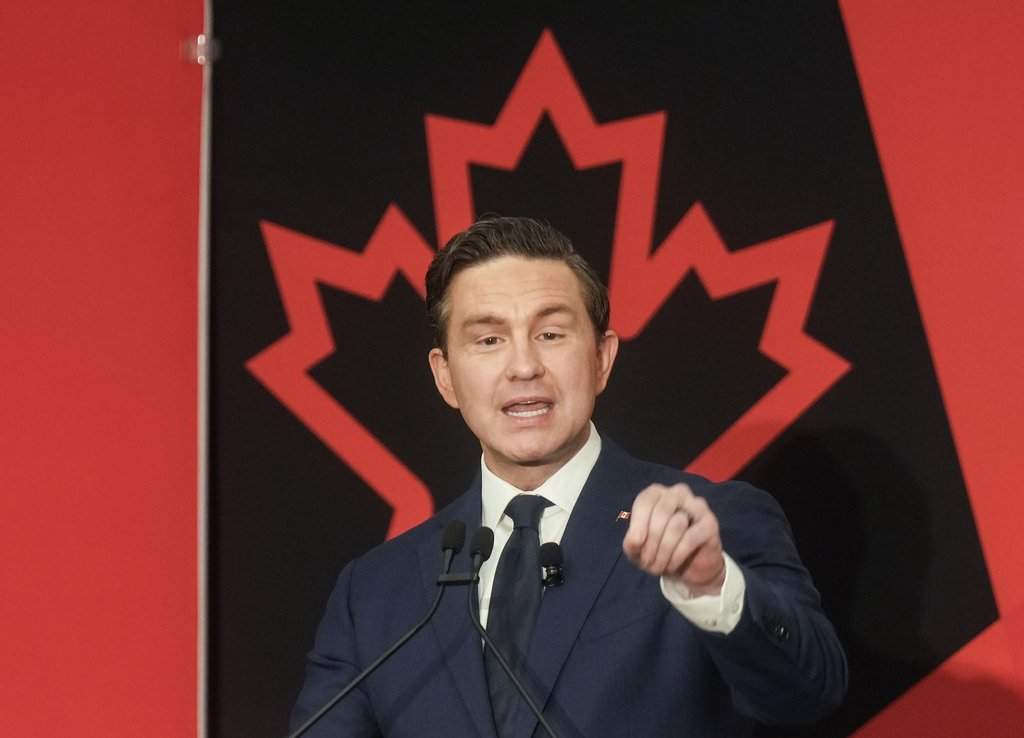
Conservative Leader Pierre Poilievre found himself in a position that no leader of the official opposition wants to occupy. Standing before a microphone in North Vancouver, he had to explicitly state that he and every single one of his Members of Parliament would campaign to keep Alberta inside Canada.
The immediate catalyst was chaos in Edmonton. Premier Danielle Smith’s United Conservative Party government bungled a legislative committee meeting, accidentally releasing a press release claiming a vote to hold a referendum on Alberta’s future in Confederation had passed before the votes were even cast. The incident forced Smith to schedule a televised address to salvage the narrative around a potential October referendum question.
For Poilievre, the political math is brutal. If Alberta separates, the federal Conservative Party loses its foundational power base and its easiest path to a parliamentary majority. By drawing a hard line against western separation, Poilievre is trying to shut down an ideological civil war before it destroys his chances of taking the prime minister's office.
The Mathematical Death Sentence for Federal Conservatives
To understand why Poilievre rushed to declare himself a staunch federalist, look at the seats in the House of Commons. Alberta is the bedrock of the modern Conservative Party of Canada. In a typical federal election, the province delivers a near-monolithic block of blue seats to Ottawa.
If Alberta leaves the federation, the electoral map alters permanently. Stripping those guaranteed seats from the Conservative column tilts the balance of power decisively toward the center and the left. The remaining electorate in Ontario, Quebec, and the Atlantic provinces would hold structural majorities that a conservative movement, devoid of its western engine, might never overcome.
Poilievre’s problem is that the anger driving Alberta's current referendum push is the exact same anger he spent years stoking to secure the federal leadership. He built his brand on weaponizing western grievance against Ottawa. Now, that grievance has mutated into a localized independence movement that he cannot control, led by a premier who is leveraging the threat of secession to force concessions from the federal government.
The Two-Front Separatist Trap
The political landscape has shifted dramatically under Prime Minister Mark Carney. Unlike his predecessor, Carney has adopted an aggressive policy of economic appeasement toward the west. Just last week, Carney signed an agreement with Danielle Smith that adjusted industrial carbon pricing frameworks and put federal backing behind a new oil pipeline to the Pacific Coast, aimed for completion in the early 2030s.
This leaves Poilievre fighting a two-front war against separation.
- The Western Flank: Premier Smith is pushing legislation like Bill 14, which lowers the threshold for referendum petitions and sidelines constitutional court challenges. She is using the threat of a "Yes" vote on independence to extract concessions from Ottawa, ignoring how it undermines Poilievre's national unity message.
- The Eastern Flank: In Quebec, the Parti Québécois is resurgent, threatening its own sovereignty referendum if it takes provincial power.
Poilievre attempted to deflect this pressure by blaming the current federal government for the rise of regionalism, claiming that separatist movements were non-existent under Stephen Harper. But historical reality complicates that view. Western alienation did not disappear during the Harper years; it was merely suppressed by having an Albertan in the Prime Minister's Office.
The Sovereignty Act and the Illusion of Control
The mechanism driving this crisis is the Alberta Sovereignty Within a United Canada Act. Passed by Smith's government, it allows the province to direct provincial entities—including municipal police, school boards, and health authorities—to ignore federal laws deemed harmful to Alberta's economic interests.
The legal reality is that a province cannot legally pick and choose which federal laws it obeys while remaining part of a constitutional framework. By attempting to lower the barriers to a referendum through provincial bills, the UCP is creating an unpredictable legal environment.
Poilievre is trying to position himself as the only leader capable of cooling this anger, promising to eliminate small business red tape and cancel federal gun buyback programs. But his insistence that every federal Conservative will campaign for Canadian unity shows he knows that policy tweaks may not be enough. If Smith goes through with a referendum in October, Poilievre will be forced to spend his political capital campaigning against his own core supporters in Calgary and Edmonton.
The current situation reveals the fundamental flaw in the federal Conservative strategy. You cannot spend years telling a region that the national capital is an existential threat to its way of life, and then expect that region to remain docile when you tell them to stay part of the family. Poilievre needs a united Canada to win the prime minister's office, but the forces of western alienation he helped unleash are no longer taking orders from Ottawa.