When government agencies announce a check for $277,200 to secure twenty-seven patches of dirt, skeptics usually roll their eyes. It sounds like small change in the grand machinery of state budgets, a modest line item buried deep inside environmental allocations. But the real story of the Lowries Run expansion project in Ross Township is not about the purchase price. It is about a desperate municipal calculation happening quietly across the American Rust Belt.
Local water authorities and municipal engineers are staring down a math problem they cannot pave their way out of.
The Economics of Gravity and Concrete
To understand why the Pennsylvania Department of Conservation and Natural Resources handed that money over to the Allegheny Land Trust, you have to look at what happens when it rains hard in Allegheny County. Decades of suburban expansion, commercial strip malls, and asphalt parking lots have systematically paved over the region's natural drainage capacity. When precipitation hits concrete, it has nowhere to soak. It accelerates, channeling into local creeks, overwhelming aging municipal storm sewers, and flooding basements in low-lying residential neighborhoods.
Building concrete retention basins or upgrading subterranean municipal storm pipes costs millions of dollars per mile. Municipalities that are already financially strapped simply do not have the capital to dig up every suburb and install industrial-grade stormwater management infrastructure.
Instead, planners are rediscovering an old-fashioned piece of technology: unpaved soil.
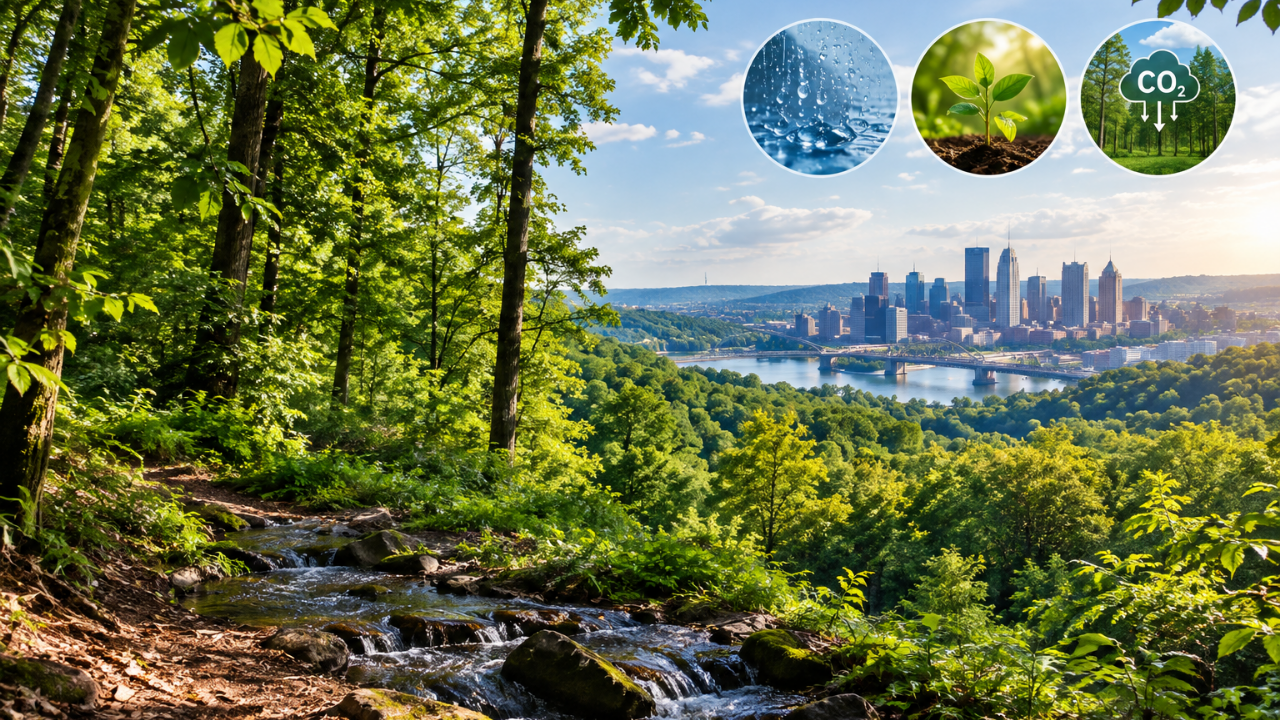
State estimates indicate that this specific twenty-seven-acre woodland corridor can absorb roughly 22.5 million gallons of rainwater annually. That figure is not a random ecological talking point. It represents millions of gallons of water that do not have to be managed by taxpayer-funded mechanical systems, concrete culverts, or emergency pumping stations. By preserving the canopy and the sponge-like organic layer of the forest floor, the state is essentially buying a decentralized flood defense mechanism for roughly twelve thousand dollars an acre.
Permanent Protection Versus Paper Parks
Buying land and keeping land wild are two entirely different legal challenges.
Many small woodlots survive for decades simply because they sit on steep slopes or awkward topography that makes heavy construction economically unviable. Owners pay taxes on them, hikers walk past them, and deer bed down in them. But economic pressures shift. When a developer makes a lucrative offer to clear-cut a hillside for housing townhomes, the passive protection vanishes overnight.
Permanent conservation through a land trust strips away that developmental optionality. Once a parcel is locked under a conservation easement or acquired outright for passive recreation, the legal deed restricts future commercial extraction. The trees stay put. The organic humus layer—packed with fungi, roots, and decaying organic matter that acts as the primary sponge—remains undisturbed.
This preservation also locks away carbon. Officials calculate that the Lowries Run acreage sequesters more than 100,000 pounds of carbon dioxide every year. While that number is a drop in the bucket compared to global industrial emissions, it underscores a vital reality of municipal climate adaptation. Localized protection yields localized resilience. Cleaner air and regulated soil temperatures are immediate co-benefits of managing stormwater at the source.
The Limits of Small-Scale Conservation
We should be clear-eyed about the limitations here. Spending a quarter-million dollars to save twenty-seven acres is a tactical holding action, not a sweeping regional strategy.
Pennsylvania features millions of acres of forestland, and thousands of acres face incremental degradation every year from invasive species, utility line clearances, and residential sprawl. A patchwork approach relying on individual land trust acquisitions and state Community Conservation Partnership grants cannot scale fast enough to offset rapid, uncoordinated commercial development across the wider watershed.
Furthermore, a forest is not a static machine. Without active stewardship—managing deer overpopulation that strips understory saplings, fighting off invasive pests, and mitigating storm damage—urban-adjacent woodlots can slowly degrade in their ecological utility. Protecting the boundary is only the first step; maintaining the biological integrity of the ecosystem determines whether that 22.5-million-gallon absorption capacity holds steady over the next fifty years.
Yet the broader shift in how state and local governments view green space is unmistakable. For generations, trees were viewed as obstacles standing in the way of taxable real estate. Today, municipal accountants are beginning to write them into the balance sheet as vital civil engineering assets.
When dirt and trees are cheaper than concrete and lawsuits, conservation stops being an idealistic environmental luxury. It becomes basic fiscal survival.