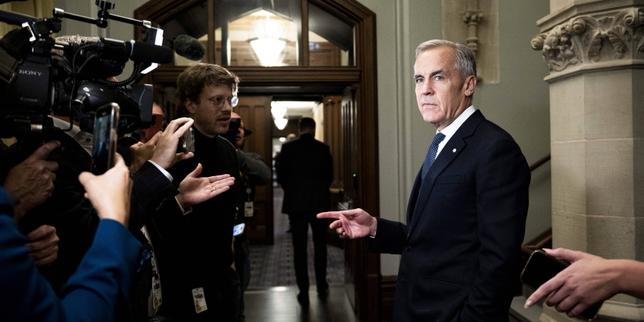
Mark Carney did not return to Ottawa to be a caretaker of the status quo. Since assuming the Prime Minister’s Office in March 2025, the man once dubbed the "adult in the room" has spent his first year systematically dismantling the very policy pillars he was expected to defend. By killing the consumer carbon tax and shifting toward a hard-nosed, "Canada First" industrial strategy, Carney is attempting a high-stakes pivot: saving the Liberal Party by making it look remarkably like the government of Stephen Harper, but with a McKinsey-style veneer.
The strategy is born of cold necessity. Faced with a hostile Trump administration in Washington and a domestic economy suffocating under low productivity, Carney has ditched the performative progressivism of the Trudeau years in favor of a "middle-power" realism. He is betting that Canadians care less about "sunny ways" than they do about the "steel in the ground" and the cost of groceries.
The Death of the Carbon Tax Consensus
For years, the consumer carbon tax was the moral center of the Liberal universe. Carney himself praised it in his 2021 book, Values, as the most efficient way to lower emissions. Yet, his first act as Prime Minister was to sign a directive killing it.
This wasn’t a change of heart; it was a political execution. Carney recognized that the "axe the tax" movement had moved from the fringes to the suburban kitchen tables the Liberals need to survive. By removing the consumer-facing levy while keeping the industrial pricing system intact, he effectively stole the opposition’s most potent weapon. It was a cynical, brilliant move that left the Conservatives shouting at a ghost.
The new framework, dubbed the "Made-in-Canada Competitiveness Strategy," swaps the stick for the carrot. Instead of taxing households, the government is doubling down on massive tax credits for green infrastructure and "carbon contracts for difference" to provide price certainty for big industry. It is a shift from social engineering to industrial planning.
The Technocrat as Micromanager
Walk through the halls of the Langevin Block today, and the energy is noticeably different. The colorful socks are gone, replaced by a rigid corporate culture that emphasizes punctuality and "deliverables."
Ministers who once enjoyed a high degree of autonomy under Justin Trudeau now find themselves under the intense gaze of a Prime Minister who functions more like a global CEO. There are stories in Ottawa of Carney "tasering" cabinet members in meetings—not literally, but with a level of forensic questioning that leaves unprepared politicians stammering. He has consolidated power within a small circle of technocrats and former financial executives, leading to accusations that he is building a "government of the 1%."
The Rise of the Major Federal Project Office
Central to this consolidation is the new Major Federal Project Office (MPO). For decades, Canada has been where big ideas go to die in a thicket of regulatory delays and jurisdictional infighting. Carney’s answer is a "two-year rule."
- Mandated Timelines: The MPO is required to render final decisions on nation-building projects within 24 months.
- Jurisdictional Steamrolling: Using the "One Canadian Economy Act," Carney is attempting to override provincial barriers that have long hindered interprovincial trade.
- Strategic Autonomy: The focus is on critical minerals, hydrogen, and Arctic sovereignty—sectors that serve both the economy and national security.
This is a direct response to the "rupture" in the global order Carney spoke about at Davos in 2026. He believes the era of easy globalization is over. In a world of "fortresses," Canada must build its own.
The Arctic Gambol and the $35 Billion Bet
Nowhere is the Carney shift more visible than in the North. After decades of neglect, the government recently announced a $35-billion investment in Arctic defence and infrastructure. This isn't just about sovereignty; it’s about survival.
As the ice melts and the Northwest Passage becomes a viable trade route, the lack of Canadian presence has become an embarrassment. Carney’s plan includes $32 billion for military bases in Yellowknife, Inuvik, and Iqaluit, alongside the "Arctic Economic Security Corridor"—a massive all-season road network designed to unlock critical mineral deposits.
It is a hawkish turn that would have been unthinkable under the previous leadership. By framing northern development as a national security imperative, Carney is reaching out to voters who traditionally view the Liberals as soft on defence.
The National Unity Illusion
Perhaps the most audacious part of the Carney project is his attempt to build a "national unity government" through attrition. By recruiting former Conservatives and New Democrats to his caucus, he is positioning the Liberal Party as the only "sane" center in a polarized landscape.
This "big tent" strategy is designed to create a de-facto majority through floor-crossings, avoiding the unpredictability of another federal election. It is pragmatic, yes, but it also carries a whiff of arrogance. The subtext is clear: the Prime Minister believes he is the only person qualified to navigate the current geopolitical storm, and the traditional party lines are merely obstacles in his way.
The Productivity Trap
Despite the flurry of announcements and the $1 trillion investment targets, a fundamental problem remains: Canada’s productivity crisis. Carney has been blunt with the public, telling them that the reason they can’t afford groceries is that the country isn't productive enough.
It is a risky message. While technically accurate, it risks sounding like a wealthy banker blaming the workers for a failing system. His reliance on high-level "growth tasks forces" and "innovation hubs" has yet to translate into a higher standard of living for the average family in the GTA or the Vancouver suburbs.
The High Cost of the Middle Ground
Carney is currently walking a razor-thin wire. To his left, the NDP accuses him of selling out the climate and abandoning social progress. To his right, the Conservatives paint him as a "Carbon Tax Carney" in a more expensive suit, responsible for the fiscal profligacy of the Trudeau era.
He is betting everything on the idea that the "exhausted majority" of Canadians want a competent manager more than they want an ideologue. He is trying to bridge the gap between the corporate boardroom and the hockey rink, using the language of finance to solve the problems of the federation.
The success of this experiment won't be measured in Davos speeches or policy papers. It will be measured by whether he can actually get a pipeline built, a mine opened, or a trade corridor completed before the next election cycle begins. Mark Carney has diagnosed the problem: Canada is a slow-moving country in a fast-moving world. Whether his "shock to the system" can actually fix the machinery of government remains the defining question of his premiership.
Would you like me to analyze the specific impact of Carney’s "One Canadian Economy Act" on provincial trade barriers in Western Canada?