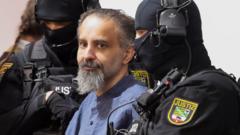
A German court has sentenced 51-year-old Saudi psychiatrist Taleb al-Abdulmohsen to life in prison with a finding of exceptional gravity, ensuring he remains behind bars long after the standard fifteen-year mark. On December 20, 2024, al-Abdulmohsen drove a rented black BMW SUV through a crowded Christmas market in Magdeburg, killing six people and injuring over three hundred. While the verdict brings a legal conclusion to the immediate horror, the case exposes deep vulnerabilities within European security frameworks. This was not a failure of intelligence gathering, but a failure of institutional imagination and cross-border cooperation.
The legal proceedings required a custom-built, temporary courtroom on the outskirts of Magdeburg to accommodate the hundreds of plaintiffs, victims, and legal representatives. Throughout the trial, the prosecution painted a picture of a man driven by hyper-narcissistic grievance rather than organized religious extremism. Yet, as the court records close, the broader questions surrounding the state’s inability to intervene remain largely unanswered.
The Verdict in Magdeburg
The regional court left no room for leniency. Judge Dirk Sternberg ruled that al-Abdulmohsen acted with premeditation and a complete lack of remorse. The designation of "particular severity" means early release is virtually impossible under German law. During the trial, prosecutors detailed how the two-tonne vehicle zigzagged through the historic city center at speeds reaching nearly fifty kilometers per hour, crushing wooden stalls and festive crowds in a rampage lasting exactly sixty-four seconds.
Five women and a nine-year-old boy lost their lives. Hundreds of others carry physical and psychological scars that will never heal. The defense attempted to argue that the defendant did not realize he was running people over, a claim the prosecution rightly dismissed as completely absurd given the shattered windshield and the screams of the crowd.
A psychiatric expert diagnosed the defendant with narcissistic personality disorder. He possessed an overwhelming craving for public attention. When his personal grievances boiled over, he chose a highly visible, soft target to maximize his impact on the national stage.
A Killer Outside the Red Flags
Security agencies frequently struggle to track individuals who do not fit established radical profiles. Al-Abdulmohsen was a trained medical professional, an asylum seeker who arrived in Germany in 2006 and later secured permanent residency. He worked at a rehabilitation clinic for criminals with addictions, operating inside the very system tasked with managing societal risks.
He publicly identified as an ex-Muslim and an atheist. On his online platforms and social media accounts, he distributed anti-Islamic rhetoric and expressed alignment with far-right political figures. This complicated the initial public response. In the immediate aftermath of the tragedy, speculation ran rampant that the incident was a repeat of the 2016 Berlin Christmas market terror attack.
The reality proved far more complex. Al-Abdulmohsen was not a foot soldier for a foreign terrorist network. He was a highly isolated individual whose radicalization was fueled by online conspiracy theories and an obsessive focus on personal legal disputes. He blamed the German government for his failures in civil court, specifically pointing to a lost lawsuit against a refugee organization. His anger metastasized into a desire for indiscriminate revenge against the citizens of his host country.
Warnings Ignored Across Borders
The most damning revelation to emerge from the investigation is that the German state had ample opportunity to intervene. Security officials were not entirely in the dark. Between November 2023 and September 2024, the government of Saudi Arabia sent three separate warnings to German security authorities regarding al-Abdulmohsen.
The Saudi intelligence reports indicated that he had announced intentions to commit a major act of disruption in Germany. The Federal Intelligence Service received these notifications and passed them down to regional state authorities. Local police departments also received multiple complaints from individuals whom al-Abdulmohsen had threatened with physical violence.
The bureaucratic machine stalled. Investigators looked into the tips but ultimately deemed them too vague to warrant preventative detention or a revocation of his residency status. In a highly decentralized federal system like Germany, critical pieces of information often remain siloed within regional police departments, preventing a unified threat assessment.
Bureaucracy Over Public Safety
This tragedy highlights the limitations of modern threat monitoring. When an individual operates outside of known extremist networks, security agencies frequently lack the legal mechanisms to act until a crime occurs. Al-Abdulmohsen weaponized a standard rental vehicle, an object accessible to anyone with a valid license and a credit card.
Preventative measures require swift action. When foreign governments flag an individual multiple times, the threshold for investigative intervention must change. The German national election campaign in early 2025 was heavily influenced by this systemic failure, as political factions debated how a flagged individual with a history of threatening behavior could remain unmonitored.
The reliance on formal checklists often blinds authorities to erratic, high-risk actors. Al-Abdulmohsen posted video messages on the day of the attack, rambling about ancient philosophers and accusing the local police of stealing a USB stick from his mailbox. The signs of severe instability were hiding in plain sight, scattered across public internet forums.
The Illusion of Secure Plazas
Following previous vehicle-ramming incidents across Europe, municipalities invested heavily in physical barriers, concrete bollards, and increased police presence at public gatherings. The Magdeburg market had security protocols in place, yet a determined actor managed to bypass these defenses within seconds.
Physical infrastructure cannot solve a systemic intelligence integration problem. True security relies on the ability to connect the dots before a vehicle ever enters a pedestrian zone. The life sentence delivered in Magdeburg punishes the perpetrator, but it offers little reassurance to a public increasingly aware of the gaps in institutional protection. Germany must reform how its regional and federal agencies share foreign intelligence, or it will remain perpetually vulnerable to lone actors who broadcast their violent intentions long before they strike.