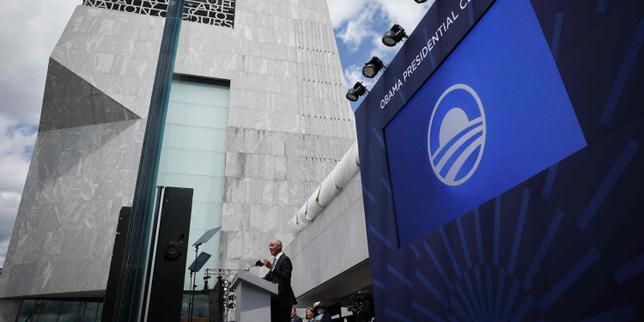
The long-delayed, billion-dollar Barack Obama Presidential Center officially opened its doors in Chicago, marked by an elite gathering of political power including Joe Biden, Bill Clinton, and George W. Bush. Behind the star-studded celebration and the rhetoric of civic renewal lies a deeper, more complicated reality about the modern American presidency and the shifting economic fabric of Chicago's South Side. The 19-acre campus represents a major departure from the traditional model of a quiet research archive, functioning instead as a physical manifestation of a political philosophy that faces severe headwinds in a polarized nation.
While the opening ceremony delivered the expected theater of bipartisan camaraderie, the true story of the Obama Center is not found in the speeches of past presidents. It is found in the sharp tension between national legacy-building and local survival. For more than a decade, this project has forced a difficult conversation about who actually benefits when a global landmark drops into a historically divested urban neighborhood.
A Museum Without an Archive
To understand the friction surrounding the Obama Presidential Center, one must first look at how it breaks the established mold. Every commander-in-chief since Franklin D. Roosevelt has built a repository administered by the National Archives and Records Administration (NARA). These institutions traditionally draw historians and researchers who spend decades combing through physical paper files to decode the inner workings of an administration.
Barack Obama chose a different path. The physical documents of his two terms remain in a NARA facility in Maryland, preserved digitally rather than shipped to the Midwest.
By separating the museum from the official paper records, the Obama Foundation freed itself from strict federal design guidelines. This choice allowed them to conceptualize a massive, privately funded campus featuring a 225-foot museum tower, a branch of the Chicago Public Library, an athletic facility, and vast landscaped public spaces. This is a monument designed for the public square rather than the ivory tower.
This shift in focus has drawn criticism from the traditional academic community. Skeptics argue that turning a presidential library into an active community hub dilutes its historical purpose, turning serious administrative history into a curated narrative. The foundation counters that a living, breathing civic center does far more to advance the democratic process than a quiet reading room used by a select few.
The Neighborhood Cost of Progress
The decision to place the complex within Jackson Park—a historic emerald landscape designed by Frederick Law Olmsted and Calvert Vaux for the 1893 World's Columbian Exposition—triggered a bitter, years-long battle with environmentalists and preservationists. Activists filed federal lawsuits arguing that handing over public parkland to a private foundation set a dangerous legal precedent. The legal challenges ultimately failed, but the scars within the local advocacy community remain deep.
Beyond the trees and open spaces, the project has radically altered the economic conditions of the surrounding Woodlawn and South Shore neighborhoods.
Median Home Sale Price Increase (2015 vs. 2025)
------------------------------------------------
Woodlawn:     +115%
South Shore:  +82%
City Average: +38%
Speculators spent years buying up brick three-flats and vacant lots within a mile radius of the construction site. For longtime working-class residents, this influx of capital has felt less like an investment and more like an eviction notice. Rising property taxes and escalating rents have steadily pinched families who stuck by these neighborhoods during decades of municipal neglect.
Community organizers fought back, successfully demanding a historic Community Benefits Agreement (CBA) ordinance from the city council to mandate affordable housing protections. It was a rare victory against the gravity of gentrification, but it remains a defensive measure against an ongoing economic wave. The new cafes and boutique storefronts cropping up along 63rd Street are an asset for some, but a stark reminder for others that they may soon be priced out of the neighborhood they called home.
The Fragile Illusion of Bipartisanship
The sight of Joe Biden, Bill Clinton, and George W. Bush standing alongside Barack Obama on the South Side provided a brief, nostalgic look back at a different political era. It offered an image of institutional stability that stands in sharp contrast to the current political climate. This display of unity, however, serves to highlight just how much the country has drifted from the consensus politics that Obama championed during his rise to power.
The modern presidency is no longer viewed through a lens of shared institutional respect. The bipartisan goodwill on display at the grand opening exists almost exclusively in the rearview mirror, shared by leaders whose active governing days are behind them. For the millions of Americans watching the livestream, the scene felt less like a celebration of an ongoing democratic tradition and more like a museum exhibit of a political environment that has ceased to exist.
The architectural ambition of the complex—specifically the tower featuring a multi-story facade engraved with the text of Obama’s 2008 Selma voting rights speech—is explicitly designed to inspire civic action. Yet the ultimate success of the center will not be measured by the eloquence of its stone walls or the star power of its opening night performers. It will be measured by whether a billion-dollar investment can genuinely lift an urban community without displacing the very people who give that community its soul.


