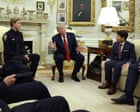
Sixteen-year-old Ryder Williams entered the Oval Office this week not as a politician, but as a reminder of what happens when preparation meets the absolute worst-case scenario. When the Santa Cruz lifeguard pulled ten-year-old Nathaniel Rai from the thrashing surf of Seabright Beach last July, he didn't have time for a grand gesture. He had exactly enough time to rely on the months of conditioning instilled by his training.
President Donald Trump, hosting both the rescuer and the rescued on Monday, offered a candid admission while praising the teen’s bravery. "I don't know if I'd do it. I wouldn't, probably," the president remarked, drawing a sharp contrast between the reflexive instinct required in an aquatic emergency and the calculated nature of executive decision-making.
The viral footage of that July day remains difficult to watch. It is a raw, unvarnished look at a struggle against a force that does not negotiate. Waves pounded the duo, dragging them under, yet Williams maintained his grip on the boy until a fellow guard, Aaron Bohnen, arrived to assist in the final extraction. That moment of kinetic, physical courage has sparked a quiet but significant conversation far beyond the White House fireplace.
The encounter brings to the surface an ongoing legislative debate in California regarding the official classification of lifeguards as first responders. It is a distinction that feels overdue to many observers, yet it remains mired in the friction between professional recognition and the rigorous standards required of traditional emergency services.
Proponents argue that granting this status is about more than just a title. It carries implications for funding, long-term health benefits, and the structural support necessary for those who place their bodies between the public and an unforgiving ocean. Skeptics, however, point to the granular reality of training mandates. Lawmakers like State Senator John Laird have highlighted the logistical complexity of the transition, noting that the standards for peace officers often involve months of intensive instruction that would need to be reconciled with the specialized, high-intensity requirements of water rescue.
Watching a teenager step into this national spotlight forces a reconsideration of who we categorize as essential. Williams, who stated his goal is to pursue work as a firefighter and paramedic, embodies the transition from specialized athletic skill to broader public service. His training allowed him to bypass panic. That is the true takeaway from the Santa Cruz event.
We often romanticize the act of rescue. We fixate on the bravery. We ignore the machine of training—the repetitive drills, the boring days of observation, and the psychological conditioning—that actually prevents tragedy. When the surf turned violent, Williams did not look for an exit strategy or calculate the political fallout of his actions. He executed a series of maneuvers he had practiced until they were etched into his muscle memory.
The president’s invitation to the White House acted as a formal recognition of this individual grit. Yet, the systemic questions remain. If a sixteen-year-old is expected to perform at the level of a first responder during a life-or-death crisis, our institutions owe it to them to provide the framework that keeps them standing long after the cameras turn off.
The gulf between a viral video and the administrative reality of emergency service is wide. Bridging that gap requires moving past the temporary glow of a photo opportunity. It demands a hard look at how we value the people who do not just watch the waves, but dive into them when they break.
A look at the viral rescue footage
This video provides the original context for the encounter, showing the exact moments of the rescue that brought the lifeguard and the boy to the White House.