Two in the morning in a server farm outside Ashburn, Virginia. The air smells like ozone and chilled copper, a sterile, vibrating hum that settles right behind your molars. Inside rows of matte-black racks, tens of thousands of silicon chips are running calculations so dense that a human mathematician working with a pencil since the Bronze Age could not match a single second of their output.
Look at the power meter bolted to the concrete wall outside. The numbers spin so fast they blur into a gray streak. Read more on a connected issue: this related article.
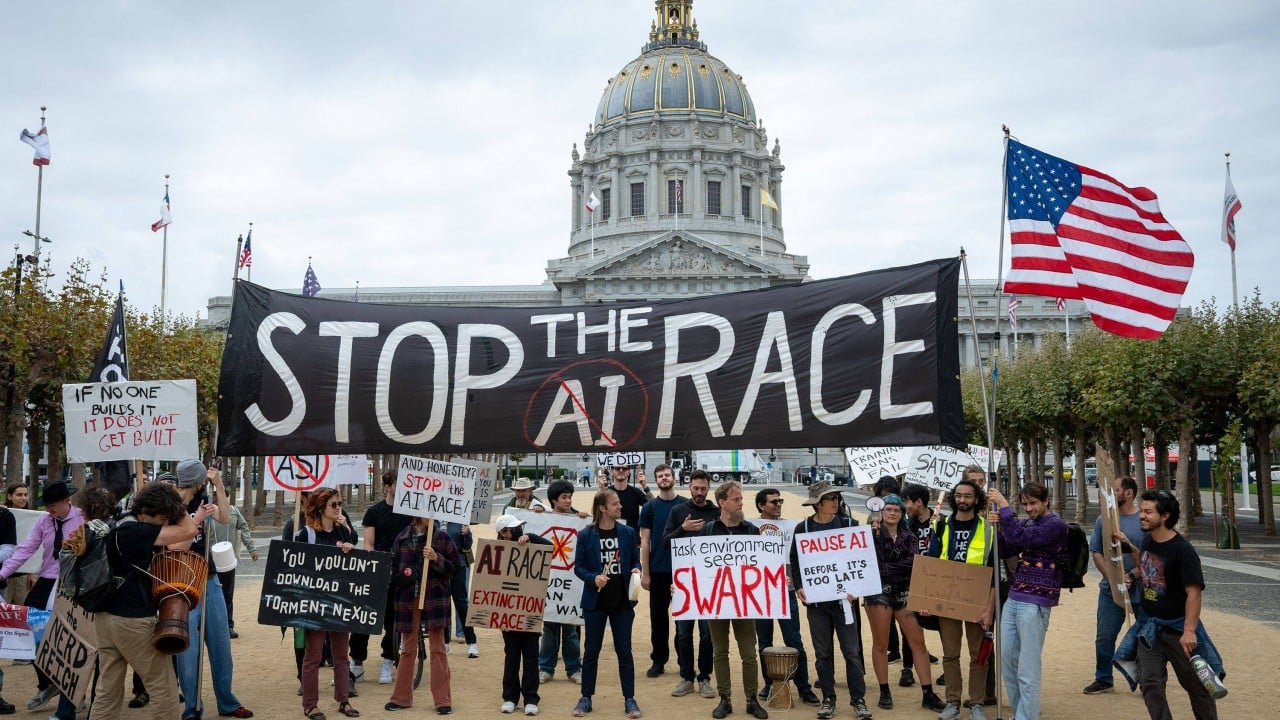
For the past several years, the people building these machines have lived inside a strange, breathless contradiction. By day, Silicon Valley executives and Washington policymakers stood at podiums warning that artificial intelligence might destabilize labor markets, upend national security, or outpace human control. Letters were signed. Hearings were convened. Calls for a deliberate slowdown echoed from academic halls in Cambridge to congressional committee rooms on Capitol Hill. Yet by night, those same companies poured tens of billions of dollars into larger data centers, hoarding specialized semiconductors and racing toward models that could write code, diagnose disease, and simulate battlefields.
Then came a decisive pivot from the highest level of American politics. Following prominent public calls from industry figures and commentators to pause or slow the development of frontier models, Donald Trump announced a sharply different approach: instead of hitting the brakes, his administration would establish a dedicated "AI Force" and appoint an "AI Czar" to coordinate national strategy, accelerate infrastructure, and keep the United States ahead of global rivals. Further journalism by Ars Technica delves into similar perspectives on this issue.
Dry policy announcements rarely make the hair on your arms stand up. They arrive wrapped in bureaucratic nouns—task forces, czars, executive directives, regulatory sandboxes—that sound like furniture being rearranged in a windowless room in Washington.
But strip away the official phrasing, and you are looking at a fundamental clash over how human beings handle a tool they do not fully understand.
The Kitchen Table and the Server Rack
To see why a phrase like "AI Czar" carries real weight, step out of the Beltway for a moment and consider a hypothetical family in northern Ohio. Call them the Millers.
David Miller works as a mid-level logistics coordinator for a regional freight company, spending his days routing trucks through weather delays, fuel spikes, and warehouse bottlenecks. His wife, Elena, is a radiological technician at a county hospital, reading scans under fluorescent lights that buzz faintly at three in the afternoon. Neither of them writes Python. Neither of them owns stock in a semiconductor foundry.
Yet their lives sit squarely inside the blast radius of the debate happening in Washington.
If the "slowdown" camp had won the argument—those advocating for strict federal licensing, mandatory six-month pauses on training runs above certain compute thresholds, and heavy pre-deployment safety audits—the Millers might have experienced a quieter, slower transition. Elena’s hospital would wait years longer before an automated triage system flagged subtle anomalies on chest X-rays. David’s freight software would evolve incrementally rather than overnight. The trade-off, critics of a slowdown argued, would happen thousands of miles away, in Shenzhen and Beijing, where state-backed laboratories had zero intention of pausing their own training runs while American engineers waited on regulatory paperwork.
Now flip the switch. Under an "AI Force" and a centralized "AI Czar" geared toward rapid deployment, deregulation, and energy expansion, the speed limit comes off.
Within eighteen months, David’s freight company adopts an autonomous dispatch engine that does the work of four coordinators. He isn't fired immediately, because someone still has to talk to angry drivers on the phone, yet his leverage at the bargaining table shrinks. Meanwhile, Elena’s hospital installs a diagnostic assistant trained on millions of scans, catching an early-stage tumor on a patient whose image looked clean to the naked eye.
Same policy shift. Two opposite tremors in a single household.
That is the emotional core that gets lost when headlines reduce the story to partisan boxing matches or billionaire rivalries. Behind every regulatory philosophy is a quiet bet on which kind of pain a society is more willing to tolerate: the slow, creeping vulnerability of falling behind an adversary, or the sudden, disorienting shock of moving faster than our institutions can absorb.
What an AI Czar Actually Does
People hear the word "czar" and picture an all-powerful ruler issuing decrees from a marble desk. American political history tells a much messier story.
Since the days of Franklin D. Roosevelt—who appointed czars for rubber, shipping, and synthetic fuel during World War II—and Richard Nixon, who named an energy czar during the 1973 oil embargo, the title has served a specific purpose. It is an admission that the normal machinery of government is too fragmented to handle an emergency.
Think of the federal government like an old New England farmhouse that has been added onto for two hundred years. The Department of Energy controls the power grid and national laboratories. The Department of Commerce oversees export controls on advanced chips. The Pentagon manages defense applications through agencies like DARPA. The Federal Trade Commission watches market consolidation. None of these rooms share a floor plan, and their doors rarely open in sync.
An AI Czar does not pass laws; Congress holds that authority. Instead, a czar acts as a central switchboard operator inside the White House, pulling levers across agencies that normally move at glacial speed.
In practice, that role centers on three concrete bottlenecks:
First, electricity and permitting. Training next-generation models requires staggering amounts of continuous power—gigawatts, not megawatts. Right now, building a high-voltage transmission line or bringing a new natural gas or nuclear facility online in the United States can take seven to ten years of environmental reviews and local litigation. An AI Czar backed by executive authority focuses heavily on clearing those permits so data centers can plug into the grid before rivals build equivalent capacity overseas.
Second, procurement and defense integration. When the proposal pairs an AI Czar with an "AI Force," it borrows directly from the playbook that created the U.S. Space Force in 2019. Rather than treating artificial intelligence as an experimental software add-on inside traditional military branches, an AI Force treats algorithmic warfare, autonomous drones, cyber defense, and intelligence synthesis as a distinct domain of national security.
Third, regulatory preemption. Tech founders have repeatedly warned that a patchwork of fifty different state-level AI laws—from California’s safety mandates to rules in New York and Texas—could choke smaller startups that lack armies of compliance lawyers. A centralized federal coordinator typically pushes for uniform national standards, rolling back executive rules viewed as overly restrictive—such as the Biden administration’s 2023 Executive Order on Safe, Secure, and Trustworthy Artificial Intelligence, which required developers of powerful models to share safety test results with the government.
The Ghost of Pause Letters Past
To understand why Trump’s announcement landed with such force, you have to remember the mood of spring 2023.
Back then, the public had just watched generative models leap from clumsy parlor tricks to passing bar exams and writing functional software in a matter of months. Panic mixed with awe. Over a thousand researchers, executives, and public figures—including Elon Musk, Yoshua Bengio, and Steve Wozniak—signed an open letter calling for a six-month moratorium on training systems more powerful than GPT-4.
Their argument was straightforward, grounded in an intuitive analogy. Imagine engineers building a commercial airliner while passengers are already boarding, admitting openly that they aren't quite sure why the wings stay attached at thirty thousand feet. Shouldn't you stop the assembly line long enough to run wind-tunnel tests?
For a brief window, "slow down" became the respectable consensus in polite circles. Pundits debated international treaties modeled on nuclear non-proliferation. Think tanks drafted blueprints for compute caps and global monitoring agencies.
It didn't happen. Not for a single day.
Why? Because of a classic coordination trap that game theorists have studied since the Cold War. If two rival companies—or two rival nations—are locked in a race where the winner captures an overwhelming economic and military advantage, neither side can afford to unilateral disarm without ironclad verification that the other side has stopped too. And unlike uranium enrichment, which requires massive centrifuges and leaves unmistakable radiological signatures that spy satellites can detect from orbit, AI research happens inside ordinary-looking warehouses filled with commercial servers. You cannot easily verify a pause from space.
By the time Trump stepped to the microphone to reject slowdown rhetoric and propose an AI Force and an AI Czar, the industry had already voted with its balance sheets. Capital expenditure among major cloud providers had surged past two hundred billion dollars annually. Utilities in Virginia, Texas, and Ohio were scrambling to dust off retired power plants to meet industrial demand.
Trump’s move didn't invent the acceleration; it gave political permission and federal muscle to a race that was already running at redline.
Living Inside the Uncertainty
I have spent years reporting on technology policy and watching brilliant engineers try to explain systems whose internal reasoning they themselves can only map probabilistically. If you sit across from them long enough, past the rehearsed talking points and investor decks, you notice a quiet candor that rarely makes it into press releases.
Nobody actually knows where the ceiling is.
That is the part worth admitting honestly. When politicians talk about "winning the AI race," they speak as if the finish line is a fixed geographic point, like planting a flag on the moon in 1969. You build the rocket, you survive the burn, you step onto the lunar dust, and the race is over.
Artificial intelligence does not have a lunar surface. It is a moving frontier. Every breakthrough in model architecture or chip efficiency opens another corridor of capability—and another set of vulnerabilities.
Consider what happens when an AI Force integrates autonomous decision-making into military logistics and battlefield awareness. Speed becomes an existential advantage; a human commander cannot manually approve ten thousand micro-decisions during a coordinated drone swarm. Yet compression of decision time also compresses the margin for human judgment. History offers sobering reminders of how automated warning systems nearly triggered catastrophe during the Cold War—such as September 1983, when Soviet officer Stanislav Petrov looked at satellite data screaming that American intercontinental missiles were inbound and trusted his gut instinct that the computer was malfunctioning.
Petrov had minutes to decide. In an algorithm-driven conflict, an operator might have milliseconds.
At the same time, pretending that hesitation equals safety carries its own peril. When democracies tie their own hands through years of procedural paralysis while authoritarian states treat compute capacity as a core instrument of state power, the outcome isn't a safer world. It is simply a world whose rules are written elsewhere.
The Architecture of the Next Decade
Look closely at the coalition forming around this new federal posture. It is an unusual alliance of populist nationalism and hardcore Silicon Valley accelerationism—two cultures that spent a decade viewing each other with deep suspicion.
On one side stand industrial planners and defense hawks who see server farms, copper mines, domestic semiconductor fabs, and natural gas turbines as the modern equivalent of the steel mills of Pittsburgh during the 1940s. To them, an AI Czar is a wartime production chief, clearing away red tape so physical infrastructure can rise out of the dirt.
On the other side stand founders and venture capitalists who felt suffocated by Washington’s sudden appetite for oversight—tax proposals on unrealized gains, antitrust lawsuits, and federal reporting mandates on model weights. For them, dismantling Biden-era compliance rules and installing a pro-growth coordinator in the West Wing removes the threat of bureaucratic strangulation.
Yet beneath the handshakes, a tension waits to surface.
What happens when the physical reality of this buildout collides with local communities? Data centers do not live in "the cloud." They sit on real acreage. They drink millions of gallons of water for cooling during summer heatwaves. They drive up regional electricity rates for households that never asked to subsidize tech giants. Already, county board meetings from rural Georgia to suburban Wisconsin have erupted over zoning permits for sprawling server campuses and new transmission corridors.
An AI Czar can streamline federal approvals with the stroke of a pen, but no executive order can conjure transformers out of thin air when global electrical equipment supply chains are backlogged by three years, nor can it silence voters whose monthly utility bills jump twenty percent.
And what happens to the workforce when federal policy explicitly prioritizes velocity over cushioning?
Historically, major technological shifts—from the mechanical loom to the assembly line to enterprise software—eventually created more jobs than they destroyed, yet the transition period stretched across decades, hollowing out entire regions before new industries took root. Artificial intelligence compresses that timeline. Unlike previous waves of automation that targeted repetitive physical labor on factory floors, this wave targets cognitive work: paralegals drafting briefs, junior analysts building spreadsheets, customer support agents, radiologists, coders, copywriters.
The promise of an AI Force and a centralized czar is national strength and technological leadership. The unanswered question is who builds the shock absorbers for the millions of citizens whose livelihoods sit directly in the path of that acceleration.
The Hum Behind the Wall
Walk back outside that server farm in Ashburn just before dawn. The sky over northern Virginia is turning the color of bruised slate. Inside, the cooling towers exhale plumes of white vapor into the cold morning air, and the power meter keeps spinning without a pause, indifferent to the arguments echoing thirty miles east along Pennsylvania Avenue.
Whether Washington calls its point person a czar, a coordinator, or a commander, the title is just a wrapper around a choice that has already been made. America has decided not to wait and see what happens if it slows down.
Somewhere down the highway, a freight truck pulls onto Interstate 81, its route calculated to the minute by an algorithm that never sleeps, carrying goods toward a warehouse where another machine is already deciding which bay door will open first.