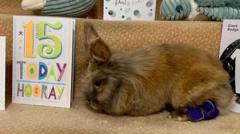
The floorboards in the hallway don't creak much, but for Herbie, they are an expansive, polished continent. He moves across them with a slow, deliberate dignity. He is not the frantic, twitching creature of a garden-variety meadow. He is something else entirely. He is a marvel of biological stubbornness.
Most rabbits live for eight years. If they are loved, pampered, and kept away from the stress of foxes or frozen winters, they might reach twelve. But Herbie has blown past those milestones like a runner who missed the finish line and just kept going out of sheer curiosity. At eighteen years old, Herbie is the oldest living rabbit on the planet.
To put that into perspective, an eighteen-year-old rabbit is the human equivalent of a person celebrating their 130th birthday. He has survived three presidencies, the rise and fall of social media empires, and a world that has grown infinitely louder while his own world has grown quiet.
The Weight of Eighteen Years
Longevity is rarely about luck. It is about a specific, quiet kind of environment. When you look at Herbie, you aren't just looking at a pet; you are looking at the result of a meticulously crafted peace.
Rabbits are prey animals. Their entire nervous system is wired for the "pop." A loud door slam, a predatory shadow, or a sudden change in diet can send their heart rates into a fatal spiral. They are fragile clocks. Yet, Herbie’s heart keeps a steady, unhurried rhythm.
His owner, a woman named Maria, didn't set out to break a world record. She just wanted a companion. But as the years turned into a decade, and that decade stretched toward a second, she realized she was part of a strange, beautiful experiment in survival. She watched as his fur, once a sharp, vibrant brown, softened into a dusty grey, like a stone worn smooth by a river.
Herbie’s day begins at 6:00 AM. There is no frantic thumping for food. He waits. He knows the schedule. His diet is a precise chemistry of high-fiber timothy hay, specific greens, and a limited amount of pellets that provide the nutrients his aging joints require.
In a rabbit, the gut is the engine of life. If it stops moving for even a few hours, the animal can slip away. This is why Herbie’s age is so statistically improbable. To reach eighteen, his digestive system has had to remain flawlessly functional through thousands of days without a single significant stall. It is a biological masterpiece of maintenance.
The Invisible Stakes of Gentleness
We often think of aging as a battle. We use violent metaphors: fighting off disease, beating the odds, struggling against time. But Herbie suggests a different path. His survival is a testament to the power of the unremarkable.
Consider the baseline of a rabbit’s life. In the wild, their survival strategy is "r-selection"—produce as many offspring as possible because the individual is disposable. Nature doesn't care if a rabbit lives to see its second winter. But in the sanctuary of a carpeted living room, the rules change.
Maria noticed the shift around year fourteen. Herbie’s eyesight began to cloud with the milky veil of cataracts. His hearing, once sharp enough to catch a falling leaf outside the window, dimmed. This is where most stories end. For a rabbit in the wild, this is a death sentence. For Herbie, it was simply a transition into a more sensory-focused existence.
He began to navigate by scent and whisker-touch. He memorized the map of the house. He knew exactly where the sun hit the rug at 2:00 PM. He became a creature of pure habit.
There is a lesson here for us, the bipedal observers. We spend our lives chasing the new, the loud, and the fast. We think growth is upward and outward. Herbie’s growth is inward. He has mastered the art of being still. He has survived because he refused to be hurried.
A Biological Outlier
Veterinarians who have examined Herbie speak about him with a sort of hushed reverence. They look for the usual signs of decay—calcification of the heart valves, kidney failure, or the dreaded tumors that plague older small mammals.
While Herbie has some arthritis in his hips, his vitals remain shockingly "boring." That is the word one specialist used. Boring. In the medical world, boring is a miracle. It means the systems are still talking to each other. The lungs are still exchanging gases with the blood; the liver is still filtering out the debris of the day.
This isn't just about good genes, though Herbie undoubtedly has them. It is about the absence of cortisol. Chronic stress is the great silent killer of all mammals, but for rabbits, it is a loud killer. By removing the spikes of fear from Herbie’s life, Maria essentially slowed down his internal clock.
The Quiet Horizon
There is a certain melancholy in being a record-holder. Herbie is a solitary figure in his age bracket. All the rabbits he might have known in his youth are long gone. He is a survivor of a generation that has vanished.
Sometimes, Maria watches him sleep in his favorite corner, his nose twitching in a dream. She wonders what a rabbit dreams about after nearly two decades of life. Does he remember the taste of a specific carrot from 2012? Does he recognize the change in the air when autumn approaches?
We are obsessed with the "oldest" of everything because we are terrified of our own expiration dates. We look at Herbie and see a fuzzy, long-eared loophole in the law of mortality. If a creature so small and vulnerable can endure for eighteen years, perhaps there is hope for the rest of us to linger a little longer in the light.
But Herbie isn't thinking about records. He isn't thinking about the Guinness World Records officials or the journalists who want to snap his picture. He is thinking about the sensation of the carpet beneath his paws. He is thinking about the specific, sweet smell of the hay being topped up in his bowl.
He is a reminder that life is not measured by the distance traveled, but by the depth of the peace one manages to find along the way.
As the sun begins to set, casting long, orange shadows across the living room, Herbie makes his way back to his bed. He doesn't hop; it’s more of a rhythmic shuffle. He settles in, tucking his paws beneath his chest until he looks like a loaf of silver-grey bread. He closes his eyes. He has lived another day that he wasn't supposed to have, and he has done so with a grace that puts our own frantic lives to shame.
The world keeps spinning, loud and chaotic and demanding. But in a quiet house on a quiet street, a small heart keeps beating, steady and slow, proving that sometimes, the best way to win the race is to simply refuse to run it.