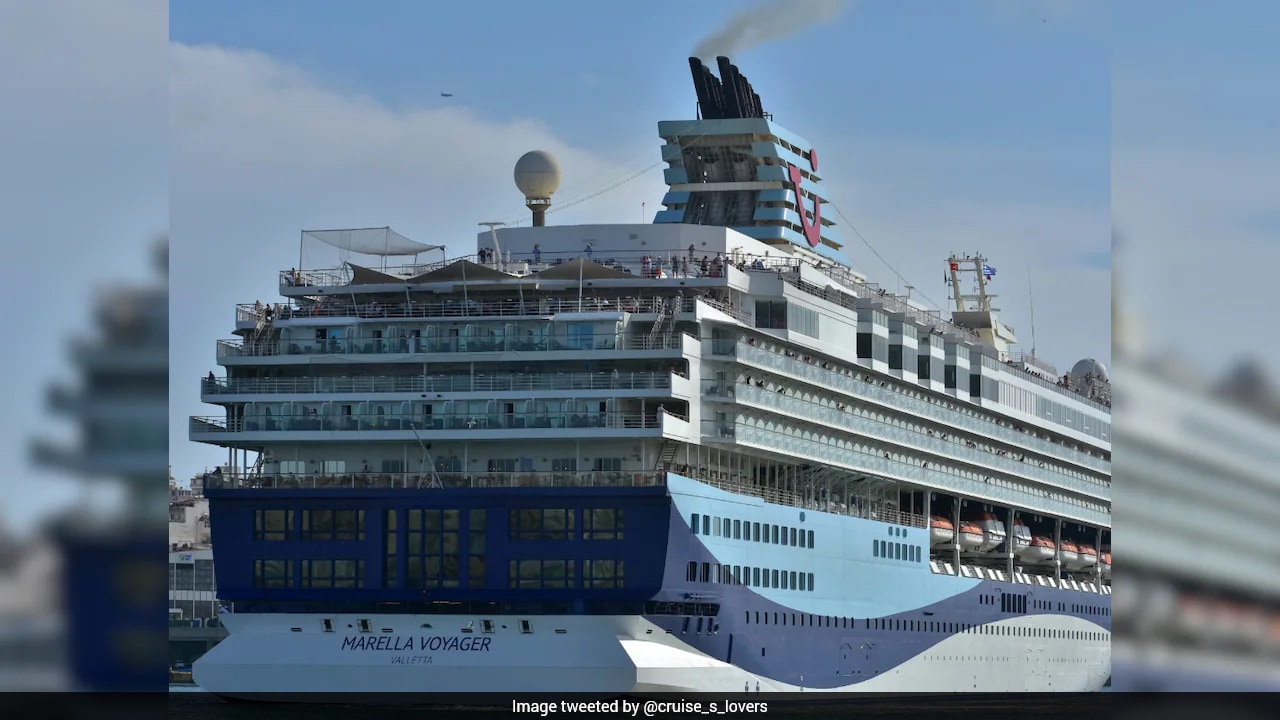
At three in the morning, a modern cruise ship is a floating city fast asleep. Three thousand passengers lie tucked behind heavy fire-rated doors, lulled by the low, rhythmic thrum of diesel-electric engines vibrating through the steel deck plates. Out on the open promenade, the air smells of salt, ozone, and diesel exhaust. The ocean below is not the sparkling turquoise postcard sold in glossy brochures. At night, in the middle of the Atlantic, the water is an ink-black void moving past the hull at twenty knots.
Then, someone crosses the railing.
No alarm sounds on the bridge. No automated sensor flashes red on a security console. A life ring does not automatically drop into the churning wake. Instead, there is only a sudden, silent displacement of water, and within four seconds, the towering stern of the vessel is already a hundred feet away, rushing toward the horizon while the person in the water is swallowed by the dark.
When news broke that a British woman had vanished from a cruise ship in the Atlantic Ocean, the headlines followed a familiar, sterile script. Authorities notified. Search-and-rescue planes launched. Coast Guard vessels scouring thousands of square miles of empty sea. To the casual reader scrolling past the story over morning coffee, it registers as a tragic, isolated freak accident—a momentary lapse in judgment or a terrible stroke of bad luck on vacation.
That perception is entirely wrong.
Behind every terse press release about a passenger feared overboard lies a haunting, systemic reality that the maritime industry rarely discusses openly. When someone disappears from a cruise ship, the tragedy is rarely just the fall itself. It is the agonizing hours of silence that follow, the technological blind spots on billion-dollar vessels, and the brutal physics of the open ocean that turn a rescue mission into a recovery operation before the ship even turns around.
The Illusion of the Floating Resort
To understand how a human being can vanish without a trace from one of the most heavily surveilled environments on earth, you have to step aboard and feel the psychological shift that happens the moment the gangway is pulled up.
I spent years working on deep-water vessels, and I still remember the specific disorientation of my first midnight watch on the upper decks. On land, our brains are wired to respect edges. We see a cliff, a rooftop, or a subway platform, and a primal instinct tells us to step back. A mega-ship systematically dismantles that instinct. It wraps steel and deep water in warm lighting, carpeted hallways, cocktail lounges, and manicured teak decks. It convinces you that you are in a luxury hotel in Las Vegas, not perched twelve stories above freezing, bottomless water moving at highway speeds.
Consider a hypothetical passenger—let us call her Clara, a retired teacher from Surrey taking her first transatlantic crossing. She cannot sleep. She steps out onto the outer deck for fresh air, leaning against a chest-high glass barrier to watch the moonlight fracture across the swells. On a standard cruise liner, regulations mandate that perimeter railings stand at least forty-two inches high. That is roughly hip-to-rib height for an average adult. If Clara climbs onto a deck chair to take a better photograph, or slips on a patch of sea spray while leaning too far over to look at the hull, physics takes over in a fraction of a second.
Once a body leaves the deck, the fall itself is violently deceptive. From the upper passenger decks, the drop to the waterline can exceed one hundred feet. At that height, hitting the ocean is not like diving into a swimming pool. Water does not compress. Impacting the surface at fifty miles per hour feels like striking concrete, frequently causing broken bones, knocked-out wind, or immediate unconsciousness before the cold shock response even begins.
The Four-Hour Blind Spot
The most chilling part of a maritime disappearance is not the moment of impact. It is the silence afterward.
In movies, someone shouts "Man overboard!" and the ship immediately banks hard to port while spotlights sweep the waves. In reality, unless another passenger physically witnesses the fall and sprints to alert the crew, nobody knows anyone is gone.
Look at the timeline of almost every high-profile cruise disappearance over the past two decades. A passenger is last seen leaving a lounge at midnight. Their cabin partner wakes up at seven in the morning, notices the bed is empty, and assumes they went up to the buffet for coffee. By nine o'clock, worry sets in. By ten, ship security is notified. Crew members search the cabins, check the spa, inspect the medical bay, and review hundreds of hours of closed-circuit television footage from dozens of cameras.
By the time the captain is informed that a passenger is genuinely unaccounted for, six to ten hours have elapsed.
At a cruising speed of twenty knots, a ship covers roughly twenty-three miles every hour. Over an eight-hour delay, the vessel has steamed nearly two hundred miles away from the point where the person entered the water. The search area is no longer a pinpoint; it is a sweeping, shifting corridor of ocean spanning thousands of square nautical miles, pushed sideways by unpredictable surface currents and trade winds.
Even when the Coast Guard scrambles C-130 Hercules aircraft and cutters to comb the Atlantic, the odds are stacked cruelly against survival. Finding a human head bobbing in six-foot Atlantic swells from an airplane flying at a thousand feet is like trying to spot a stray basketball floating in a darkened stadium.
The Technology That Exists—And Why It Isn't There
Here is the question that haunts families left standing at the arrival terminal with an extra suitcase: why don't ships know the second someone goes over the side?
The technology to detect a falling body is neither experimental nor prohibitively expensive. Automated Man Overboard systems—known in the maritime sector as MOB detection—already exist. They combine thermal imaging cameras, radar arrays, and motion-tracking software designed to scan the perimeter of a vessel continuously. If an object the size of a human torso crosses the plane of the railing, the system triggers an instant alarm on the bridge, marks the exact GPS coordinates of the drop, and records a video loop of the incident within seconds.
In 2010, the United States Congress passed the Cruise Vessel Security and Safety Act, which explicitly required cruise lines to integrate technology capable of capturing images of passengers falling overboard and detecting when such an incident occurs, to the extent that such technology is available.
Yet more than a decade later, comprehensive, automated detection across the global fleet remains patchy at best.
Cruise operators have frequently argued that marine environments produce too many false alarms—a seagull flying past a sensor, a tossed napkin, or heavy sea spray triggering a bridge alert in the middle of the night. Critics, maritime lawyers, and victims' advocacy groups point to a different friction: cost and liability. Retrofitting a massive hull with military-grade thermal perimeter tracking requires millions of dollars per ship and threatens the carefully curated illusion of effortless, risk-free leisure.
So, on most ships crossing the Atlantic tonight, security relies on traditional CCTV cameras pointed down the length of the decks, monitored passively or reviewed only after a report is filed. If a camera angle has a blind spot behind a lifeboat davit, or if glare from deck lights washes out the lens, the sea keeps its secret.
The Physics of Cold Water and Hope
When a British traveler goes missing in the mid-Atlantic, the public naturally clings to stories of miraculous rescues. We want to believe in human endurance. And occasionally, miracles do happen. In 2022, a man fell from a cruise ship in the Gulf of Mexico and survived for more than fifteen hours treading water before a Coast Guard helicopter plucked him from the waves.
But the North and Mid-Atlantic are vastly less forgiving than the warm waters of the Gulf.
Even in milder months, open Atlantic water temperatures hover well below human body temperature. Immersion triggers an immediate, involuntary gasp reflex—if your face is underwater when that happens, you drown within seconds. If you survive the initial shock, hypothermia sets in steadily. Blood vessels constrict, pulling warmth away from your arms and legs to protect your heart and brain. Within an hour or two, fine motor control vanishes. Fingers go numb. Swimming becomes exhausting, then mechanically impossible. Without a life jacket to keep the airway above the chop, exhaustion eventually wins.
This is the grim calculus facing search-and-rescue coordinators when they draw grid lines over the Atlantic. Every hour that passes without a confirmed time of entry exponentially reduces the probability of finding someone alive. Coast Guard crews push their aircraft to the limits of fuel endurance, flying grid patterns until the mathematical probability of survival drops to zero—a threshold that forces commanders to make the heaviest call in maritime service: suspending the search.
What Every Passenger Needs to Know Before Boarding
Cruising remains, statistically, one of the safest ways to travel. Millions of people step onto ships every year, eat too much at the midnight buffet, watch Broadway-style shows, and return home with sunburns and souvenir magnets. According to industry data compiled by maritime consultants, roughly twenty to twenty-five people go overboard worldwide each year out of more than thirty million passengers.
Low odds, however, offer zero comfort when it happens to someone you love. And because the industry will not break the vacation spell by warning you about the dangers of the railing, you have to carry that awareness yourself.
First, treat every exterior deck as an active marine environment, not a hotel balcony. Alcohol is a primary factor in a high percentage of overboard incidents; a drink package combined with a rolling deck at two in the morning impairs balance faster than people expect. Never sit on railings, never climb onto deck furniture near the edge for a photo, and never lean over the glass to look down at the water.
Second, establish a check-in habit with your travel companions. If you are traveling with family or friends, agree on a simple rule: nobody walks the outer decks alone late at night without sending a quick message or leaving a note. If someone does not return to the cabin when expected, do not wait until breakfast to investigate. Every minute between the fall and the alarm is a mile of ocean you cannot get back.
Third, pay attention to where you are on the ship. Notice the deck numbers, the location of the nearest emergency phone along the promenade, and the life rings mounted along the bulkheads. If you ever see someone go over the side, do not run away to find a crew member—keep your eyes locked on the person in the water, scream for help so bystanders can call the bridge, and throw the nearest life ring immediately. That bright orange ring does not just offer flotation; it gives search planes a high-visibility marker in miles of uniform blue-gray water.
The Wake That Never Closes
Out in the middle of the Atlantic, there are no landmarks. There are no road signs, no streetlights, and no footprints left behind to show where a life intersected with the sea.
When a ship loses a passenger, the vessel eventually resumes its course. The dining rooms open for dinner. The band plays by the pool. Within a few days, the ship pulls into Southampton or Miami, passengers roll their luggage down the gangway, and another wave of vacationers steps aboard, eager to feel the sea breeze on their faces.
Yet somewhere far behind the stern, beneath thousands of fathoms of dark, indifferent water, a family's entire world has stopped turning—anchored forever to an empty cabin, an untouched suitcase, and a railing that was just low enough to cross.