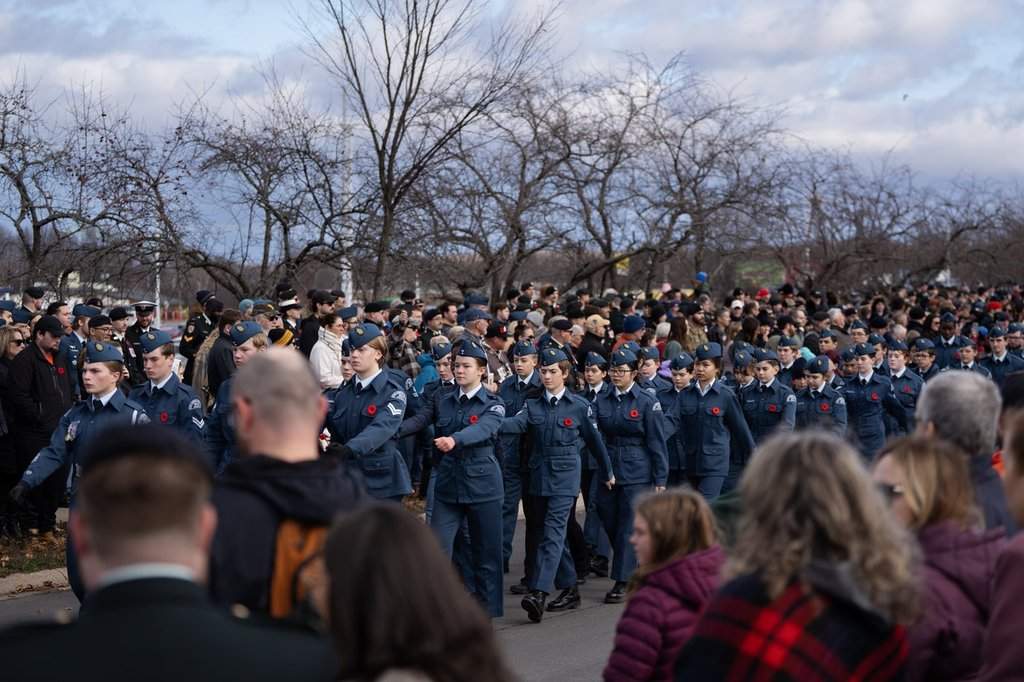
The boots sit by the front door like abandoned monuments.
For months, the thick leather has collected dust in the corner of the hallway, laces coiled neatly inside the cuffs, soles scrubbed clean of mud and pine needles. If you walk into thousands of homes across the country on a Friday evening, you will see this exact still life. A pressed uniform hanging in a closet wrapped in dry-cleaner plastic. A canteen sitting empty on a kitchen shelf. A teenager staring at a glowing phone screen in the dim light of a bedroom, scrolling endlessly through feeds that offer noise without direction.
When a defense or youth minister announces that cadet weekend activities will resume until the end of March, the press release reads like a bureaucratic footnote. Two lines of administrative prose. A scheduling adjustment. A calendar update designed to satisfy questions from regional commanders and parliamentary committees.
Newsrooms treat it that way, too. They run a three-paragraph wire brief, slap a functional headline on it, and move on to elections, inflation numbers, or celebrity divorces.
They miss the entire story.
Because a weekend field exercise is never just a line item on a government calendar. It is the difference between a sixteen-year-old discovering who they are under pressure and that same teenager spending another winter weekend isolated in a bedroom, convinced that adulthood is just a series of screens you never turn off.
The Anatomy of a Lost Weekend
To understand why the resumption of weekend training matters, you have to understand what disappears when those weekends are canceled.
Consider a hypothetical fifteen-year-old named Leo. Leo is not a troublemaker, nor is he an academic prodigy. He occupies that vast, invisible middle ground of adolescence where most kids live. In school, he blends into the back row. At home, he answers questions with single syllables. Before weekend cadet activities were paused, Friday nights meant packing a rucksack with meticulous care—checking waterproof liners, folding wool socks, testing a headlamp against the bedroom wall. Saturday mornings meant standing in the freezing mist at 0600 hours alongside twenty other kids from completely different neighborhoods, learning how to read a topographic map when your fingers are too numb to hold a compass steady.
When weekend training stops, Leo does not suddenly join a debate club or volunteer at a hospital. Vacuum fills with static.
I remember my own years in uniform during late winter, back when March felt less like the arrival of spring and more like an endurance test designed by people who hated central heating. I remember the specific smell of wet canvas tents and cold rations, and the sheer, overwhelming relief of realizing that nobody in that clearing cared what shoes you wore to school or how many followers you had online. In the woods, status was measured by whether you remembered to bring extra dry matches and whether you stayed behind to help the slowest person in your squad climb a muddy ridge.
You cannot simulate that in a classroom. You cannot replicate it during a two-hour Wednesday night parade in a gymnasium under fluorescent lights.
The mid-week meeting teaches drill, history, and rank structure. It is the theory. The weekend exercise is the laboratory where theory collides with cold rain, blistered heels, and genuine exhaustion. Without the weekend, the program loses its heartbeat.
Why the End of March Is a Clock Ticking Loudly
Look closely at the phrasing of the ministerial announcement: cadet weekend activities will resume until the end of March.
That specific boundary—March 31—is not arbitrary. In the rhythm of the training year, late autumn through early spring represents the crucible of cadet development. It is the window between the initial recruitment rush of September and the major summer camps, national competitions, and leadership courses that begin once the school year winds down.
Think of the training year like building a bridge across a river.
September and October are when you pour the concrete footings on the riverbank. You teach basic discipline, uniform standards, and fundamental safety. Summer camps are the grand opening, when cadets travel across the country to earn advanced qualifications in aviation, sailing, marksmanship, or wilderness survival.
Winter and early spring—January, February, March—are the suspension cables that hold the entire structure together.
If you lose the weekend training window leading up to the end of March, you do not simply lose a few days of camping. You break the chain of qualification. A senior cadet cannot be certified to lead a section in the summer if they have not spent winter weekends practicing field leadership under supervision. A junior cadet cannot safely attend an advanced survival course in July if they have never spent a night below freezing in February learning how to spot the early signs of hypothermia in a teammate.
When authorities authorize weekend activities to resume right up to the end of March, they are effectively opening an emergency pressure valve. They are giving local squadrons, corps, and units roughly four months—sixteen precious weekends—to compress months of stalled progression into a tight, disciplined sprint before the spring administrative cutoff.
Every single weekend between now and March 31 carries double weight.
What Happens Inside the Hall Before Dawn
If you want to see what this decision actually looks like in practice, picture an armory or community drill hall at 5:30 AM on a Saturday in January.
The parking lot is dark, save for the amber glow of streetlamps reflecting off patches of black ice. Cars pull up one by one, exhaust plumes curling into the freezing air. Parents sit behind steering wheels with the heaters blasting, watching their kids haul heavy duffel bags toward the heavy steel doors.
Inside, the air smells of floor wax, damp wool, and cheap instant coffee brewing in a dented steel urn for the adult volunteers.
Nobody is getting rich here. That is the detail the public almost always forgets about cadet organizations. While the program is backed by defense ministries and guided by national policy, the people actually unlocking the doors at five in the morning, inspecting boots, checking medical forms, and driving fifteen-passenger vans through sleet are overwhelmingly volunteers. Many are former service members; plenty are ordinary parents, teachers, mechanics, and nurses who give up their own weekends because they remember what a mentor once did for them.
When weekend activities were suspended or restricted, those volunteers felt the frustration just as sharply as the youth. You can hold a unit together on Zoom or in a church basement for only so long before the energy drains out of the room. Teenagers possess an extraordinarily sensitive radar for authenticity. If they sense that a program is merely treading water, they walk away. Retention collapses. Once a sixteen-year-old quits a youth organization, the odds of getting them back are close to zero.
Resuming weekend activities through March is a lifeline thrown directly to those local units. It tells the volunteers that their preparation matters. It tells the cadets that the promise made to them when they signed their enrollment papers—the promise of real challenge, real responsibility, and real adventure—is finally being kept.
The Invisible Stakes of Adolescent Resilience
There is a quieter, more uncomfortable truth sitting beneath all of this.
We are living through an era in which young people are safer, more supervised, and more digitally connected than any generation in human history—and simultaneously more anxious, more isolated, and less confident in their own physical capability.
Psychologists and educators have spent years sounding the alarm about the disappearance of structured, real-world risk from childhood and adolescence. When young people are never allowed to be cold, tired, lost, or uncomfortable in a controlled, mentored environment, they never develop the internal evidence that they can survive difficulty. Every minor setback feels like an emergency because they have never tested their own limits against something concrete.
Cadet weekend training offers something almost extinct in modern life: benign adversity.
Consider what happens to our hypothetical cadet, Leo, on a weekend navigation exercise in February.
Halfway through the afternoon, the map reading goes wrong. His team misses a trail junction by four hundred meters and ends up at the edge of a frozen cedar swamp as the light begins to fade. Nobody is in mortal danger—adult safety officers are tracking their radio check-ins from a ridge half a mile away—but Leo does not feel rescued. He feels responsible. His feet are wet. Two younger cadets in his group are starting to panic, complaining that they will never make it back to base camp before dark.
In that moment, nobody can swipe left on the swamp. No algorithm can generate a shortcut.
Leo has to take a breath, pull out his compass, orient the map to the terrain, admit to his team that they took a wrong turn, and calculate a new bearing back to the main trail. Forty minutes later, when they step out onto the gravel road and see the lanterns of the base camp flickering through the trees, something permanent has shifted inside his chest.
He knows, with bone-deep certainty, that when things fall apart, he does not crumble. He thinks. He adapts. He leads.
Try putting that on a standardized test. Try teaching that through a smartphone app.
The Questions Parents Actually Ask
Whenever announcements like this hit the news, parents quietly wrestle with a mix of relief and hesitation. On one hand, they want their kids out of the house and off screens. On the other, winter training sounds harsh, schedules are tight, and the logistics of getting a teenager through a weekend field exercise can feel overwhelming if you have never worn a uniform yourself.
First, there is the question of safety. Modern cadet weekend exercises operate under strict risk-management frameworks that bear little resemblance to the rough-and-tumble military training of fifty years ago. Cold-weather protocols dictate exact temperature thresholds at which outdoor overnight stays are modified or moved indoors. Ratios of certified adult supervisors to youth are strictly enforced, and every field exercise requires dedicated first-aid personnel, emergency communication channels, and extraction vehicles on standby. The goal is controlled challenge, never reckless exposure.
Second, there is the question of cost—a massive barrier for families already stretched thin by rising grocery and housing bills. Unlike travel sports, elite music academies, or private summer camps that quietly demand thousands of dollars in fees, uniforms, and hotel stays, cadet programs remain one of the last genuinely accessible youth development pathways. Uniforms and essential field gear are issued at no cost, and weekend training exercises are funded through the program's operational budget. A kid from a single-parent household working minimum wage stands shoulder-to-shoulder with the child of a surgeon, wearing the exact same boots, eating the exact same rations, judged by the exact same standard.
Third, there is the persistent myth that cadet weekend training is merely a recruitment pipeline designed to funnel teenagers straight into the armed forces. Anyone who has spent time around senior cadets knows how false that assumption is. While some alumni certainly choose military careers, the vast majority become paramedics, engineers, teachers, carpenters, software developers, and community leaders. The uniform is a tool for building citizenship, self-reliance, and teamwork—not a contract.
Racing the Calendar
Still, resuming weekend activities until the end of March is not a magic wand. It is a narrow window, and the clock is already running.
Units across the country now face a monumental logistical puzzle. Equipment quartermasters have to inspect hundreds of tents, stoves, sleeping bags, and radios that have sat in storage. Transportation coordinators have to book buses and military vehicles in a compressed timeframe. Training officers have to rewrite lesson plans to ensure that foundational skills are taught properly rather than rushed just to check a box before March 31.
There will be friction. There will be weekends canceled due to blizzards or ice storms. There will be Friday nights when exhausted teenagers stare at their packed rucksacks and wonder why they volunteered to spend their weekend sleeping on a foam mat in the woods while their friends go to the movies.
And then Sunday afternoon will arrive.
The vans will roll back into the armory parking lot just as the winter sun drops below the roofline. The doors will slide open, and out will step a group of teenagers who look noticeably different than they did forty-eight hours earlier. Their faces will be windburned. Their uniforms will smell like woodsmoke. They will be tired in a clean, honest way that no video game marathon can ever produce.
They will stack the rucksacks, clean the gear, fall into formation for final dismissal, and walk back out to their parents' cars talking loudly, laughing at shared misery, already comparing notes on the next exercise.
By the front door, the boots will no longer be collecting dust. They will be caked in dried mud, waiting for Friday night.