Silence.
In an industry engineered to monetize every heartbeat, every dinner reservation, and every charitable check written behind velvet ropes, silence is the ultimate act of defiance. For over two decades, Harrison Ford and Calista Flockhart have practiced that defiance like a sacred art, building a life together in the high-altitude quiet of Jackson Hole, Wyoming, far removed from the relentless flashbulbs of Los Angeles.
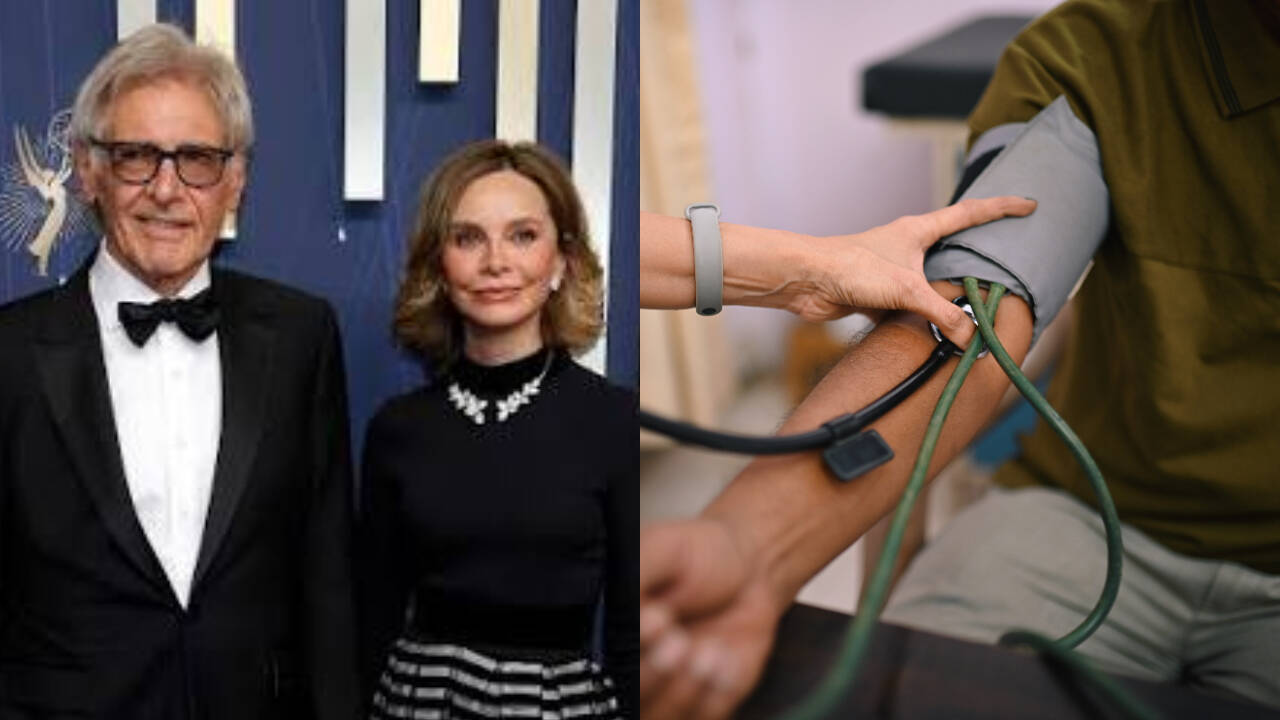
So when news broke that the couple would step onto a stage together to accept their first-ever joint philanthropy award, the reaction in Hollywood was a mixture of surprise and curiosity. Celebrities usually collect humanitarian trophies the way boxers collect belts—early, often, and with maximum press coverage. Yet here were two of the most recognizable faces on the planet, married since 2010 and together since a fateful spilled drink at the 2002 Golden Globes, finally agreeing to let the world applaud what they have been doing in the dark for twenty-four years.
To understand why this single trophy matters—and why their refusal to seek it until now exposes everything broken about modern celebrity charity—you have to look past the red carpet. You have to look at the dirt under the fingernails.
The Architecture of Quiet Giving
Most celebrity philanthropy operates like a storefront with giant glass windows and very little inventory inside. A famous face shows up for forty-five minutes, poses against a step-and-repeat banner covered in corporate logos, reads a teleprompter speech written by a publicist, and vanishes before the salad course arrives. The charity gets a momentary spike in Google searches; the star gets an image-burnishing press release. Everyone wins, except perhaps the people the foundation was built to serve.
Consider a hypothetical scenario that plays out every gala season in Beverly Hills. Imagine a small environmental nonprofit trying to protect a watershed in Montana. They spend sixty percent of their annual fundraising budget flying in an A-list actor, paying for a private jet, a penthouse suite, and a hair-and-makeup team, all for a ten-minute keynote address. By the time the lights dim, the organization has spent more on vanity than on river restoration.
Ford and Flockhart have spent their entire adult lives allergic to that transaction.
Long before they ever shared a last name, both were already entrenched in the unglamorous, logistical grind of actual advocacy. Ford has served on the board of Conservation International since 1991—over three decades of policy meetings, rainforest expeditions, and dry, unsexy legislative lobbying. He didn't just lend his voice to narrate documentaries; he flew his own planes into remote regions, studied carbon sequestration data, and sat across from skeptical heads of state who couldn't care less that he played Indiana Jones. When he famously waxed his chest on camera in 2008 to illustrate the pain of deforestation, it wasn't a vanity play. It was a grizzled, sixty-six-year-old man willing to look ridiculous if it meant someone paid attention to disappearing tropical canopies.
Meanwhile, Flockhart approached advocacy from the opposite end of the telescope: hyper-local, deeply personal, and fiercely protective of human dignity. Throughout her run on Ally McBeal and long after she stepped back from the Hollywood treadmill to raise their son, Liam, she poured her energy into organizations combating domestic violence and supporting underserved youth—specifically Peace Over Violence in Los Angeles. She didn't want cameras following her into shelters. She understood, with the sharp intuition of someone who has spent her career reading human emotion, that trauma does not heal under studio lighting.
When you put those two instincts together—his global ecological urgency and her intimate, fiercely guarded protection of vulnerable families—you get a blueprint for partnership that Hollywood rarely sees.
Why It Took Twenty-Four Years to Share a Stage
People often wonder why the couple kept their philanthropic lives on separate tracks for so long. After all, joint foundations are practically a marriage requirement for power couples. Think of the sheer number of hyphenated charities launched within six months of a celebrity wedding, complete with matching monogrammed stationery and glossy annual reports.
The truth is far simpler, and far more human. Merging their public charitable identities earlier would have turned their marriage into a brand. And if there is one thing Harrison Ford despises more than talking about his acting process, it is the commodification of his personal life.
I remember watching an interview with Ford years ago where a reporter pressed him on the secret to his longevity with Flockhart. He looked at the journalist with that signature half-scowl, paused for five seconds that felt like five minutes, and said, "Don't talk." At the time, it played like classic Ford curmudgeonry. Looking back, it was a manifesto.
By keeping their charitable work separate from their romantic narrative, they protected the integrity of both. When Ford spoke about climate science at the United Nations, the headline was the science, not his marriage. When Flockhart supported survivors of abuse, the focus remained on the survivors, not on what she was wearing or how her husband felt about it. They refused to let their fame cannibalize the causes they cared about.
That restraint is precisely what gives this first joint award its weight. It isn't a promotional launchpad for a new vanity project. It is a lifetime achievement recognition for two people who already did the work when nobody was handing out hardware.
The Invisible Stakes of the Wyoming Ranch
To grasp what drives them, you have to picture where they actually live.
In the late 1980s, Ford bought an 800-acre spread along the Snake River in Jackson, Wyoming. Over the years, he placed nearly half of that land—roughly 389 acres—into a permanent conservation easement with the Jackson Hole Land Trust.
Think about what a conservation easement actually is, stripped of legal jargon. It is a voluntary, legally binding sacrifice of millions of dollars in real estate value. In a valley where billionaires buy up ranches to build sprawling mega-mansions and private golf courses, Ford legally prohibited himself and any future owner from ever subdividing or developing that riverfront habitat. Bald eagles, trumpeter swans, elk, and moose get to keep their corridor forever because a movie star decided that open dirt was worth more than a developer's check.
That is the difference between performative charity and structural commitment. A check buys dinner for a shelter tonight; an easement alters the physical geography of a valley for the next five hundred years.
Flockhart stepped into that environment in 2002 and didn't try to turn it into Malibu East. She embraced the isolation, the harsh winters, and the unvarnished reality of a small mountain community where nobody cares about box-office grosses if your truck is stuck in a snowbank. Together, they raised Liam away from paparazzi lenses, teaching him—by sheer osmosis—that stewardship isn't something you talk about at galas. It's how you treat the land you walk on and the neighbors you pass at the hardware store.
The Shift in How We Measure Generosity
We are living through a strange cultural reckoning regarding wealth and fame. Audiences today have radar for inauthenticity that is sharper than at any point in entertainment history. Twenty years ago, a photo-op of a celebrity handing out water bottles was enough to generate a week of glowing press. Today, that same photo gets dissected on social media within minutes—people ask who paid for the photographer, how much the star actually donated, and whether they flew in on a Gulfstream.
The old model of celebrity philanthropy is dying because the public finally sees the receipts.
And that brings us back to why this joint honor for Ford and Flockhart hits a nerve. In an era where "awareness" has become a cheap substitute for action, they represent an older, tougher ethic: show up, shut up, and stay until the job is done.
Consider the sheer endurance required for their kind of commitment. Fads in philanthropy come and go just like fashion trends. One year everyone is wearing rubber bracelets for a specific disease; three years later, the bracelets are in a landfill and the donors have moved on to the next trendy cause. Staying on a conservation board for thirty-five years—through shifting political winds, economic crashes, and moments when environmentalism was deeply unpopular—requires a stubbornness bordering on obsession.
It is the same stubbornness Ford brought to flying search-and-rescue missions in his own helicopter in Teton County. In 2000, he famously piloted his Bell 407 to rescue a dehydrated hiker stranded near the summit of Table Mountain, and a year later he helped locate a missing Boy Scout in Yellowstone. He didn't call TMZ before firing up the rotors. He was simply a licensed pilot who lived nearby and had the equipment to help. When the hiker realized who had just pulled her off the mountain, she reportedly threw up in his helicopter—a detail Ford later recounted with dry amusement, completely devoid of hero-complex posturing.
You cannot fake that kind of reflex. Either you are wired to step into the breach when things go wrong, or you aren't.
What Happens When the Spotlight Finally Turns On
So why accept a joint award now?
At eighty-four, Ford is in the autumn of an extraordinary run—still working, still sharp, still visibly moved when talking about the fragility of the natural world. Flockhart, now in her early sixties, has selectively returned to the screen in projects like Feud: Capote vs. The Swans and Shrinking, bringing the same quiet ferocity to her roles that she brought to raising her family.
Accepting this honor together isn't a victory lap; it's a passing of the torch.
As younger generations of actors and musicians navigate an overwhelming, hyper-visible world, they desperately need models of how to use influence without letting it rot their souls. Standing together on that stage, Ford and Flockhart offer a radical counter-narrative to the modern obsession with personal branding. They are living proof that you can command global attention without surrendering your privacy, and that you can move mountains for the causes you love without ever turning your compassion into content.
There is a vulnerability in stepping out from behind their self-imposed curtain, even for one night. For two people who have guarded their shared space like a fortress for nearly a quarter-century, allowing the world to celebrate them as a unit requires lowering the drawbridge. It means letting strangers connect the dots between the private tenderness they share at home and the public mercy they extend to the world.
Think about the young actors sitting in the back of that ballroom, nursing sparkling water and scrolling through their phones, wondering how to survive a career that demands constant self-exposure. Watching Ford and Flockhart walk up to that podium together gives them an answer they won't hear from their agents. It tells them that longevity isn't built on noise. It is built on roots.
Long after the ballroom clears out, the tuxedo rentals are returned, and the trophy finds a quiet shelf somewhere in Wyoming—likely tucked behind a stack of aviation charts or a framed drawing from their son—the real monument to their partnership won't be made of crystal or bronze.
It will be three hundred and eighty-nine acres of untouched riverfront along the Snake River, where the water still runs cold and clear, and the eagles don't know the name of the man who saved their sky.