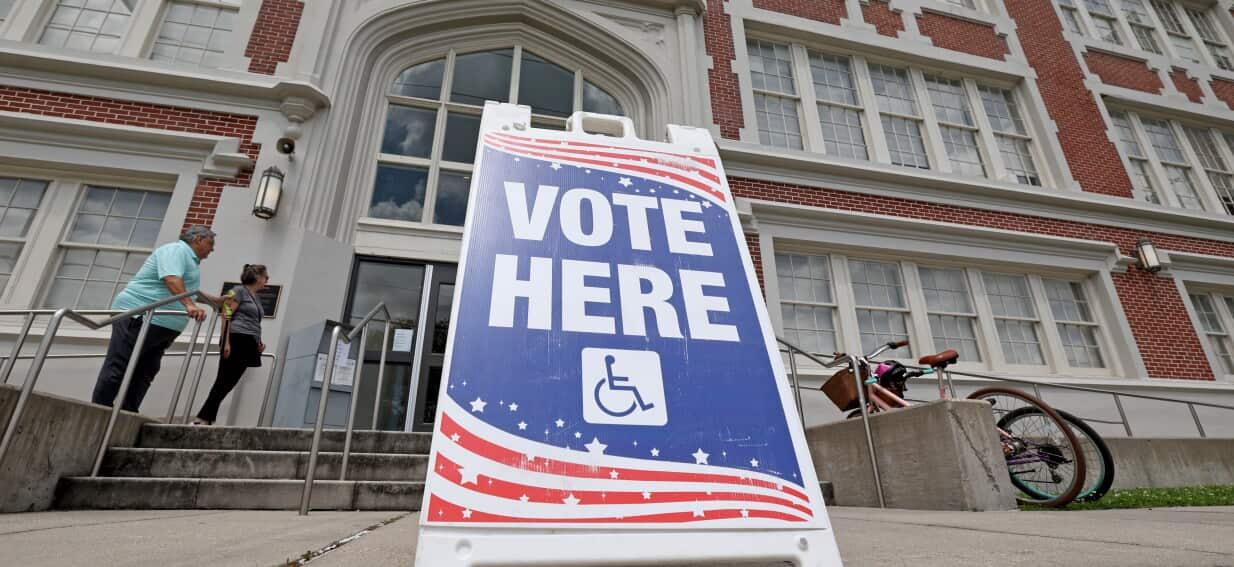
The fluorescent lights in the gymnasium of a suburban high school hum with a low, persistent vibration that gets into your teeth. It is nine o'clock on a Tuesday night in November. The smell of floor wax and damp wool coats hangs heavy in the air, the universal perfume of American democracy in the off-season.
Elena, a hypothetical composite of the millions of tired, middle-class voters who stood in rain-slicked lines from Ohio to Arizona, has just fed her paper ballot into the optical scanner. She watches the green checkmark flash on the tiny screen. She feels a sudden, hollow drop in her stomach. For months, her television has screamed about existential threats, historic waves, and the impending collapse of the republic. Now, standing next to a folding table stacked with "I Voted" stickers, the silence feels almost deafening.
Minutes later, hundreds of miles away under the bright, unforgiving glare of television studio lights, the verdict begins to crystallize. The numbers crawl across the bottom of the screen like ticker tape from an old war room. A split Congress. A razor-thin margin. The House of Representatives, that raucous, perpetually agitated lower chamber, flips hands, shifting the center of gravity in Washington by a few crucial inches.
And then comes the soundbite that defines the entire exhausting spectacle. Asked about the sudden, looming threat of congressional subpoenas, endless investigations, and the dreaded "I-word"—impeachment—President Donald Trump shrugs off the storm with practiced, theatrical nonchalance. He is, he tells the cameras, "not at all" concerned.
Pause.
Read those three words again. Not at all.
In the sterile, bullet-pointed recaps of standard wire reports, that quote is treated as a mere political footnote, a standard-issue piece of bravado tossed out during a post-election press conference. The dry summaries give you the box score: the seats gained, the seats lost, the gubernatorial races won by fractions of a percent, the Senate holding firm for the incumbent party while the House slips away. They give you the skeleton of the night. They completely miss the pulse.
Because when you strip away the punditry and the red-and-blue graphics, the story of a divided midterm election is not a story about seat counts. It is a psychological thriller about power, denial, and the invisible tug-of-war happening inside the kitchen of every household in America.
The Architecture of a Split Decision
To understand why a president can look down the barrel of a newly empowered opposition and claim total indifference, you first have to understand the peculiar genius—and profound frustration—of the American midterm cycle.
I remember covering my first midterm election years ago, sitting in a cramped, overheated county board of elections basement in Pennsylvania. By midnight, the coffee had turned to sludge, and the local party chairs were pacing the linoleum like caged cats. One of them, a retired steelworker with ink-stained fingers, leaned against a filing cabinet and told me something I have never forgotten. "Presidential years are for falling in love," he said, rubbing his temples. "Midterms are for hiring a mechanic because the transmission is slipping."
He was right. Historically, the party in the White House almost always takes a beating two years into a term. Since the Civil War, the president’s party has lost seats in the House of Representatives in nearly every single midterm election, with only a handful of rare exceptions—1934, 1998, 2002. It is a structural gravity that no amount of campaign cash can entirely defy. Voters, having handed the keys of the kingdom to one party, instinctively reach for the emergency brake twenty-four months later.
When the results settle into a divided government—one party holding the Senate and the executive branch, the other capturing the House—the machinery of Washington changes overnight. Think of the federal government as a massive, double-hulled cargo ship. For two years, both engines are pushing in the same direction, churning through legislative waters at full throttle. Tax cuts pass. Judges are confirmed. Regulatory walls are torn down or built up with dizzying speed.
Then comes November. The voters step aboard, walk down to the engine room, and throw one of the engines into reverse.
Suddenly, the ship stops moving forward. Instead, it begins to spin in tight, violent circles.
The Invisible Stakes Behind the Subpoena Power
What does a flipped House actually mean when the rhetoric fades? To grasp the real stakes, forget the cable news panels and look at the gavel.
In Washington, a committee gavel is not a ceremonial piece of wood. It is a crowbar. When the opposition party takes control of the House, they inherit the chairmanship of every major committee—Ways and Means, Judiciary, Intelligence, Oversight. With those gavels comes the unilateral power to issue subpoenas, compel testimony under oath, and demand tens of thousands of pages of internal emails, tax returns, and financial records.
Let us return to Elena, our hypothetical voter in the high school gymnasium. Why does she care about committee chairmanships? Honestly, she probably doesn't use those words. She cares about the cost of insulin, the crumbling bridge she drives over to get to her nursing shift, and the gnawing anxiety that the people running the country are more interested in destroying each other than fixing her roads.
Yet, the invisible stakes of that flipped House reach directly into her living room. When a president faces an opposition-led House, major domestic legislation essentially dies on the vine. Grand bargains on infrastructure, healthcare, or immigration become nearly impossible because neither side wants to hand the other a victory before the next presidential cycle. The legislative branch transforms from a factory of laws into a theater of investigation.
This brings us back to that remarkable moment at the podium: the declaration of being "not at all" concerned about impeachment.
To understand the audacity of that statement, you have to appreciate the psychological warfare of modern politics. Impeachment is the ultimate constitutional weapon, a nuclear option designed by the Framers for "treason, bribery, or other high crimes and misdemeanors." In the entire history of the United States, only a tiny handful of presidents have ever faced that abyss. It is meant to terrify. It is meant to chasten.
By brushing it off with a wave of the hand, a leader is attempting a high-wire act of narrative control. If you admit fear, the sharks smell blood; your own party begins to fracture, donors start hedging their bets, and your political capital evaporates before breakfast. If you project absolute, unshakeable indifference, you attempt to reframe the constitutional crisis as mere partisan harassment. You turn the weapon back on the wielder, telling your supporters, Look at them. They aren't trying to help you. They're just trying to get me.
It is a gamble of breathtaking proportions. Because history shows that investigations have a momentum of their own. They are like water finding a crack in a concrete foundation; once the freezing and thawing begins, nobody can predict how much of the wall will eventually crumble.
The Exhaustion of the Perpetual Campaign
There is a human cost to this perpetual state of warfare that rarely makes it into the election night highlights. You can see it in the way people talk to their neighbors over the backyard fence, or rather, the way they carefully avoid talking to them.
Consider Marcus, a fictional small-business owner running a hardware store in a purple district just outside a major Midwestern city. His customer base is split right down the middle. On Tuesday morning, before opening the shop, he votes. On Wednesday morning, he unlocks the front door, turns on the fluorescent lights, and watches two of his regulars—one wearing a faded campaign hat, the other carrying a tote bag from a local progressive group—stand awkwardly by the paint counter.
Neither mentions the results. Neither brings up the House, the Senate, or the looming threat of impeachment hearings. They talk about the early frost. They talk about the price of lumber. They tread around the election results like a live wire lying across a wet sidewalk.
This is the quiet tragedy of our hyper-polarized era. The headlines celebrate the drama of the clash—the wins, the losses, the defiant quotes at the podium—while the people living inside the results are left to manage the fallout in silence. When politics becomes an all-consuming, zero-sum blood sport, civic exhaustion sets in. People stop believing that the system can produce tangible improvements in their daily lives, so they settle for watching their chosen champion fight the enemy to a bloody draw.
Look closely at the numbers from any modern midterm, and you will see this tension carved into the geography of the map. Cities grow bluer, rural counties grow redder, and the suburbs—those sprawling, anxious rings of cul-de-sacs and strip malls—become the sole battleground where the fate of the nation is decided by a few thousand undecided souls.
The dry news summaries tell you that suburban women swung toward one party while rural turnout surged for the other. What they don't capture is the sheer emotional weight carried by those suburban swing voters. They are the ones bombarded by thirty-second attack ads during their children's cartoons. Their mailboxes are stuffed with glossy, terrifying flyers warning of doom if they pull the wrong lever. They are not ideologues; they are exhausted pragmatists trying to figure out which side will do the least damage.
When Gridlock Becomes a Mirror
There is a comforting myth that Americans hate gridlock. We complain endlessly about Congress doing nothing. We bemoan the bickering, the partisanship, the endless cycle of investigations and counter-investigations.
Yet, look at our behavior. Over and over again, when given the chance to hand unchecked power to a single party, the American electorate blinks. We split the ticket. We divide the chambers. We create the very gridlock we claim to despise.
Why? Because deep down, beneath the tribal cheering and the cable news outrage, a profound skepticism of concentrated power still beats in the American chest. When one party holds the White House, the Senate, and the House, the temptation to overreach is nearly irresistible. Every faction within the ruling party demands its pet project, its ideological purity test, its pound of flesh. Inevitably, they push too far, frightening the middle of the country.
So the midterms arrive as a corrective lens. By handing the House to the opposition while leaving the Senate in the hands of the president's allies, the voters construct a deliberate stalemate. It is the political equivalent of putting two rival siblings in the backseat of a station wagon and drawing a line down the middle with masking tape. Nobody gets to stretch out, nobody gets the whole seat, and the driver has to keep both eyes on the road.
Of course, this stalemate comes with a steep price. While Washington consumes itself with subpoenas, judicial confirmations, and partisan posturing, the great, slow-moving crises of the nation—the ballooning national debt, the fragility of the healthcare system, the rapid disruption of the workforce by automation—sit unattended in the waiting room.
The Long Shadow of the Morning After
By Thursday morning, the television trucks have packed up their satellite dishes and rolled away from the campaign headquarters. The confetti has been swept off the ballroom floors by night-shift janitors pushing wide brooms. The bold-type headlines have already begun to yellow on kitchen tables across the country.
In Washington, the newly elected members of Congress are arriving for orientation, wandering the marble corridors of the Capitol like freshmen on the first day of high school, clutching folders and looking for the nearest coffee shop. Behind closed doors, senior lawmakers are already drafting the first batch of oversight letters, sharpening their pencils for the battles to come.
And in the White House, the bravado of election night settles into the cold reality of governing under siege. Saying you are "not at all" concerned is easy when the cameras are flashing and the adrenaline is pumping. Maintaining that posture six months later, when a dozen committees are digging through your administration's every phone call and financial transaction, requires a entirely different kind of stamina.
History teaches us that divided governments rarely end cleanly. Sometimes, the constant friction wears down the presidency, turning the final two years of a term into a defensive crouch. Other times, a savvy leader uses the opposition's aggression as a foil, painting himself as the lone defender of the people against a vindictive, do-nothing Congress, riding that wave of grievance all the way to re-election.
Nobody knows which script will play out this time. The polls can't tell you. The pundits, still wiping egg off their faces from the races they called wrong, certainly can't tell you.
Back in that suburban high school gymnasium, the voting machines have been unplugged, rolled into a storage closet behind the bleachers, and locked away until the next cycle. The floor has been mopped clean. Tomorrow morning, seventh-graders will run laps across the polished wood, their sneakers squeaking in the bright, fluorescent light, entirely unaware of the quiet rebellion their parents staged on those exact floorboards just hours before.