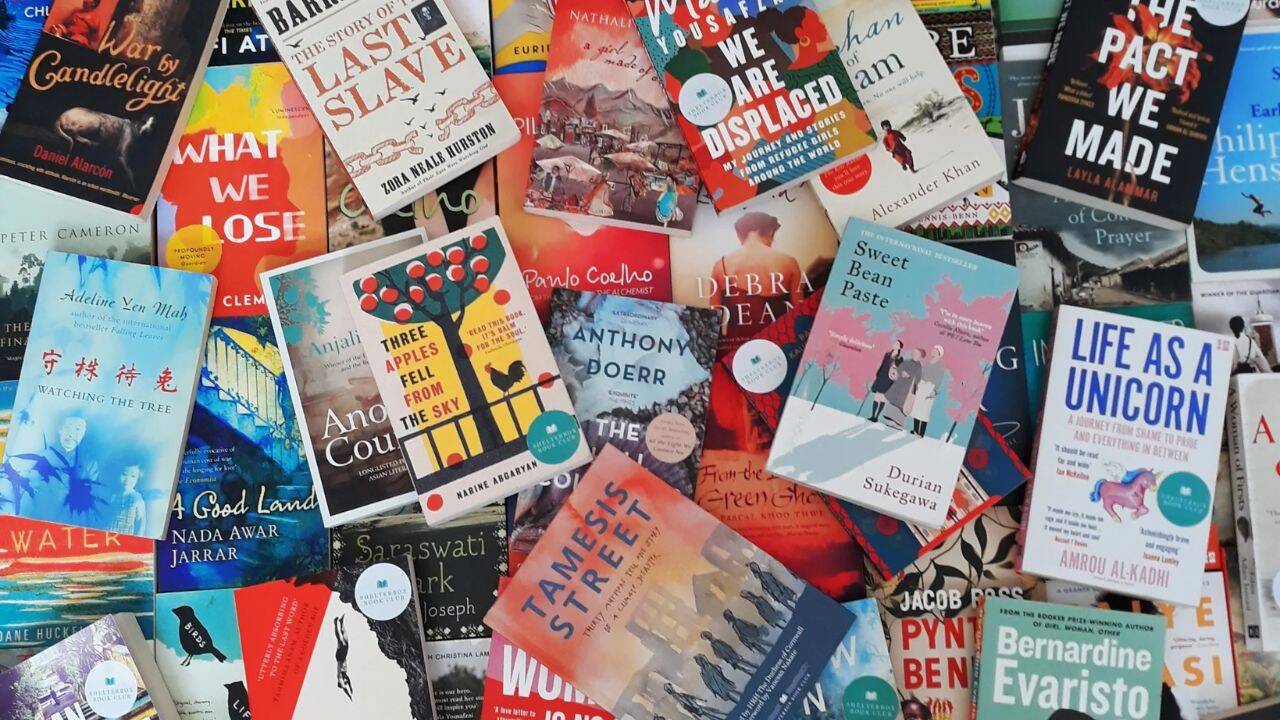
Paper bends. That is the first thing you notice when a house comes down.
Not concrete. Concrete shatters, pulverizes, turns into gray dust that coats your teeth and stays in the creases of your knuckles for weeks. Timber snaps with a sound like a rifle shot. Glass sings a high, terrible note before it hits the floor. Paper simply curls at the edges, absorbs the damp, and holds onto ink with a stubbornness that feels almost cruel when everything else is gone.
I know that smell. Damp plaster, diesel from a generator running three streets over, wet wool, and the faint, metallic tang of crushed masonry. Years ago, standing beside a collapsed cinderblock wall after a flash flood had chewed through a hillside neighborhood, I watched a neighbor pull a sodden paperback from the mud. The cover was gone. Half the pages were welded together into a gray brick. Still, he held it by one corner, thumbing the swollen sheets as if trying to coax a familiar voice out of the sludge.
A book cannot stop rain. A novel will not hold up a roof when wind tears the shingles off a ridge at ninety miles an hour.
So how did a reading circle—a slow, quiet, unhurried habit of turning pages and talking about what those pages meant—end up raising £2 million for disaster-hit families through ShelterBox?
At first glance, the pairing sounds absurd. A book club is an exercise in stillness. You sit in an armchair, or lean against a kitchen counter with a mug cooling beside your elbow, or gather once a month in a back room where a kettle clicks on and off. Emergency shelter is the opposite of stillness. It is frantic logistics, customs manifests, tarpaulins stretched tight against monsoon gusts, solar lanterns charged at dusk, water filters pressed into trembling hands before cholera sets in.
Why on earth would people curled up with stories care enough—and stay consistent enough—to push a fundraising effort past the two-million-pound mark?
Let us be honest about our own habits. Most of us have felt that brief, sharp pang of guilt when a breaking news alert flashes across a screen. An earthquake levels a valley. Floodwaters swallow a town. A conflict pushes thousands across a border before dawn. For ten minutes, maybe twenty, we refresh the feed. We donate once if a link sits right there, or we tell ourselves we will later, and then the phone buzzes with a calendar reminder, a grocery list, an email asking about a spreadsheet. Compassion fatigue is not a moral failure; it is what happens when human nervous systems are asked to carry the weight of the entire planet without a rhythm to sustain it.
A reading circle works on a completely different clock.
Why Slow Attention Outlasts Breaking News
Consider what happens when a group of people agrees to read the same book over four weeks. There is no siren. There is no countdown timer ticking down to midnight. Instead, there is a small, recurring covenant: I will show up on Tuesday, and I will have finished Chapter Six.
Let us step into a hypothetical scenario to see how that quiet ritual shifts from page to page to real-world rescue. Picture Clara, a school librarian in Bristol, and Tariq, a structural engineer who commutes by train from Bath. Neither of them knows the other when they join a local reading group tied to ShelterBox. In week one, they talk about a fictional family living near a fault line—how a crack in a garden wall looks harmless in May and terrifying in October. In week two, someone brings up what real displacement feels like when the walls are gone: not just the lack of a bed, but the loss of privacy, of a door you can latch behind you when your children finally fall asleep.
In a hypothetical group like Clara and Tariq's, money does not arrive as a single dramatic gesture born out of panic. It trickles in month by month. Someone skips a restaurant lunch and drops fifteen pounds into the pot. A book swap raises forty more. A local cafe hosts an evening reading and passes a tin around the tables. None of those sums looks heroic on its own. Stacked end to end across hundreds of readers, across months and years of turning pages, they become something immovable.
Two million pounds.
Think about what that figure represents in practical terms. Disaster response is expensive because emergencies rarely happen in neat, well-paved places. When a storm hits a remote coastline or an earthquake fractures mountain roads, getting heavy-duty tents, thermal blankets, cooking sets, and water purification gear to families who have lost everything requires stockpiles positioned in advance, rapid deployment teams, and tireless coordination on the ground. Every pound raised through steady community giving buys time—and in the first seventy-two hours after a catastrophe, time is the scarcest currency in existence.
Here is the part that surprises people who think charity is purely transactional: reading changes how you imagine another person's floor.
When we read deeply, we practice empathy like a muscle. A story forces us to stay inside someone else's skin longer than a thirty-second news clip ever allows. You learn how a character holds their breath when thunder rolls overhead. You notice what they reach for when they have ten seconds to grab something before running outside. That imaginative stretch does not stay locked between hard covers. It leaks into how you read the real world.
The Architecture of a Roof When Everything Else Breaks
I have never been a ShelterBox deployment responder, and I will not pretend to know every calculation that goes into packing an emergency shelter kit. What I do know—from watching families try to rebuild routines after sudden loss—is that shelter is never just canvas and poles.
Shelter is a boundary.
When a home collapses, the outside world rushes straight into your private life. Strangers see where you sleep. Weather decides when you eat. Children lose the small, predictable geography of their own corners—the spot by the window where light hits in the morning, the wall where a drawing hung, the quiet pocket where fear can settle down.
A well-made emergency tent and its accompanying essentials restore a fraction of that boundary. They give a mother a dry place to nurse a baby. They give an older brother a table to set a lamp on. They turn a muddy field or a ruined courtyard back into a place where a family can whisper at night without the wind carrying every word away.
There is an old behavioral pattern worth noticing here, too. Humans rarely act on abstract statistics. Tell someone that millions of people are displaced globally and their shoulders drop; the number is too vast for the mind to grip. Tell someone about one family waiting out rain under a ripped sheet of plastic, and suddenly the distance collapses.
Book clubs thrive on that exact scale. A single story has a center of gravity. One character, one household, one storm. When readers gather to talk about what they just read, they are already practicing the exact skill humanitarian relief demands: paying close attention to what happens to ordinary people when extraordinary force strikes.
Wait—let us pause and ask a fair, skeptical question. Could a book club fundraising drive ever replace government aid, large institutional grants, or large-scale reconstruction?
No. Of course not. Anyone who claims a community reading group can fix global housing shortages or rebuild entire cities on its own is selling a fairy tale. Rebuilding permanent homes, restoring power grids, and repairing hospital wings takes massive public investment and years of engineering.
The mistake is treating small, consistent community action as though it has no weight because it cannot solve everything at once. A single drop of water does not put out a forest fire. A million drops carried in buckets by people who refuse to walk away might keep the fire from reaching the next ridge.
What Turns Pages Into Pounds
Why did ShelterBox's book club model strike such a deep chord? Look closely at the mechanics of how people live today.
Many of us feel strangely isolated even when our phones glow all evening. We scroll past thousands of strangers' lives without ever speaking a real sentence to the person sitting three feet away on the bus. A book club reverses that pattern. You show up. You listen. You disagree gently about whether a character made a foolish choice. You share tea or biscuits or quiet company.
When an organization invites that kind of gathering to support emergency shelter, it is tapping into a truth that modern life keeps forgetting: generosity sticks best when it belongs to a community rhythm.
Think of it like tending a garden in a windy county—a metaphor for how slow, repeated care builds something hardy enough to weather sudden storms. You do not plant seeds during a gale and expect a harvest by morning. You turn the soil in mild weather, water when the ground dries out, mend the fence before winter arrives. When the big blow comes, the roots are already deep.
In real life, as in our hypothetical Bristol and Bath circle, the people giving through a book club are rarely billionaires writing headline-grabbing checks. They are teachers, nurses, retired mechanics, students splitting a copy of a paperback, parents sneaking in ten pages after bedtime. Their generosity is ordinary, repeatable, and remarkably hard to extinguish once it becomes part of who they think they are.
And when you multiply ordinary generosity by thousands of readers over time, two million pounds stops looking like a miracle. It starts looking like the natural result of people who care enough to keep turning the page—and keep showing up for neighbors they may never meet.
The rain will fall again somewhere tonight. Somewhere, a siren will sound or the earth will shift or a river will rise past its banks before dawn.
In a quiet room miles away, a lamp will click on, a group of friends will open a book to page one hundred and twelve, and another brick of help will be laid in the dark.