Humidity in Mumbai does not merely touch the skin. It wraps around your collarbone like a warm, damp wool blanket and refuses to let go.
If you have ever stood on an elevated platform along the Mumbai Metro Line 1 during the late afternoon rush, you know the specific sensory overload of that space. There is the metallic screech of arriving brakes. There is the low, vibrating hum of ten million lives moving simultaneously across a narrow peninsula. And there is the heat—a thick, persistent pressure that turns crisp cotton into crumpled paper within twenty minutes. You might also find this similar article useful: What Happens When the Noise Stops Behind Bars.
Now, picture stepping into that exact sensory furnace when your every blink is being recorded by forty telephoto lenses, when your posture is scrutinized by constitutional historians three thousand miles away, and when a single bead of sweat on your forehead becomes an international news cycle.
That was the invisible crucible waiting for Catherine, the Princess of Wales, when she stepped onto the Mumbai Metro alongside Prince William. As extensively documented in recent coverage by Associated Press, the implications are worth noting.
Most coverage of that afternoon reduces the moment to a predictable celebrity fashion blotter. Journalists noted the vibrant blue hue of her dress. They admired the tailoring. They remarked that she "stole the spotlight" while riding public transit with her husband. On the surface, it looks like another glossy entry in the endless catalog of royal style—a pretty outfit worn in a photogenic place.
Look closer, though. When you strip away the superficial chatter of best-dressed lists, something far more calculated, human, and quietly brilliant emerges. That vibrant blue dress was not merely a wardrobe choice. It was a masterclass in visual diplomacy, physical endurance, and the unspoken language of modern monarchy.
The Architecture of Visibility
To understand why a single garment mattered so much in a Mumbai train carriage, we have to talk about the strange physics of public attention.
Consider a hypothetical commuter—let us call her Priya—standing near the sliding doors of that same metro car. Priya works in a mid-level accounting firm in Andheri. She rides this line five days a week. To Priya, the metro is neither exotic nor ceremonial; it is simply the concrete artery that gets her home before dark. When word ripples down the platform that British royals are boarding the train, Priya’s first instinct isn't breathless awe. It is curiosity mixed with healthy skepticism. What does a future Queen of England actually look like when she isn't framed by gilded palace gates or manicured Berkshire lawns?
In a crowded space filled with dark suits, security personnel in muted blazers, and the visual static of bustling commuters, a royal figure faces an immediate optical problem. Blend in too much, and the public cannot find you; the historic visit dissolves into a blurry cluster of elbows and shoulders. Dress too ostentatiously, and you create an instant wall of alienation, reminding everyone in the carriage that you belong to an untouchable stratosphere of inherited wealth.
Catherine solved that equation before she even stepped out of the motorcade.
Think of a lighthouse beam cutting through coastal fog. The beam does not shout, yet every ship on the water knows instantly where the shoreline lies. That vibrant, saturated cobalt-blue silhouette functioned in the exact same way inside the fluorescent-lit interior of the Mumbai Metro.
Color psychology in diplomacy is rarely accidental, and royal stylists operate less like fashion editors and more like set designers for live theater. Blue, across both British and Indian visual traditions, carries heavy symbolic freight. In Britain, it whispers stability, continuity, and calm authority. In India, deep blues echo everything from the traditional indigo dye trades that shaped centuries of global commerce to sacred iconography associated with protection and resilience.
By choosing a shade of blue so vivid it practically hummed against the brushed steel of the train poles, Catherine ensured that Priya—and every commuter crane-necking from the adjacent carriage—could see her clearly without her ever having to raise her voice or wave frantically for attention. She gave the crowd what they came for: an unmistakable focal point.
Sweat, Silk, and the Myth of Effortlessness
I still remember the first time I tried to navigate a formal diplomatic reception in South Asia wearing a structured Western blazer. Within fifteen minutes, the lining felt like plastic wrap. By the half-hour mark, I was acutely aware of every crease forming across my elbows, terrified to lift my arms lest the fabric pull awkwardly across my shoulders. You stop listening to the people speaking to you because half your brain is trapped in a losing battle with your own clothing.
Now multiply that discomfort by a factor of a hundred.
Public figures—especially women in the British royal family—are expected to perform an exhausting biological illusion. They must appear immune to gravity, fatigue, jet lag, and ambient temperature. When Prince William and Catherine boarded that Mumbai Metro train, they were navigating a tightly choreographed itinerary designed to highlight urban infrastructure, sustainability, and modern India's rapid transit ambitions.
Behind the poised photographs lies a grueling physical reality.
Let us be honest about something most fashion commentary politely ignores: looking serene in ninety-degree heat while standing upright on a moving train is deeply uncomfortable. Trains lurch. Handrails are warm from hundreds of previous hands. Photographers press backward into tight spaces, flashes popping inches from your eyes while you try to hold a genuine, unhurried conversation with local transit officials.
Look at the mechanics of the outfit she wore that day. The cut had to allow enough airflow to prevent visible perspiration while maintaining crisp, architectural lines that wouldn't collapse into wrinkles the moment she sat down or reached for a handrail. The hem length had to be calibrated to the millimeter—long enough to preserve royal modesty when stepping across the gap between platform and train, short enough not to catch on a heel or brush against a dusty floor. Even the choice of footwear on a moving metro car carries high stakes; a single stumble on a grooved metal floor becomes a viral GIF within ninety seconds.
When observers say she "stole the spotlight," what they are actually reacting to is the absence of visible strain. We are wired as human beings to notice friction. When someone looks hot, hurried, or physically restricted, we feel secondhand anxiety. When someone moves through a chaotic, humid environment looking as cool and unhurried as morning water, our nervous systems relax. She made an intensely unnatural situation—a royal tour inside a commuter train—feel effortless.
The Delicate Tightrope of Royal Transit
Why put a prince and princess on a metro train in the first place?
To answer that, you have to look at the shifting survival strategy of the modern British monarchy. For centuries, royal power relied on distance. Kings and queens traveled in gilded carriages pulled by matched horses, elevated physically above the mud and the crowd. Mystery bred reverence.
That formula collapsed in the late twentieth century. In an era of relentless scrutiny and egalitarian expectations, pure distance breeds resentment. Yet total informality destroys the very mystique that justifies a monarchy's existence. If royals act entirely like ordinary citizens, taxpayers inevitably ask why they fund palaces.
The Mumbai Metro ride was a textbook exercise in walking that razor-thin line.
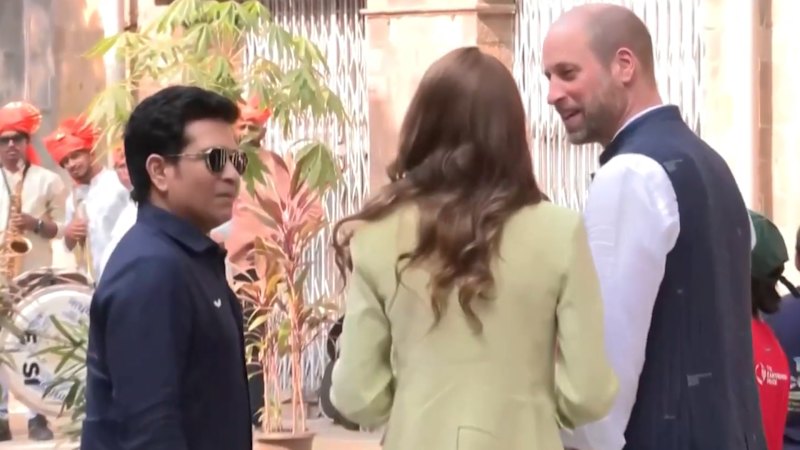
Step onto the platform with Prince William and Catherine, and watch the choreography unfold. William, dressed in sharp, understated tailoring, represents the institutional backbone—the quiet observer asking technical questions about ridership numbers, commuter safety, and urban expansion. Catherine, beside him in that electric burst of blue, serves as the emotional bridge.
Watch how people react in the candid frames captured during that journey. Notice the posture of the transit workers and young commuters standing a few feet away. Nobody is bowing low in feudal terror, yet nobody is treating them like casual acquaintances either. There is a palpable warmth in the carriage—a mixture of civic pride that their city's modern infrastructure is worthy of international attention, and genuine delight at seeing an iconic global figure treat their everyday commute with respect.
This is where historical memory quietly enters the frame. Whenever members of the British royal family visit India, the ghost of empire sits in the corner of every room. Even decades after independence, every gesture is weighed against a complex, often painful shared past. A condescending glance or an overly imperial display of pomp can trigger immediate backlash in the Indian press. Conversely, treating the visit too casually can be read as indifference.
Riding the Mumbai Metro—a sleek, modern symbol of India's economic self-reliance and engineering ambition—flipped the old colonial script on its head. The royals were not arriving as rulers inspecting a territory; they were guests admiring a thriving, twenty-first-century metropolis on its own terms. And Catherine’s vibrant blue dress honored the occasion with the kind of deliberate, formal polish that says: We took this seriously. We dressed up for you.
What the Camera Missed
We live in a culture trained to consume images in half-second increments. You scroll past a thumbnail of Princess Kate on a train, register the striking color, admire her smile, and move on to the next headline.
Yet if you freeze the frame and study the margins of those photographs, you begin to see the real story.
Look at the hands. Not just hers, resting lightly against a vertical grab pole or gesturing mid-sentence, but the hands of the people around her. You see commuters clutching smartphones, desperate to capture a clean angle without stepping past the invisible perimeter maintained by protection officers. You see a transit official leaning forward, animatedly explaining a route map, completely absorbed in his work because his listener is giving him unbroken eye contact.
Eye contact on a moving train is harder than it sounds. Your peripheral vision is constantly assaulted by passing concrete pillars, flashing station signs, and shifting shadows. To lock onto one person's face amid that visual noise requires deliberate mental discipline.
Think back to our hypothetical commuter, Priya, watching from three rows away. What does Priya actually take away from those four minutes between stations? She probably won't remember the exact designer label sewn into the collar of that blue dress. She might not even recall the official diplomatic talking points released by Kensington Palace later that evening.
She will remember the color. She will remember how the bright blue cut through the gray afternoon haze like a sudden break in monsoon clouds. And she will remember the feeling that, for one brief stretch of track above the roaring streets of Mumbai, the widest ocean in the world seemed to shrink to the width of a train aisle.
The Heavy Crown of Modern Spectacle
It is easy to feel a twinge of cynicism about royal fashion coverage. Part of me always hesitates when serious geopolitical tours get distilled down to hemlines and color palettes. Does a dress really change diplomatic policy? No. Does a vibrant shade of cobalt solve urban congestion or rewrite trade agreements? Of course not.
Yet pretending that aesthetics don't matter in public life is a naive denial of human nature. We are visual creatures first and analytical creatures second. Before we read a single word of a speech or evaluate a single policy initiative, our brains make a thousand instantaneous judgments based on posture, color, expression, and presence.
Catherine understands something that many seasoned politicians still struggle to grasp: in a noisy, distracted world, silence paired with visual clarity speaks louder than a microphone. She rarely gives sweeping, headline-grabbing interviews. She does not trade in dramatic public pronouncements. Instead, she communicates through consistency, physical poise, and an uncanny instinct for what a room—or a train carriage—needs in order to feel seen.
That afternoon in Mumbai, the heat remained relentless. The metro doors slid shut with a pneumatic hiss, the train accelerated smoothly out of the station, and within minutes the royal party stepped back out into the blinding glare of the city. The press pack surged forward. The motorcade doors clicked locked. The news cycle churned onward, hungry for the next frame.
Somewhere along Line 1, though, long after the cameras had packed their lenses and the security detail had cleared the platform, the late afternoon commuters kept riding home through the humid dusk—carrying with them the lingering afterimage of a single, unmistakable flash of blue against steel.