Two hundred and eighteen.
In the architecture of American power, that number is not merely a statistic; it is the exact threshold where ambition either becomes law or dies in committee. Walking through the marble corridors of the Rayburn House Office Building on a humid Washington morning, you can almost hear the silent arithmetic ticking behind every closed mahogany door. The air smells faintly of floor wax, stale coffee, and the low-grade anxiety that defines modern congressional life. For anyone who has ever watched a piece of legislation stall out—not because it lacked merit, but because the partisan temperature in the room rose ten degrees too high—the mechanics of the United States House of Representatives feel less like a deliberative body and more like a high-wire act performed without a net.
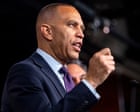
When House Minority Leader Hakeem Jeffries publicly signaled his willingness to cross the political aisle to advance the Democratic agenda, the reaction across political media was predictable. Pundits treated it like a chess move. Cable news chyrons flashed words like "pivot" and "bipartisanship," reducing a deeply fraught human calculus into a sterile headline. Yet, behind the press releases and the carefully calibrated remarks at the podium lies a far more complicated reality—one that stretches from the cloakrooms of the Capitol directly to the kitchen tables of people who never watch C-SPAN.
To understand what it actually means for a party leader to reach across the aisle in an era of razor-thin majorities, you have to step away from the punditry and look at the invisible stakes.
The Anatomy of a Stalemate
Consider a hypothetical scenario that plays out in quiet variations across hundreds of districts every week. Picture Elena, a small-business owner in a mid-sized Rust Belt town, staring at an invoice for commercial health insurance that has jumped twenty-two percent in a single calendar year. Three hundred miles away, in a rural county in the South, picture Marcus, a retired county road worker trying to figure out whether a delayed federal infrastructure grant means the bridge two miles from his house will remain closed through another winter.
Elena and Marcus do not care about procedural posturing. They do not care which caucus won the afternoon news cycle on social media. They care about whether the machinery of government is capable of producing a tangible result before their personal margins run out.
This is the exact friction point where Hakeem Jeffries operates. Having succeeded Nancy Pelosi as the top House Democrat—making history as the first Black lawmaker to lead a major party in either chamber of Congress—Jeffries inherited a caucus operating in the minority, yet wielding an unusual degree of leverage. In a House divided by margins so narrow that a handful of absences or a localized rebellion can upend the floor schedule, the minority party is no longer a passive spectator. It becomes a necessary counterweight.
When Jeffries states, as he has repeatedly in press briefings and interviews, that Democrats are prepared to find common ground with Republicans whenever possible while pushing back against extremism whenever necessary, he is describing a tightrope walk. Think of legislative negotiation in a divided Congress not as a grand philosophical debate, but as an aging municipal water system. When the main valves are rusted shut by ideological rigidity, pressure builds in the pipes until something bursts—a government shutdown, a defaulted debt ceiling, an expired farm bill. Crossing the aisle is the act of finding a bypass valve. It is unglamorous, high-risk plumbing.
The Precedent of Unlikely Coalitions
History offers plenty of warnings—and a few blueprints—for what happens when a minority leader decides to deal with the opposition. In the mid-1990s, following the Republican sweep that ended four decades of Democratic House control, House Minority Leader Dick Gephardt faced a similar strategic dilemma. How do you protect your party’s core priorities—protecting Medicare, defending labor standards, preserving environmental regulations—when you do not control the gavel?
Gephardt and the Clinton White House learned, often painfully, that pure obstruction carries a political expiration date. Voters eventually tire of paralysis. At the same time, capitulation fractures your own base. The sweet spot, narrow as a razor’s edge, lies in selective, issue-by-issue alignment.
We saw modern echoes of this dynamic during the 118th Congress. When internal divisions within the Republican conference threatened to stall essential governance—most notably during the 2023 debt ceiling standoff and subsequent short-term government funding battles—it was Democratic votes, marshaled by Jeffries and his leadership team, that ultimately provided the margin of passage to keep the federal government open and prevent a sovereign default.
According to public statements from Jeffries’ office and reporting from congressional outlets like The Hill and Politico, that posture was never framed as ideological surrender. Instead, Jeffries characterized it as "putting people over politics." By supplying the votes needed to pass clean continuing resolutions and bipartisan appropriations bills, House Democrats extracted key concessions: preserving funding levels for domestic nutrition programs, protecting clean energy investments enacted under the Inflation Reduction Act, and blocking conservative policy riders that would have restricted reproductive healthcare or rolled back regulatory protections.
Yet every time those votes were cast, a quiet tension rippled through the Democratic caucus.
The Price of the Handshake
If you have ever stood in a crowded room and tried to negotiate a compromise between two people who fundamentally distrust each other, you know the physical sensation of that stress. Your shoulders tighten. You weigh every adjective twice before speaking. You know that giving an inch to the person across from you means explaining to the people behind you why you didn't hold the line.
That vulnerability is the unspoken cost of bipartisanship. For progressive members of the House Democratic Caucus, reaching across the aisle can look perilously close to legitimizing an opposition whose core platform they view as harmful to their constituents. For frontline Democrats—those representing swing districts won by a percentage point or two—bipartisan cooperation is not an abstract ideal; it is political oxygen. Without tangible, cross-party accomplishments to point to back home, their seats are the first to vanish in November.
Jeffries’ challenge is holding both wings together while extending a hand to Republican counterparts. It requires a specific kind of political temperament—one that favors discipline over theatrics. Observers on Capitol Hill frequently note Jeffries’ methodical, almost courtroom-like cadence, a holdover from his years as a corporate litigator in New York before entering the State Assembly and, later, Congress. He rarely improvises in front of cameras. Every phrase—including his recurring mantra that Democrats will "work with anyone, anytime, anyplace" to lower costs and grow the middle class—is engineered to create maximum room to maneuver.
But what does "working across the aisle" actually look like behind closed doors? It rarely resembles the cinematic image of two ideological rivals clinking glasses over bourbon. More often, it looks like staff directors trading red-lined PDFs at eleven o'clock at night. It looks like trading a provision on rural broadband expansion for a concession on veterans' healthcare access. It looks like agreeing to strip out a controversial amendment so that a bipartisan reauthorization of the Federal Aviation Administration can reach the president’s desk before air traffic control modernization stalls.
What Voters Actually Want From Compromise
People often wonder whether genuine bipartisanship is even possible anymore, or if the phrase itself has become little more than a campaign slogan. The confusion is understandable. When you turn on the television and see congressional hearings devolve into viral shouting matches, the idea that these same lawmakers are quietly co-sponsoring bills on semiconductor manufacturing, opioid treatment, or small-business tax relief feels almost implausible.
The truth is slightly more nuanced—and far more human. Congress operates on two distinct tracks simultaneously. Track one is the performative arena: committee hearings designed for cable clips, floor speeches aimed at fundraising emails, and social media battles engineered to maximize outrage. Track two is the legislative machinery: appropriations subcommittees, conference committees, and quiet bilateral meetings where members who publicly attack one another sit down to divide up federal grants for their home states.
When Hakeem Jeffries signals an openness to cross-party collaboration, he is essentially trying to pull legislative energy out of track one and back into track two.
Consider the practical stakes of specific Democratic priorities that require Republican buy-in to survive a divided government:
- Cost-of-living and housing affordability: Expanding the Low-Income Housing Tax Credit or passing bipartisan tax packages that enhance the Child Tax Credit cannot happen on party-line votes in a split Congress. Reaching across the aisle is the only mathematical path to getting money into the pockets of working families before the next election cycle.
- Infrastructure and domestic manufacturing: Implementing the long-term goals of the Bipartisan Infrastructure Law and the CHIPS and Science Act requires ongoing appropriations and permitting adjustments. Districts in red states and blue states alike are competing for battery plants, microchip facilities, and bridge repairs. That shared economic self-interest creates a natural, if fragile, bridge between parties.
- National security and foreign aid: Supplemental funding packages for global allies and border security have repeatedly demonstrated that neither party can govern entirely alone when crisis hits. Passing major national security legislation in the House has consistently required a coalition of mainstream Republicans and Democrats willing to absorb criticism from their respective flanks.
Still, there is an honest uncertainty at the heart of this strategy. Cooperation requires a willing partner. A hand extended across the aisle only works if someone on the other side is willing—and politically able—to shake it without losing their own gavel. In an environment where primary voters often punish lawmakers for compromising with the other party, the political incentives frequently reward the arsonist over the builder.
The Long Shadow of the Gavel
Late in the evening on Capitol Hill, after the tourists have cleared out of the Rotunda and the press gallery has thinned to a handful of tired reporters waiting for a final procedural vote, the building grows remarkably quiet. Footsteps echo differently when the cameras are turned off.
In those moments, the grand ideological battles of the day shrink back down to human scale. You see a member from Brooklyn and a member from rural Ohio standing near the elevator bank, talking not about cable news talking points, but about a shared constituent issue—a delayed passport, a veterans' clinic backlog, a local factory facing supply chain bottlenecks.
That quiet space between ideological certainty and practical necessity is where Hakeem Jeffries is placing his bet. It is a gamble rooted in the belief that voters are exhausted by perpetual gridlock, and that delivering incremental, imperfect progress on the Democratic agenda—even with Republican fingerprints on the final bill—is infinitely better than presiding over a graveyard of noble, unpassed resolutions.
Whether that gamble pays off will not be decided in the press rooms of Washington, nor in the instant analyses of political commentators. It will be decided slowly, quietly, in the arithmetic of a family budget in Ohio, on a repaired bridge in the South, and in the simple, stubborn question every citizen eventually asks of the people they send to govern them: Did you actually get anything done?



