The battery in your pocket is dying.
Look at the little green icon in the top right corner of your screen. It is draining, pixel by pixel, as you read this sentence. You probably think of that battery as a magical, sealed black rectangle—a clean piece of modern engineering that gets charged by plugging a white cable into a wall. You rarely think about the red dust of Western Australia, the freezing brine flats of the Chilean Andes, or the acid-leaching vats in southern China that made that tiny green icon possible.
You should. Because right now, the invisible plumbing that keeps your phone glowing, your car moving, and your country's power grid humming is dangerously close to snapping.
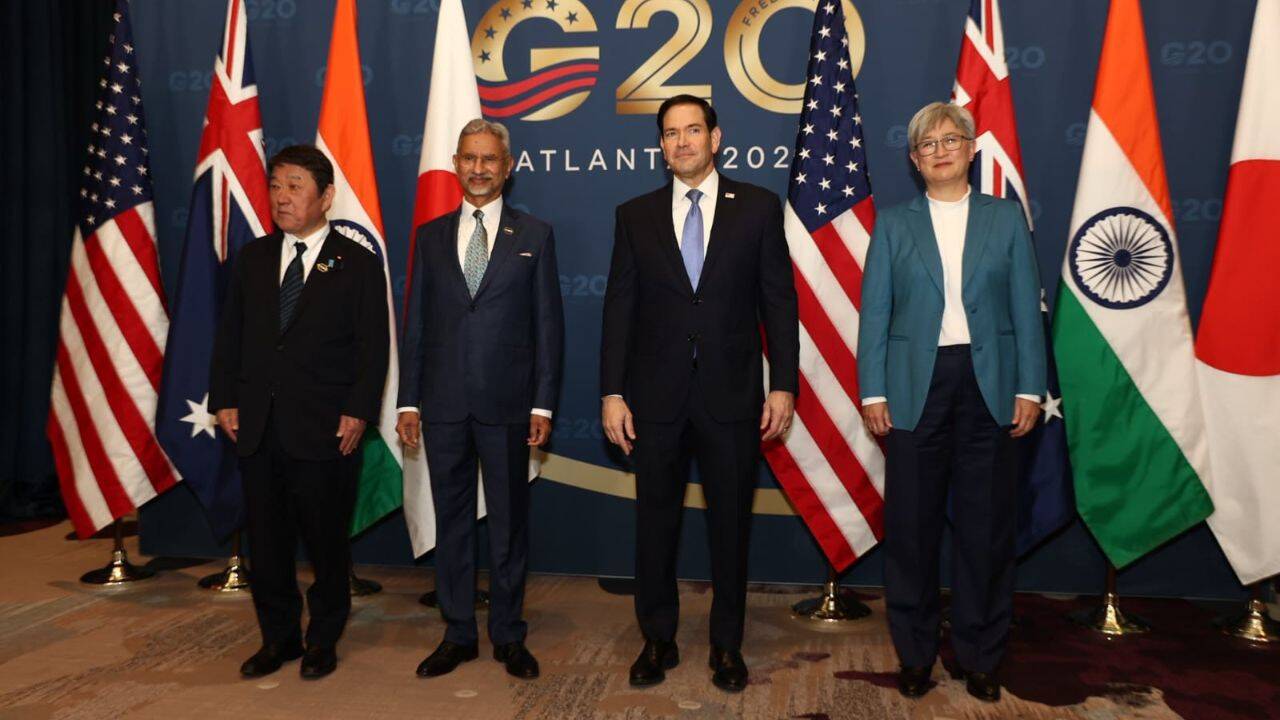
That is the real reason four of the world’s most powerful diplomats quietly stepped off planes in Atlanta, Georgia, away from the predictable marble corridors of Washington or New York. On the surface, the gathering of the Quadrilateral Security Dialogue—the Quad, an informal strategic partnership linking the United States, India, Australia, and Japan—looked like another dry, routine diplomatic summit. Press releases mentioned "strategic alignment." Communiqués nodded politely toward "Indo-Pacific stability."
If you skimmed the headlines, you missed the quiet panic humming beneath the floorboards of the conference room.
Indian External Affairs Minister S. Jaishankar did not fly halfway across the globe to trade polite pleasantries over lukewarm coffee. He arrived in Atlanta with a blunt, almost impatient demand: stop talking, start building. The era of endless working groups and beautifully worded joint statements is dead. In its place, the four nations just unveiled an aggressive, coordinated push into two things that will dictate who runs the twenty-first century—critical minerals and artificial intelligence.
To understand why a diplomat from New Delhi was pushing his counterparts in Atlanta for immediate, tangible action, we have to step out of the boardroom and walk onto a factory floor.
The Factory That Almost Went Dark
Consider a hypothetical scenario, grounded in the exact supply chain vulnerabilities keeping defense planners awake at night. Imagine a mid-sized precision manufacturing plant—let’s call it Apex Magnetics—sitting on the outskirts of Pune, India, or perhaps outside Nagoya, Japan.
Apex makes high-efficiency electric motors. Not the kind that spin a cheap desk fan, but the ultra-dense, heat-resistant motors required for next-generation electric vehicles, wind turbines, and naval radar systems. Every single one of those motors relies on a tiny, silver-gray magnet made from neodymium and dysprosium—two obscure elements buried near the bottom of the periodic table, grouped under the deceptively gentle name of "rare earths."
For years, the floor manager at Apex didn't care where those magnets came from. They arrived in neat, shrink-wrapped pallets from a broker in Shenzhen, cheap and on time. The world had optimized itself for efficiency, not survival. Why dig dirty, toxic holes in your own backyard when someone else was willing to do it for pennies on the dollar?
Then, one Tuesday morning, the shipments stop.
There is no war. No missiles are fired. Just a quiet administrative notice issued by a ministry in Beijing citing "export controls for national security." Suddenly, the global supply of processed dysprosium drops by ninety percent overnight.
Within three weeks, the assembly lines at Apex Magnetics grind to a halt. Workers are sent home. Within six weeks, a wind farm project in Texas stalls because the turbines lack generators. Within two months, a shipyard in Yokosuka delays the launch of a patrol vessel. The entire modern economy, it turns out, rests on an inverted pyramid—and one single nation holds the tip.
This is not a fever dream. It is a historical pattern we have already lived through. In 2010, following a maritime dispute over a handful of uninhabited islands, China abruptly halted rare earth exports to Japan. Tokyo’s high-tech manufacturing sector nearly choked to death before it could scramble for alternatives. More recently, export restrictions on gallium, germanium, and graphite—the lifeblood of semiconductors and EV batteries—sent shockwaves through corporate boardrooms from Seoul to Silicon Valley.
I remember the first time I held a raw chunk of spodumene—the lithium-bearing rock pulled from the earth in Western Australia—during a reporting trip years ago. It looked utterly unremarkable. Heavy, dull, flecked with pale gray crystals like cheap granite countertop. Yet the mining engineer standing beside me held it like a live grenade. "We pull this out of the dirt," he told me, shouting over the roar of the crushers, "put it on a boat, and send it north to be refined. If they ever close the port gates, this rock is just a paperweight to us."
That is the trap. Even when democracies own the mines, they rarely own the refineries. Australia has vast reserves of lithium and rare earths. The United States has the Mountain Pass mine in California. India sits on massive deposits of monazite sands along its southern coastlines, rich in thorium and rare earth elements. Yet, for decades, nearly eighty to ninety percent of the chemical processing—the messy, expensive, environmentally brutal work of turning raw rock into battery-grade lithium or magnet-grade neodymium—has been concentrated inside a single country.
Jaishankar’s Impatience in Atlanta
When Jaishankar sat down with his American, Australian, and Japanese counterparts in Atlanta, that exact vulnerability was sitting in the empty chair at the table.
For years, critics dismissed the Quad as a "talk shop"—a loose grouping of four democracies that shared anxieties about Beijing’s growing assertiveness in the Indo-Pacific, yet struggled to turn shared anxiety into concrete muscle. India, fiercely protective of its strategic autonomy, was often the most cautious member of the quartet, wary of being dragged into formal military alliances.
Not anymore.
The mood in Atlanta marked a sharp, unmistakable pivot. Jaishankar’s insistence on an "action-oriented agenda" wasn't just diplomatic phrasing; it was an admission that time has run out. India is attempting one of the most ambitious industrial transformations in human history, trying to lift hundreds of millions of people into the middle class while simultaneously decarbonizing its energy grid and building a domestic tech manufacturing base. You cannot build a green, digital India if your access to solar wafers, lithium cells, and semiconductor substrates depends on the geopolitical goodwill of a rival neighbor.
Think of the Quad’s new critical minerals initiative like four neighbors realizing they all rely on a single, erratic landlord for their water supply. Instead of writing another strongly worded letter to the landlord, they finally decided to pool their money, buy a drilling rig, and dig their own well.
Under the framework pushed forward in Atlanta, the four nations are moving to knit together an end-to-end supply chain that bypasses single-point choke holds. It works like a relay race where each runner plays to their natural strength:
- Australia brings the raw geological wealth and world-class mining engineering, pulling lithium, cobalt, and rare earths out of ancient continental crust.
- India offers massive scale, industrial labor, and increasingly sophisticated chemical processing and manufacturing capacity—turning raw inputs into refined components at competitive costs.
- Japan provides the unmatched precision metallurgy, battery chemistry patents, and decades of hard-won expertise in recycling critical minerals from old electronics.
- The United States brings the deep capital markets, federal financing mechanisms, and massive consumer demand needed to guarantee that these new, cleaner, slightly more expensive mines don't get driven out of business by artificially cheap state-subsidized dumping.
It sounds straightforward on paper. In reality, it is brutally difficult. Opening a new mineral processing facility in Texas, Gujarat, or Queensland takes years of environmental permitting, billions in upfront capital, and political nerve. It requires convincing Western consumers and shareholders to accept that resilient supply chains cost more than fragile ones.
The Second Front: Who Owns the Mind of the Machine?
Yet, as the diplomats in Atlanta made clear, securing the rocks beneath our feet is only half the battle. The other half lives in the cloud—and it is moving ten times faster.
Alongside the critical minerals push, the Quad unveiled a sweeping new coordination on artificial intelligence. At first glance, pairing dirty rock mining with ethereal neural networks seems like an odd marriage. Look closer, and you realize they are two sides of the exact same coin.
Artificial intelligence is not weightless. Every time you ask a generative model to write an email, diagnose a medical scan, or optimize a shipping route, massive data centers burn staggering amounts of electricity, guzzle millions of gallons of cooling water, and rely on tens of thousands of specialized silicon chips—chips made from those very same critical minerals.
More importantly, AI is rapidly becoming the operating system of modern society. And right now, the world is fracturing into two competing visions of how that operating system should be built.
One model treats AI as an instrument of state surveillance, algorithmic censorship, and social control—a digital panopticon exported cheaply to developing nations under the guise of "smart city" infrastructure. The other model—the one the Quad is scrambling to defend and define—aims to keep AI open, interoperable, accountable, and anchored in democratic norms.
For India, this is deeply personal. Over the past decade, India built something the West largely missed: Digital Public Infrastructure. Through systems like Aadhaar (biometric digital identity) and UPI (instant, zero-fee digital payments), New Delhi brought hundreds of millions of unbanked citizens into the formal economy overnight. A street vendor selling chai in Varanasi now takes digital payments via a QR code pasted to a cardboard box, settling billions of transactions a month with near-zero friction.
Jaishankar and his team arrived in Atlanta knowing that AI is the next layer on top of that digital foundation. Imagine a smallholder farmer in rural Maharashtra pointing a cheap smartphone at a blighted tomato leaf, receiving an instant diagnosis and localized treatment plan in Marathi, spoken aloud by an AI model trained on sovereign, uncorrupted agricultural data. Now imagine that same farmer’s digital identity, health records, and crop loans being processed by opaque algorithms controlled by an adversarial foreign state.
That is the invisible stake behind the Quad’s AI push. By pooling research funding, aligning safety standards, sharing compute infrastructure, and developing open-source AI tools tailored for the Global South, Washington, Tokyo, Canberra, and New Delhi are trying to offer the developing world a third choice. Countries in Southeast Asia, Africa, and Latin America shouldn't have to choose between predatory digital authoritarianism and unaffordable Western tech monopolies.
The Messy Reality of Trust
I have to be honest here: there is nothing guaranteed about this working.
Watching four sprawling democracies try to coordinate industrial and technological policy can feel like watching four brilliant jazz musicians trying to play a symphony without sheet music. Each country has its own domestic politics, its own protectionist reflexes, and its own bureaucratic turf wars.
Washington loves subsidies that favor American factories, often frustrating allies in Tokyo and Canberra. New Delhi fiercely guards its data sovereignty and refuses to sign onto rigid Western regulatory frameworks that might stifle its own booming startup ecosystem. Australia worries about balancing its security alliance with the United States against its massive trade relationship with China, which still buys the lion's share of its iron ore.
There will be delays. There will be missed targets, awkward compromises, and moments when private corporations balk at the cost of decoupling from decades-old supply chains. Anyone who tells you this transition will be smooth is selling you a brochure.
Yet, when you step back from the daily noise of diplomatic communiqués, a profound shift comes into focus. For thirty years after the Cold War, the world operated under a comforting illusion: that trade naturally breeds peace, that supply chains are purely commercial, and that geography no longer matters in a digital age.
Atlanta was the quiet burial of that illusion.
Geography matters. Geology matters. The people who refine the lithium, write the code, and set the standards for the machines that think for us hold the keys to sovereignty in the twenty-first century. The Quad isn't trying to build a wall around the Indo-Pacific, nor is it trying to recreate the rigid military blocs of the twentieth century. It is trying to build redundancy into a world that became dangerously brittle.
Look at Your Phone Again
Pick up your phone one more time. Feel the cool aluminum frame against your fingers. Look at the glass screen, the glowing pixels, the tiny battery icon ticking quietly downward.
Behind that smooth, effortless glass lies a silent, invisible tug-of-war stretching from the red deserts of Australia to the server farms of Virginia, the laboratories of Tokyo, and the bustling tech corridors of Bengaluru. Every swipe, every search, every electric mile driven on a highway depends on whether the quiet agreements hammered out in places like Atlanta actually turn into steel, silicon, and refined ore on the ground.
The diplomats have packed their briefcases and flown home. The press releases have already vanished from the front pages. Now comes the hard part—turning words into mines, mines into magnets, and code into something free people can actually trust.