Rain hits the glass of a forty-second-floor window in Shenzhen differently than it hits the cornfields outside Des Moines. In Shenzhen, the rain streaks past neon towers that did not exist forty years ago, blurring the reflection of container cranes working through the night along the Pearl River Delta. In Iowa, the same storm system—metaphorically speaking, though the global weather of trade connects them both—drummed on the tin roof of a grain bin where bushels of soybeans sat unsold, waiting for a buyer across the Pacific.
Wait.
That image is too easy, isn't it? We love the tidy split-screen of geopolitics. On one side, the gleaming Chinese tech metropolis hosting the Asia-Pacific Economic Cooperation summit; on the other, the American heartland, or a semiconductor cleanroom in Arizona, or a boardroom in Washington where men in dark suits speak of strategic competition
The Quiet Bargain Behind the Shenzhen Summit And Why Your Wallet Depends on It
news, business
The fluorescent lights in a Shenzhen electronics workshop do not flicker. They hum. It is a low, steady vibration that settles into the teeth of anyone standing on the concrete floor past midnight.
Consider a hypothetical factory manager named Lin Wei, thirty-eight years old, staring at two stacks of shipping manifests on a metal desk. One stack represents circuit boards bound for Rotterdam. The other, thicker and stamped with red customs holds, represents components meant for a mid-sized appliance manufacturer in Ohio. For six months, those Ohio boxes have sat in a bonded warehouse near Yantian Port, victims of tariff schedules that shift like coastal sandbars. Halfway across the Pacific, in Toledo, a purchasing director named Sarah Jenkins—another composite of the thousands of real logistics managers currently losing sleep—is staring at the exact same digital tracking numbers, calculating how many assembly line shifts she will have to cut before Thanksgiving if those boards do not clear customs.
This is the invisible geometry of global trade. When diplomats talk about the Asia-Pacific Economic Cooperation summit in Shenzhen, they speak in bloodless abstractions. They talk about bilateral frameworks, strategic competition, and de-risking. They rarely mention the hum of the fluorescent lights or the spreadsheet sitting open on Sarah’s desk in Ohio.
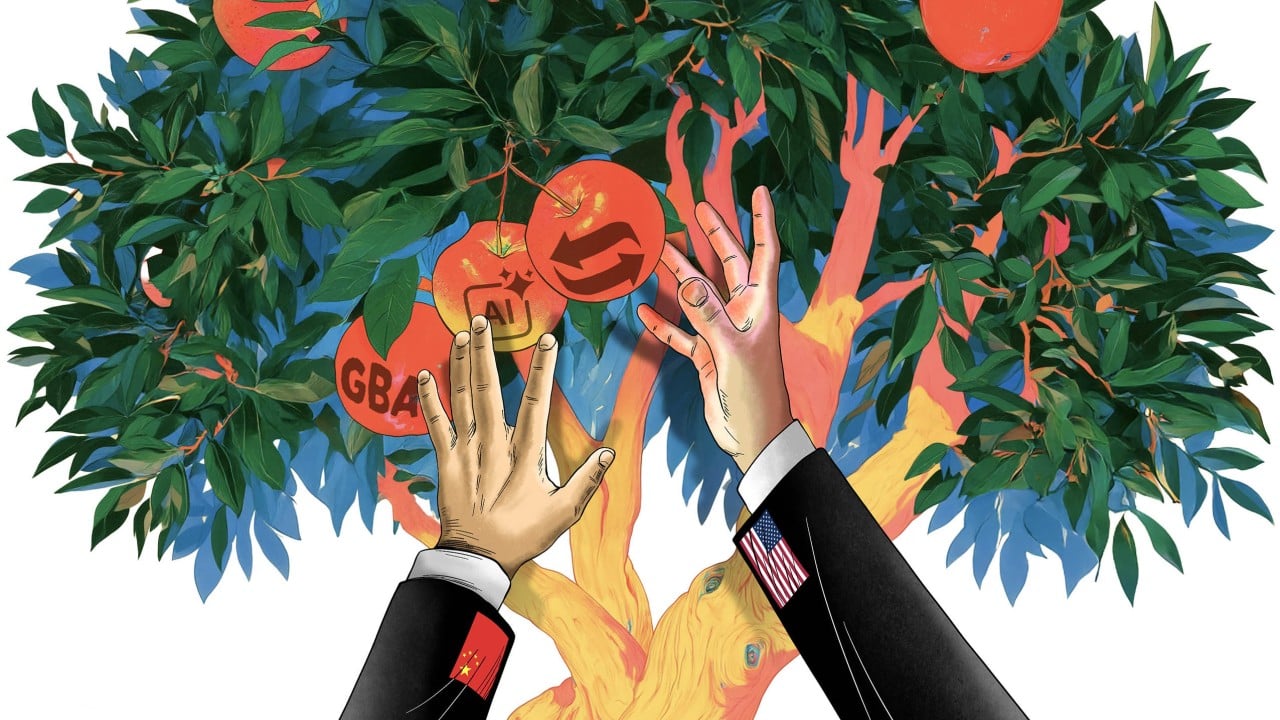
Yet, as Donald Trump and Xi Jinping prepare to sit across from one another in China’s hyper-modern southern boomtown, the real story is not about grand ideological victory. Neither leader can afford an economic cardiac arrest at home. Both men are pragmatists wrapped in nationalist armor, and both are staring at an orchard of easy wins—diplomatic low-hanging fruit—that could immediately lower the temperature between the world’s two largest economies without requiring either side to surrender a single core principle.
The Anatomy of a Diplomatic Thaw
To understand why Shenzhen matters, you have to strip away the theater of superpower rivalry and look at the cold arithmetic of domestic survival.
I remember walking the docks of Long Beach during the height of the first trade war several years ago. The air smelled of diesel and salt, and the cranes stood frozen against a bruised sky like giant iron giraffes waiting for food that never arrived. Back then, the prevailing wisdom in Washington and Beijing was that economic pain was a weapon you wielded against your adversary. Today, after years of supply chain fractures, inflation shocks, and sluggish post-pandemic recoveries, both capitals have learned an uncomfortable truth. Tariffs and decoupling are not sniper rifles. They are grenades tossed into a crowded room.
Think of the US-China relationship right now as two neighbors who share a massive, ancient oak tree on their property line. They hate each other’s politics. They argue over the fence every Sunday. Yet, if a storm knocks a heavy branch onto the power lines feeding both of their houses, neither man is foolish enough to let his own freezer thaw just to spite the guy next door. They grab their saws, clear the branch together, and go back to glaring at each other once the lights come back on.
In Shenzhen, the power lines are sagging.
China is wrestling with a stubborn real estate slump, youth unemployment that refuses to vanish, and local governments drowning in debt. Xi Jinping needs foreign capital to stop fleeing and domestic factories to keep humming. Across the ocean, Donald Trump faces an American electorate exhausted by the lingering sting of high prices and anxious about manufacturing jobs. He needs tangible, headline-grabbing wins that lower costs for American consumers and open markets for American farmers, all while projecting unyielding strength.
What Actually Sits on the Table in Shenzhen
When policy analysts whisper about "low-hanging fruit," they are not talking about resolving the status of Taiwan or dismantling the military architecture of the South China Sea. Those are structural fault lines that will grind against each other for decades. Easy wins are smaller, quieter, and immediately felt in places like Toledo and Shenzhen.
First, look at the soil. Agricultural trade remains the purest pressure valve in the bilateral relationship. During previous trade disputes, American soybean, sorghum, and pork producers bore the brunt of Beijing’s retaliatory tariffs, forcing Washington to spend tens of billions of dollars in taxpayer bailouts just to keep family farms solvent. China, meanwhile, cannot feed 1.4 billion people without massive grain imports, and relying solely on Brazil leaves Beijing dangerously exposed to South American weather patterns and port bottlenecks. A simple agreement in Shenzhen—where Beijing commits to bulk purchases of American agricultural goods in exchange for targeted tariff exemptions on non-strategic Chinese consumer imports—delivers an instant political victory for Trump in the American heartland while securing food price stability for Xi.
Second, look at the sky. Before the pandemic and the subsequent diplomatic freeze, more than three hundred direct flights crossed the Pacific every week, carrying engineers, students, tourists, and executives. For years, that number collapsed to a trickle, turning a fourteen-hour flight into a grueling thirty-hour odyssey through Seoul, Tokyo, or Istanbul, with ticket prices tripling. Restoring commercial air capacity costs neither government a dime in subsidies. Yet, putting planes back in the air immediately revives tourism revenue in California and New York, eases the burden on multinational executives trying to inspect their supply chains, and signals to global markets that the two superpowers are still open for business.
Third, consider the chemical precursors and public health pipelines. The fentanyl crisis has hollowed out towns across the American Midwest, turning addiction into a generational trauma. China is the primary source of the precursor chemicals used by cartels to manufacture the synthetic opioid. Cracking down on illicit chemical exporters inside China’s sprawling pharmaceutical sector is something Beijing’s domestic security apparatus is entirely capable of doing when properly incentivized. Expanding joint counternarcotics task forces—trading intelligence and regulatory enforcement for modest adjustments in technology export reviews on strictly non-military medical equipment—allows Trump to claim a direct hit against the opioid epidemic while giving Xi a relatively painless way to demonstrate responsible global leadership.
The Trap of the Grand Bargain
Whenever two leaders of this magnitude meet, commentators inevitably demand a "grand bargain"—a sweeping, historic treaty that resets the entire geopolitical board. That expectation is not just naive. It is dangerous.
History shows that chasing perfection in high-stakes diplomacy usually guarantees collapse. Consider what happened during the late stages of the 2019 trade negotiations. Both sides were inches away from an agreement, until last-minute demands for sweeping, irreversible structural changes to China’s state-subsidized economic model blew the entire framework apart, triggering eighteen months of escalating tariffs that cost global markets trillions of dollars.
I have sat in enough briefing rooms to know how easily pride hijacks pragmatism. When negotiators try to solve everything at once, every minor concession looks like surrender on the evening news. Hardliners in Washington scream about appeasement. Nationalists on Chinese social media accuse their leaders of weakness. The room grows hot, positions harden, and everyone walks away empty-handed.
Shenzhen itself is a monument to incremental pragmatism. Forty-five years ago, it was a cluster of quiet fishing villages and rice paddies across the border from Hong Kong, home to barely thirty thousand people. Deng Xiaoping did not try to transform all of China overnight. He drew a circle around a small patch of mud, called it a Special Economic Zone, and let small, practical experiments take root. One factory at a time. One shipping container at a time. Today, that mud is a forest of glass skyscrapers and the beating heart of global hardware manufacturing.
The Invisible Stakes in Your Living Room
It is easy to read about an APEC summit from the comfort of an armchair in Chicago or London and feel entirely detached from the choreography of motorcades and flag-draped podiums. Diplomacy feels like a spectator sport played by billionaires and generals.
It isn't.
Every percentage point of tariff relief negotiated in a Shenzhen conference room translates directly into the price tag on a washing machine, the interest rate on a mortgage, and the survival of a mid-sized logistics firm. When the US and China stop talking, global companies panic. They duplicate factories, hoard inventory, and pass those massive inefficiencies straight down to the person standing at the checkout counter. Economists call this "friction." Consumers experience it as shrinking paychecks and vanishing savings.
Conversely, when Beijing and Washington agree on even modest, technical guardrails—establishing regular crisis hotlines between their finance ministries, clarifying customs rules for green-energy components, or mutually recognizing safety standards for pharmaceuticals—the global economy exhales. Capital stops hiding under the mattress and starts building things again.
Still, skepticism is warranted. We have seen false dawns before. Handshakes in summit halls have a habit of dissolving the moment a spy balloon drifts off course, a naval vessel strays too close to a disputed reef, or an election cycle demands a fresh villain. Neither Xi nor Trump is interested in becoming friends. Their visions of global order remain fundamentally incompatible. One believes in a state-directed, multipolar world where authoritarian stability trumps Western norms; the other believes in aggressive economic nationalism and transactional dominance.
Beyond the Handshake
That is precisely why the small victories matter so much. In a relationship defined by deep, structural mistrust, trust is not built through grand speeches. It is built through boring, verifiable transactions. You ship the soybeans. We lift the tariff on the circuit boards. You shut down the rogue chemical plant in Hebei. We approve the commercial flight routes into Los Angeles.
If Lin Wei in Shenzhen and Sarah Jenkins in Toledo are lucky, the leaders meeting by the Pearl River Delta will resist the urge to swing for the fences. They will ignore the pundits demanding ideological purity, reach up into the branches, and take the fruit that is already ripe.
Outside the Shenzhen convention center, massive container ships will continue to glide silently through the dark waters of the South China Sea, their hulls stacked high with steel boxes filled with the mundane, indispensable stuff of modern life. Whether those ships dock smoothly in California or sit rusting at anchor depends entirely on whether two of the most powerful men on earth remember a simple truth: sometimes, the smartest move in a high-stakes game is just to keep the lights on.