Two inches.
That is the distance between a routine Tuesday afternoon in the summer sun and an unthinkable tragedy on a steel track ninety feet above the concrete.
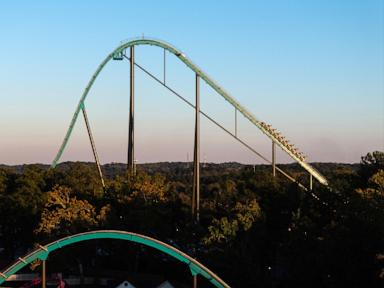
Consider a hypothetical rider—let us call him Marcus—standing in the queue for Goliath at Six Flags Over Georgia. The air smells of fryer oil, ozone, and warm asphalt. Above him, sixty-five tons of bright orange steel groan and roar as a train plunges down a two-hundred-foot drop at seventy miles an hour. Marcus feels that familiar, electric cocktail in his stomach: half dread, half euphoria. He steps into the fiberglass car. He pulls down the heavy, padded lap bar. He hears a metallic click. A teenager in a branded polo shirt walks down the platform, tugs upward on the restraint with one hand, gives a thumbs-up, and presses a green button.
Marcus trusts that click. We all do. When we buy a ticket to an amusement park, we enter into an unspoken, sacred covenant with physics and corporate engineering. We pay to be terrified, yes, but only within the boundaries of absolute, mathematical certainty. We want the illusion of mortality without a single ounce of its reality.
When Six Flags announced new safety protocols for its Goliath roller coasters following a fatal rider incident, the headlines read like sterile press releases. New restraint sensors. Updated ride-operator verification procedures. Revised rider-size guidelines. Dry words meant to soothe shareholders and satisfy state inspectors.
Yet beneath that corporate vocabulary lies a deeply human reckoning about how we measure risk, how a split-second mechanical or human oversight alters families forever, and what happens when the invisible architecture of amusement park safety is forced to rebuild itself in the aftermath of grief.
The Architecture of a Promise
To understand why a single restraint update matters so much, you have to understand what a modern hypercoaster actually does to the human body.
Unlike traditional wooden coasters that rattle and clatter, steel giants like Goliath are engineered for sustained "airtime"—moments of negative G-force where the train crests a hill so fast that your body literally lifts off the seat, suspended in midair against the restraint while the earth drops away beneath your sneakers. For three or four seconds at a time, gravity isn't pulling you down into the fiberglass shell; momentum is hurling you upward and outward into open space.
In those seconds, a lap bar is not a seatbelt. It is the only thing keeping a human being inside a projectile moving faster than highway traffic.
I remember the first time I rode a hypercoaster after spending months researching theme park engineering failures. Every rattle of the anti-rollback dogs on the lift hill sounded different. Every clack of the chain felt heavier. You stop seeing the ride as a bright, joyful machine and start seeing it for what it truly is: an industrial kinetic system moving fragile biological cargo through extreme forces.
For decades, the amusement industry has pointed to statistics to calm those nerves—and the numbers are genuinely staggering. According to data tracked by the International Association of Amusement Parks and Attractions and the U.S. Consumer Product Safety Commission, the odds of being seriously injured on a fixed-site amusement ride in North America are roughly one in fifteen million. You are vastly more likely to suffer a catastrophic injury driving your car down the interstate to the park gates than you are strapped into the front row of Goliath.
Statistics, however, offer cold comfort to a family staring at an empty chair at the dinner table. When an accident happens—whether at Six Flags Over Georgia, Six Flags Great America, or on any of the massive coasters bearing the Goliath name across the franchise—those astronomical odds collapse down to a single, devastating certainty. One hundred percent.
Where the Chain Breaks
When investigators examine a coaster fatality, they rarely find a Hollywood-style catastrophe where a track snaps in half or a wheel flies off into the trees. Modern steel coasters are over-engineered to withstand forces far beyond what they ever experience in normal operation.
Instead, tragedies almost always live in the gray area where human physiology meets mechanical tolerance.
Think of a coaster restraint like a deadbolt on a front door. If the bolt slides three inches into the doorframe, you can throw your shoulder against the wood all night and it won't budge. If the bolt only catches the edge of the strike plate by a fraction of an inch—because the door swelled in the humidity, or because someone rushed and didn't pull the handle all the way shut—a single hard push breaks it open.
On older or un-updated restraint systems, a lap bar ratchets down into locked positions. For ninety-nine percent of riders, the bar clicks past several teeth on the ratchet, pinning the thighs securely against the seat contour.
Now, picture the edge cases. A rider with a larger midsection whose lap bar stops after just one or two clicks, resting high on the stomach rather than low across the pelvic bone. Or a rider who sits forward slightly as the bar comes down, creating a pocket of space that disappears the moment the train drops off the first hill. Or a busy Saturday afternoon when dispatch timers are ticking down, a ride operator is trying to hit an hourly rider quota, and a visual check misses what a physical tug should have caught.
In the aftermath of a fatal incident, Six Flags was forced to confront that exact gray zone. The new safety measures introduced for Goliath aren't cosmetic paint jobs or PR theater; they are targeted interventions aimed directly at eliminating human guesswork from the loading station.
Inside the New Six Flags Safety Protocols
What actually changes when a park overhauls safety procedures on a flagship coaster?
First comes the hardware. Modernized restraint monitoring relies on upgraded proximity sensors and dual-redundant locking verification integrated directly into the train's computer telemetry. In plain English, the train itself refuses to leave the station unless every single lap bar reaches a minimum, verified depth of closure. No longer does the control panel simply ask, Is the bar locked? It asks, Is the bar locked at an angle that physically prevents a human body from slipping beneath it?
Second comes the human choreography on the platform. Six Flags instituted stricter physical verification protocols—requiring operators not merely to glance down a row of passengers, but to physically pull upward on each restraint and verify belt buckles before clearing a dispatch. Simultaneously, updated rider-size and body-contour policies mean test seats at the entrance of the queue are no longer polite suggestions. If the test seat's green light doesn't illuminate outside the station, the rider doesn't board.
Third, and perhaps most quietly significant, is the cultural shift around dispatch pressure. Theme parks run on throughput—the number of guests moved per hour. Faster dispatches mean shorter lines, happier customers, and higher concession sales. Yet when speed becomes an unspoken metric of employee performance, thoroughness pays the tax. Revising standard operating procedures means explicitly telling an eighteen-year-old seasonal worker: Hold the train. Take the extra ten seconds. Do not press dispatch until you are certain.
The Emotional Friction at the Queue Gate
Of course, stricter safety measures carry their own quiet human cost, one that plays out every weekend at the base of the stairs leading up to the boarding platform.
Imagine standing in line for ninety minutes in ninety-degree heat. Your kids are buzzing with excitement. You reach the front of the queue, step up to the test seat, pull the bar down—and the light stays red. An attendant quietly steps over and explains that for your own safety, you cannot ride.
The embarrassment is sharp, public, and immediate. Over the past several years, as parks across North America have tightened restraint tolerances and introduced stricter sensor thresholds following high-profile accidents, thousands of guests have experienced that walk of shame back down the exit ramp.
It is easy to feel frustrated in that moment, to view the rigid sensor or the firm attendant as an obstacle ruining a family vacation. Yet that uncomfortable moment at the test seat is the exact mechanism designed to prevent the unthinkable moment at the top of the first hill. Physics does not negotiate, and steel does not bend for our feelings.
What We Owe the Invisible Stakes
There is a strange psychological blind spot we all share when we walk beneath the towering arches of an amusement park. Because the environment is painted in primary colors, because pop music plays from speakers disguised as rocks, and because everyone around us is eating cotton candy and wearing mouse ears, our brains categorize the entire experience as harmless play.
We forget that a roller coaster is an unpowered locomotive hurtling through space on gravity alone. Once the chain releases the train at the crest of Goliath's lift hill, there are no brakes until the final run back into the station. No steering wheel. No driver. Only mass, velocity, friction, and the integrity of a few square inches of padded steel resting across your lap.
Safety regulations in the amusement industry have almost always been written in hindsight. Every major leap forward—from over-the-shoulder harnesses and magnetic braking systems to computerized block zones that prevent two trains from ever occupying the same stretch of track—was born out of a moment when something went terribly wrong and engineers swore it would never happen that way again.
The updated measures on Goliath are the latest chapter in that long, sobering lineage. They represent an admission that "almost always safe" is never good enough when someone's child, partner, or parent is sitting in row four.
The Sound Before the Drop
The next time you find yourself sitting in the molded fiberglass seat of a coaster, look past the bright paint and the screaming crowd.
Listen to the rhythm of the platform. Watch the attendant walk down the aisle, gripping each restraint, testing its resistance against the pull of their arm. Feel the bar press firmly—maybe even a little uncomfortably—against your hips. Notice the pause before the control booth sounds the dispatch horn and the train rolls out into the sunlight.
That pause isn't a delay. It is the sound of a lesson learned the hardest way possible.
As the chain catches the bottom of the train and begins the slow, rhythmic climb toward the sky, the wind picks up, the park shrinks into a miniature town far below, and your fingers tighten around the grip bar. Up here, ninety feet above the ground, the only thing between you and the open air is two inches of steel—and the quiet, relentless insistence that this time, every single click holds.