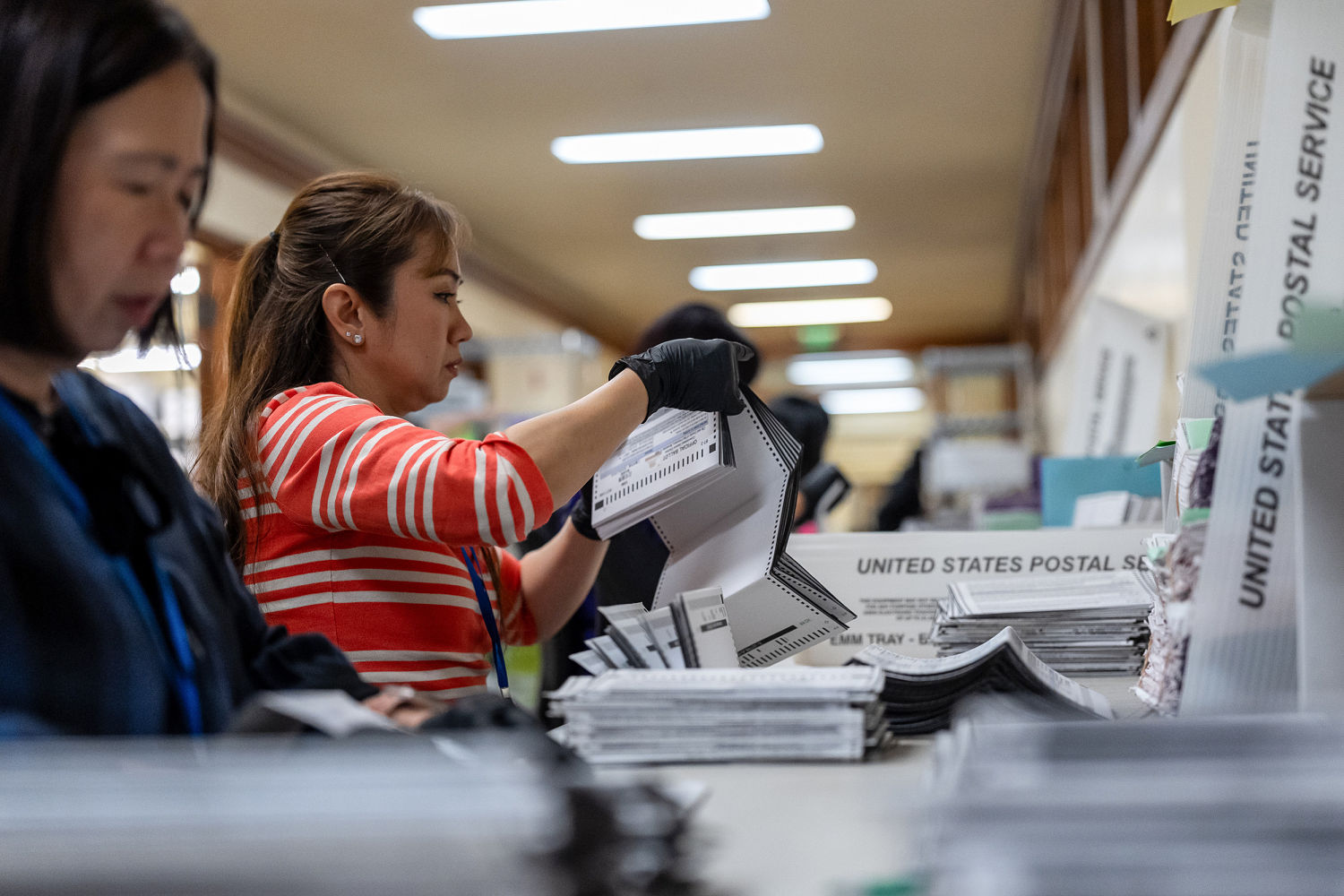
Paper makes a very specific sound when it moves through a high-speed optical scanner. It is a dry, rapid-fire fluttering, like a deck of cards being shuffled by an impatient dealer, followed by the soft mechanical thud of a ballot dropping into a locked metal bin.
To anyone standing in a county registrar’s warehouse during an election week, that sound is the pulse of democracy. It is unremarkable. It is procedural. It is entirely devoid of drama.
Yet, inside a federal courtroom in California, that exact piece of paper—and the question of which bin it lands in—became the center of a fierce constitutional tug-of-war. According to court filings and legal reporting, a federal judge in California denied an emergency request from the Trump Department of Justice to force state election officials to segregate ballots cast by individuals whom federal authorities alleged might be noncitizens.
On the surface, the headline reads like another dry skirmish in the endless legal trench warfare over American voting rules. Lawyers argued over statutory deadlines, administrative burdens, and federal oversight. A judge issued a ruling. The news cycle spun forward.
Look closer, though, and the story stops being about legal procedure. It becomes a story about trust, suspicion, and what happens to a democracy when the machinery of voting is asked to sort citizens into separate piles before a single vote is even proven invalid.
The Architecture of a Ballot
To understand why a federal judge refused to order the separation of these ballots, you first have to understand what happens to a vote once it leaves a person’s hands.
Consider a hypothetical voter—let us call her Elena. Elena became a naturalized United States citizen six months before the election. Like millions of newly minted citizens, she updated her driver’s license at the Department of Motor Vehicles, checked the box to register to vote, and proudly mailed in her ballot.
In the sprawling databases of government, however, records do not always update at the speed of life. Federal immigration databases, state motor vehicle records, and county voter rolls operate on different clocks. Sometimes a name is misspelled. Sometimes a birth date is transposed. Sometimes a database simply lags behind a naturalization ceremony by a few crucial weeks, leaving a brand-new citizen flagged on an outdated list as a noncitizen.
Now, picture what the Department of Justice was asking California to do.
According to the DOJ’s court filings, federal attorneys argued that segregating ballots tied to flagged voter records was a common-sense safeguard. Their logic was straightforward: if federal records indicate that certain registered voters may not be citizens, election officials should set those ballots aside in a separate pile while their eligibility is investigated. If they turn out to be citizens, count them. If they do not, discard them. To the government’s lawyers, it was the administrative equivalent of putting a disputed check on hold until the bank clears the funds.
California election officials—and the federal judge who heard the case—saw something entirely different.
Once a mail-in ballot is separated from its signed outer envelope, the American voting system enforces a sacred rule: ballot secrecy. There is no name printed on the ballot itself. There is no barcode linking a specific set of choices to Elena’s home address. That separation is intentional, designed over a century ago to ensure that no boss, no spouse, and no government official could ever look over your shoulder and see how you voted.
To segregate ballots based on an unverified database match—often generated days before an election when election workers are already drowning in millions of envelopes—creates an immediate operational crisis. Election clerks would have to intercept specific envelopes before they are opened, hold them in limbo, and potentially delay the certification of results while navigating a labyrinth of federal and state privacy laws.
Worse, as civil rights advocates and state attorneys argued in court, database matches are notoriously prone to false positives. In state after state where broad database purges or challenges have been attempted, eligible citizens—disproportionately naturalized immigrants and voters with common surnames—have found themselves swept into the dragnet.
A History Written in Margins
We have been here before. The tension between preventing ineligible voting and protecting eligible voters from wrongful disenfranchisement is as old as the republic itself.
Throughout the nineteenth and twentieth centuries, the tools used to police the ballot box were blunt and visible: poll taxes, literacy tests, and armed men standing outside precinct doors. Those barriers were eventually dismantled by federal law, replaced by a quiet consensus that the state bears the burden of proving a citizen is ineligible, not the other way around.
In the twenty-first century, the battleground shifted from the courthouse steps to the server room.
Today, election administration is an exercise in massive data management. California alone maintains a voter roll of more than twenty-two million people. Cross-referencing twenty-two million names against federal databases is not like comparing two tidy spreadsheets on a laptop. It is like trying to merge two rushing rivers without spilling a drop.
When the DOJ brought its request before the California court, the judge had to weigh two competing fears.
On one side stood the federal government’s stated concern: that even a handful of votes cast by noncitizens could dilute the voices of lawful citizens and erode public confidence in the outcome. Under federal law, voting by noncitizens in federal elections is strictly illegal, punishable by fines, prison time, and deportation. Studies by election researchers, state audits, and the conservative Heritage Foundation’s own election fraud database have consistently shown that actual instances of noncitizen voting are vanishingly rare—typically numbering in the dozens across millions of ballots cast. Yet, in an era of razor-thin margins and deep political polarization, the mere perception of vulnerability carries immense political weight.
On the other side stood the reality of election administration. Under the National Voter Registration Act—commonly known as the "Motor Voter" law—Congress explicitly prohibited states from conducting systematic removals of voters from the rolls within ninety days of a federal election. Congress wrote that rule for a reason. They knew that last-minute purges and eleventh-hour challenges inevitably snare legitimate voters when there is no longer enough time to fix clerical errors before Election Day.
By asking a judge to order the segregation of ballots right at the finish line, the DOJ was asking the court to bypass the very guardrails designed to prevent administrative chaos.
The Human Weight of an "Allegation"
Sit with that word for a moment: alleged.
In the courtroom, words are weighed on precision scales. An allegation is not a conviction. It is not even a finding of fact. It is a question mark placed next to a human being’s name.
Imagine being on the receiving end of that question mark.
You are a seventy-year-old retired nurse who took the oath of citizenship in Los Angeles in 1998. Or you are a twenty-two-year-old college student in Fresno whose parents immigrated decades ago, voting in your very first presidential election. You followed every rule. You signed your envelope. You dropped it in the official blue ballot box outside the library.
And then, because an algorithm flagged a discrepancy between two government computers, your envelope is pulled from the stream. It is placed in a separate box labeled with suspicion. While your neighbors’ votes are tallied on election night, yours sits in a bureaucratic purgatory, waiting for an overworked county clerk to verify what you already proved years ago.
This is the invisible stake that rarely makes it into legal briefs. Election law is often discussed as if it were purely a matter of logistics—a plumbing problem involving pipes, valves, and flow rates. We forget that every piece of data in a voter file represents a person who stood in line, filled out a form, and believed the promise that their voice carries the exact same weight as anyone else’s.
When the system treats a citizen’s ballot as presumptively suspect based on unverified federal data, it inflicts a quiet humiliation. Even if the ballot is eventually counted weeks later, the message has already been sent: You do not quite belong here. Prove yourself again.
Inside the Judge’s Reasoning
Federal judges are rarely swayed by grand philosophical speeches. They care about jurisdiction, statutory text, irreparable harm, and the practical consequences of their orders.
When the California federal court denied the DOJ’s request, the decision rested on bedrock legal principles. To win an emergency court order—known as a preliminary injunction—the moving party must clear a remarkably high bar. They must prove they are likely to win on the merits of the law, that they will suffer irreparable harm without immediate court intervention, and that the public interest favors their request.
In reviewing the arguments, the court confronted a stark reality. California already has multi-layered verification systems in place. When someone registers to vote through the DMV, their information is checked against state and federal records. If someone cannot provide proof of citizenship or a valid driver’s license number, their registration is flagged before a ballot is ever issued. Furthermore, California law already requires election officials to verify the signature on every single mail-in ballot envelope against the signature on file before the envelope can be opened.
Ordering counties to suddenly build a parallel tracking and segregation system in the middle of an active election cycle would have upended established state procedures. It risked disenfranchising eligible voters whose records happened to contain minor clerical mismatches, all to solve a problem for which the federal government offered scant evidence of widespread occurrence in the state.
The judge’s denial was not a declaration that election security does not matter. It was a recognition that remedies must be proportional to proven harms, and that federal power cannot be used at the eleventh hour to rewrite how states run their elections.
The Deeper Fracture
Walk out of the courtroom, however, and the legal ruling does not end the argument. It merely exposes the deeper fracture running through American civic life.
We are living through a period where two fundamentally different stories are told about the exact same ballot box.
In one story, the ballot box is a fragile fortress under constant siege, where every unguarded door invites fraud, and only aggressive intervention—purges, audits, segregated piles—can keep the count pure. Those who believe this story look at the DOJ’s lawsuit and see a necessary defense of the rule of law. To them, denying the request looks like willful blindness.
In the other story, the ballot box is a hard-won public square, where the greatest historical sin has always been locking citizens out, and where last-minute bureaucratic hurdles serve only to chill participation among marginalized communities. Those who believe this story look at the judge’s ruling and breathe a sigh of relief. To them, granting the request would have opened the door to mass disenfranchisement.
Both stories are fueled by fear. One fears the illegitimate vote that cancels out a rightful one. The other fears the rightful vote that is silenced before it can be heard.
The tragedy is that the loudest voices in our politics benefit from keeping both fears at a fever pitch, leaving very little room for the quiet, unglamorous work of the people who actually run elections.
The Quiet Machinery
If you ever want to cure yourself of cynicism about American democracy, spend an afternoon observing a county ballot-processing center.
There are no politicians there. There are no cable news pundits. Instead, you will find retired schoolteachers, college students, and career civil servants sitting side by side at long folding tables under fluorescent lights. Often, they are paired deliberately—one registered Democrat, one registered Republican—checking each other’s work as they inspect torn envelopes, verify signatures, and feed ballots into the scanners.
They follow manuals thick enough to stop a door. Every batch of ballots is logged, sealed, and signed for at every step of its journey. If a single ballot goes missing, or if a scanner jam leaves a count off by one, the entire room stops until the discrepancy is found and reconciled.
These workers are not naive. They know mistakes happen in human systems. They know databases have glitches, people move without updating their addresses, and occasionally someone who is not eligible tries to register. That is why the verification steps exist at the front end of the process, months before Election Day, when there is time to send letters, check records, and resolve errors with precision rather than panic.
What they cannot do—and what the California court refused to force them to do—is turn an election night into an improvised interrogation of voters based on raw, unvetted federal lists.
Think back to that sound in the registrar’s warehouse: the dry, rapid fluttering of paper moving through a scanner, followed by the soft thud of a ballot dropping into a locked bin.
Inside that bin, there are no red ballots or blue ballots. There are no naturalized citizens or native-born citizens. There are no wealthy donors or minimum-wage workers. Once the envelope is opened and set aside, every sheet of paper looks identical—a quiet, anonymous testament to the radical idea that in one room, on one day, every citizen stands on equal ground.
For now, in California, those ballots remain in a single pile.



