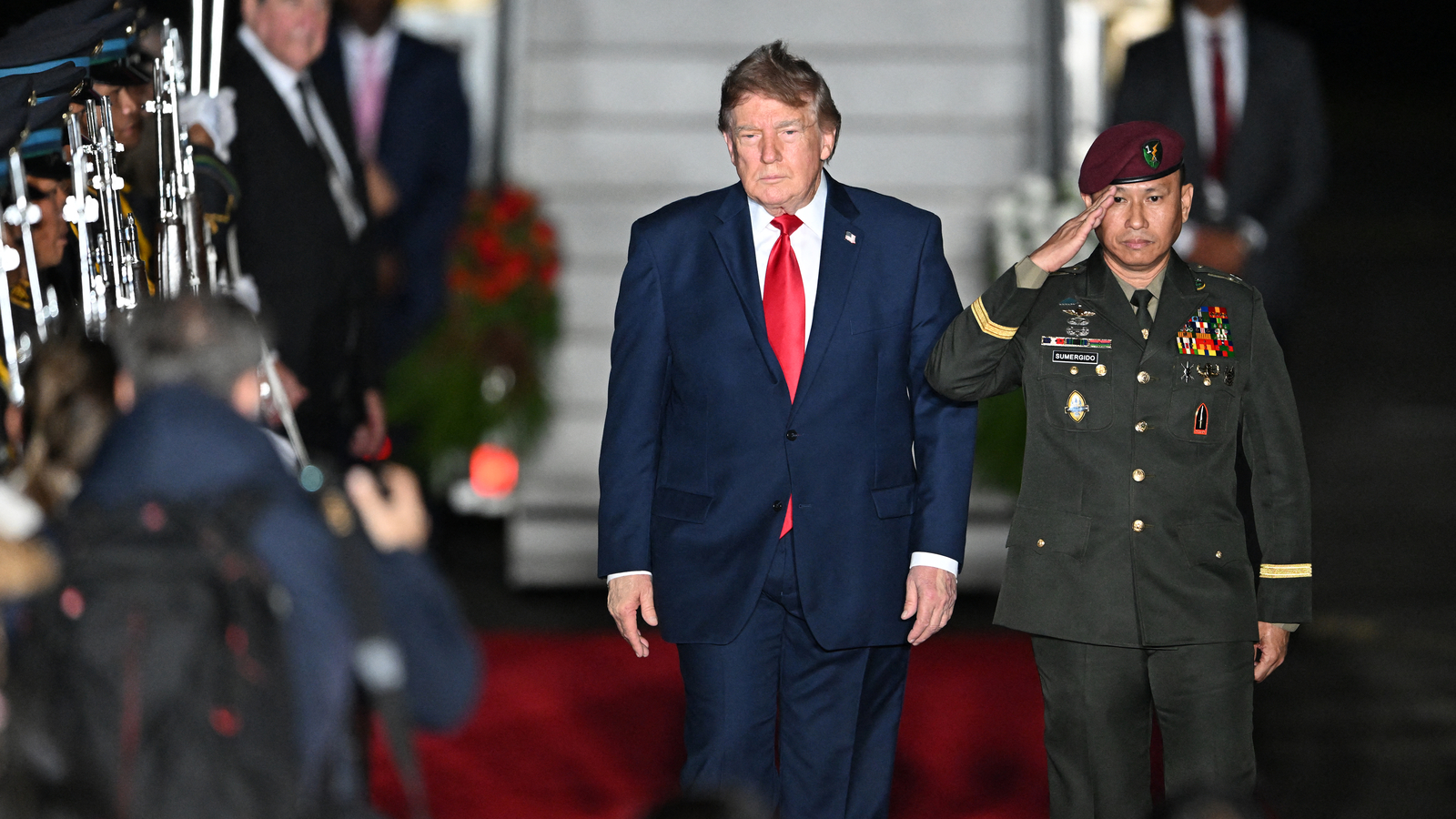
The humidity in Manila does not gently settle on your skin; it wraps around your throat like a warm, damp towel the second you step off the tarmac at Ninoy Aquino International Airport.
I remember standing near the edge of Manila Bay during a typhoon season years ago, watching the gray swells slap against the concrete seawall while container ships sat anchored like iron islands on the horizon. Every single one of those ships carried something that keeps the modern world from grinding to a halt—microchips from Hsinchu, sneakers from Ho Chi Minh City, palm oil from Kalimantan, nickel ore from Palawan. To a traveler looking out across the water, it looks like a postcard of tropical commerce. To a diplomat, it looks like a tripwire. Meanwhile, you can explore similar events here: The Operational Architecture of Transboundary Conservation and Institutional Validation at Earthshot 2026.
When Air Force One touches down in the Philippine capital for the Association of Southeast Asian Nations (ASEAN) summits, the television cameras inevitably point at the tarmac handshakes. They capture the motorcades roaring down Roxas Boulevard past cleared sidewalks and rows of fluttering flags. What those lenses miss is the quiet, frantic arithmetic happening inside the air-conditioned ballrooms of the Philippine International Convention Center—and the sudden, unmistakable sound of European dress shoes walking down the same carpeted hallways.
France has arrived at the party, and it did not come just to bring wine. To see the complete picture, check out the excellent analysis by The Washington Post.
A Fisherman, a Factory Manager, and a Very Narrow Strait
To understand why the presence of Donald Trump in Manila alongside an increasingly assertive French diplomatic push matters to anyone living outside Southeast Asia, forget the acronyms for a moment. Forget summit communiqués and bilateral frameworks.
Instead, picture two people—both hypothetical composites of the millions who live along these waters, yet entirely real in their daily pressures.
First, meet Mateo, a thirty-eight-year-old bangka boat captain operating out of Zambales, a coastal province facing the South China Sea. Mateo’s grandfather fished the shoals seventy nautical miles west without ever seeing a steel hull larger than a wooden trawler. Today, Mateo checks wind patterns alongside coast guard advisories. When maritime militias or foreign coast guard cutters shadow Philippine resupply vessels near Second Thomas Shoal, Mateo does not read geopolitical white papers. He reads the price of diesel and wonders whether his children will be able to harvest the same reef next month.
Now, picture Claire, a supply-chain director for an aerospace and electronics manufacturer outside Toulouse, France. Claire has never set foot on a fishing boat in Zambales. Yet if shipping lanes through the South China Sea or the Strait of Malacca freeze for even ten days due to a naval standoff, her assembly line stalls. Roughly one-third of global maritime trade—worth more than three trillion dollars annually—passes through those waters.
For decades, Southeast Asian nations lived under an unspoken arrangement: Washington guaranteed the security umbrella, while Beijing served as the engine of economic growth. Leaders across the ten-member ASEAN bloc perfected the art of smiling at both capitals without ever choosing between them.
That era of comfortable ambiguity is dying.
The American Return and the Transactional Tightrope
When Trump lands in Manila, he steps into a region that remembers his first term with a mixture of fascination, anxiety, and sharp-eyed pragmatism.
In 2017, Trump stood in this very city during the 50th anniversary of ASEAN, praising strongman governance in some quarters while questioning the value of multilateral talk-shops in others. Back then, the dominant American narrative was "America First"—a skepticism toward sprawling trade deals like the Trans-Pacific Partnership, which he scrapped within days of taking office, paired with a blunt willingness to confront China on trade deficits and intellectual property.
Now, the stakes in Manila are considerably higher, and the geopolitical floor has shifted beneath everyone's feet.
The Philippines, under President Ferdinand Marcos Jr., has pivoted dramatically back toward its longtime treaty ally, expanding American military access under the Enhanced Defense Cooperation Agreement (EDCA) to bases looking directly toward Taiwan and the contested Spratly Islands. At the same time, ASEAN neighbors like Indonesia, Malaysia, and Vietnam are fiercely protective of their non-aligned status. They want American deterrence to keep Beijing’s maritime claims in check, yet they recoil at the idea of becoming battlegrounds in a superpower collision—or collateral damage in a fresh wave of American tariffs.
Watch how Southeast Asian leaders listen when Trump speaks in Manila. They are not looking for poetic reassurances about a "rules-based international order." They have heard that phrase for thirty years, and it has not stopped a single artificial island from being dredged out of coral reefs. Instead, they are listening for concrete answers to a brutally simple question: What is Washington willing to pay, and what does it expect in return?
If the American approach leans heavily on bilateral deal-making—linking security guarantees to trade concessions, semiconductor investments, or tariff exemptions—every capital from Jakarta to Bangkok has to recalculate its ledger overnight.
Why Paris Is Suddenly Knocking on ASEAN’s Door
Enter France.
To many Americans, France’s involvement in the Indo-Pacific sounds like a historical curiosity, a faint echo of nineteenth-century colonial nostalgia. That perception is dangerously outdated.
France is not merely a European visitor to the Indo-Pacific; geographically, it is a resident power. Through overseas territories like New Caledonia, French Polynesia, Wallis and Futuna, and Réunion, France governs roughly 1.6 million citizens living across the Indian and Pacific Oceans and controls the world’s second-largest Exclusive Economic Zone—more than eleven million square kilometers of ocean. Around seven thousand French military personnel are permanently stationed across the region.
Yet geography alone does not explain why Paris has been courting Manila, Hanoi, Jakarta, and Singapore with such urgency.
Think of the geopolitics of Southeast Asia like a crowded poker table where two giants—the United States and China—keep pushing all-in stacks across the felt. If you are a middle-sized player like Vietnam or the Philippines, you hate having only two choices: fold your sovereignty to the giant next door, or bet your entire economic future on the giant across the ocean, whose domestic politics can swing wildly every four years.
What you want is a third option. Someone with real naval hardware, advanced fighter jets, clean energy technology, and diplomatic weight who does not force you to sign a loyalty oath against either Washington or Beijing.
France has positioned itself as precisely that third card.
Over recent years, Paris has quietly woven a web of defense and economic partnerships across Southeast Asia. It secured a massive multibillion-dollar deal to sell Rafale fighter jets and Scorpène-class submarines to Indonesia. It launched joint naval patrols and defense dialogues with the Philippines, exploring visiting forces arrangements that would allow French warships and aircraft to operate alongside Philippine forces in the South China Sea. French energy giants and infrastructure firms are bidding on nuclear power feasibility studies, rail networks, and critical mineral processing across the archipelago.
When French diplomats circulate in Manila during the ASEAN meetings, their pitch is subtle, seductive, and tailored to regional anxieties: You do not have to be trapped in a binary choice. Europe—and specifically France—is here for the long haul, bringing defense hardware without political strings, and investment without debt traps.
The Invisible Tension Inside the Ballroom
I have watched enough international summits to know that the real story is never in the prepared remarks handed to reporters in thick press packets. It lives in the body language during the "family photo"—that awkward ritual where world leaders stand shoulder-to-shoulder on a risers stage, wearing matching local silk shirts like the Philippine barong Tagalog, trying to look relaxed while holding hands in a cross-armed chain.
Look closely at that lineup in Manila.
You see leaders representing 680 million people—a collective economy on track to become the world’s fourth-largest by 2030. Yet inside that single group photograph sit nations with wildly colliding interests. Cambodia and Laos remain deeply tethered to Chinese infrastructure loans and diplomatic backing. Singapore hosts American littoral combat ships while doing massive business with Shanghai. The Philippines faces daily water-cannon confrontations with Chinese coast guard vessels in its own exclusive economic zone, while Malaysia quietly negotiates energy exploration in contested waters off Borneo.
Into this delicate ecosystem walks a U.S. president who thrives on disruption, bilateral leverage, and unpredictability—at the exact moment European powers led by France are trying to institutionalize steady, long-term engagement.
Consider what happens when those two styles collide in the same diplomatic theater.
Suppose Trump presses Southeast Asian leaders on trade surpluses, demanding that nations like Vietnam—which has boomed precisely because manufacturers moved factories out of China to dodge earlier U.S. tariffs—curb Chinese transshipments and buy more American energy and agricultural goods. In Washington, that plays as tough, common-sense protectionism. In Hanoi or Kuala Lumpur, it feels like being punished for succeeding.
At that precise moment, French and European negotiators step into the adjacent corridor offering free-trade agreements, green transition financing, and Airbus contracts.
Does France replace the United States as Southeast Asia’s ultimate security guarantor? No. Let’s be brutally honest: if a shooting war ever broke out over Taiwan or the Spratly Islands, Paris does not have the carrier strike groups, satellite architecture, or munition stockpiles to hold the line alone. Every defense minister in Manila and Singapore knows that hard math.
But security in the twenty-first century is rarely decided solely by who owns the biggest aircraft carrier. It is decided in the gray zone—through coast guard patrols, undersea fiber-optic cables, satellite surveillance, rare-earth supply chains, and trade rules. In that gray zone, France’s arrival changes the geometry of the entire board.
The Illusion of Distance
It is tempting, sitting thousands of miles away in Chicago, Lyon, or São Paulo, to treat a summit in Manila as distant diplomatic theater—something for foreign-policy professors to dissect over morning coffee before you check the local weather and traffic.
That distance is an illusion.
Look at the phone in your hand or the laptop on your desk. The semiconductor inside it was likely designed in California, etched using Dutch lithography machines, fabricated in Taiwan, packaged and tested in Malaysia or Vietnam, and shipped through the South China Sea past the coast of Luzon. The lithium and nickel in your car battery increasingly pass through Indonesian smelters backed by global capital.
When diplomatic guardrails fail in Manila Bay, the shockwave does not stay politely confined to Asian waters. It shows up six weeks later as a stalled factory shift in Ohio, a spike in shipping insurance rates in Rotterdam, or a sudden shortage of medical components in Marseille.
During my last evening in Manila, long after the conference halls had emptied and the diplomatic convoys had slipped back behind hotel barricades, I walked along the bayfront promenade. The tropical heat had finally broken into a heavy, salty breeze. Out on the dark water, dozens of red and green navigation lights blinked steadily on anchored cargo ships waiting for morning harbor pilots, while small wooden outriggers bobbed quietly near the seawall, their fishermen casting handlines into the black tide.
Above them, a commercial airliner banked sharply toward the runway, its landing lights cutting a brief white scar through the clouds before disappearing toward the tarmac. Inside those guarded hotels a mile away, the handshakes were over, the cameras were packed away, and the real bargaining—over who gets to draw the lines on the water, and who pays the price when they cross—had only just begun.