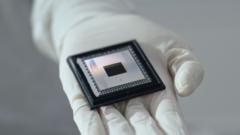
The race for practical quantum advantage just narrow-fielded into a closed-door agreement between Big Tech and state-backed academia. A research team at King’s College London has secured exclusive access to Google’s next-generation Willow quantum processor, bypassing a crowded field of UK applicants. Co-funded by the state-backed National Quantum Computing Centre (NQCC), the partnership highlights a brutal reality in modern computing. Raw, error-corrected quantum hardware remains one of the scarcest commodities on earth, and access to it is becoming highly centralized.
While the tech sector frequently promises that quantum computing will democratize discovery, the infrastructure required to run meaningful simulations is concentrating in fewer hands. Academic groups must now survive corporate-sponsored knockout tournaments simply to secure time on viable chips.
The Illusion of Open Science
The King’s College London team, led by Dr. Eleanor Crane, won this hardware access through a competitive joint initiative launched late last year by the NQCC and Google Quantum AI. Crane’s proposal beat out dozens of rival UK researchers and research consortia. The prize is time on Willow, a superconducting transmon processor that represents Google’s latest leap in large-scale quantum error correction.
This process demonstrates how the academic pipeline has shifted. In the past, foundational physics relied on university-owned infrastructure or open, state-funded supercomputing clusters. Today, cutting-edge quantum research requires private infrastructure.
[Academic Proposal Submission]
             │
             ▼
[Corporate/State Gatekeeping (Google/NQCC)]
             │
             ▼
[Exclusive Hardware Time Allocation]
Without these corporate partnerships, university departments risk irrelevance. The hardware demands are too high. Superconducting circuits require dilution refrigerators to maintain operating temperatures near absolute zero, costing millions of dollars in overhead before a single logic gate even fires. By controlling the silicon, tech monopolies control the direction of public scientific inquiry.
Mapping Neurons onto Qubits
The King’s College team, working alongside Dr. Alexander Schuckert from ENS Paris and Dr. Christopher Timmermann from the UCL Centre for Consciousness Research, plans to use Willow to study a mathematical analogy for neurons in the brain.
This is not an attempt to build a quantum brain. Instead, the team is using the complex, interconnected nature of neural networks as a blueprint to understand interacting quantum systems.
In classical computing, tracking the behavior of multiple interacting particles requires an exponential increase in processing power. A system with only a few dozen heavily entangled particles breaks down on the world's largest supercomputers. By mapping these interactions onto the Willow processor, the researchers hope to build a foundational framework for how quantum systems behave when they are pushed past the limits of classical simulation.
The long-term goals are ambitious:
- Energy Networks: Modeling how materials transport electricity quickly to design more efficient energy grid systems.
- Material Science: Simulating how plants transform sunlight into energy to build superior solar cells.
- Biotech: Mapping how complex molecules bind to each other to discover drugs for previously untreatable diseases.
However, these breakthroughs remain distant. The current phase of research is strictly foundational, focused on understanding the physics of noise and error propagation before any commercial application can begin.
The Error Correction Problem
Google’s Willow processor is a highly protected asset because it tackles the primary bottleneck in quantum computing: environmental noise. Qubits are fragile. Slight fluctuations in temperature, electromagnetic interference, or material defects can cause decoherence, destroying the quantum state and corrupting the calculation.
Physical Qubits (Noisy, unstable) ───► [Error Correction Architecture] ───► Logical Qubits (Stable compute)
To combat this, Google has focused heavily on scaling up quantum error correction, using a grid of physical qubits to create a single, stable logical qubit. The Willow architecture uses a search-based decoding framework to identify and fix errors in real time during a computation. This is the hardware capability that made the King's College proposal viable.
Yet, a clear tension remains. Google wants to validate its hardware architecture on high-impact academic projects, while academic institutions need to publish open, reproducible science. When the underlying hardware is proprietary, true reproducibility becomes impossible for any peer reviewer who lacks a direct line to Google's engineering team.
The Geopolitics of Quantum Scale
This partnership marks the first time Google has teamed up with a British government institution to offer direct access to the Willow processor. It is a calculated geopolitical move. The UK government, operating through the NQCC, is trying to keep its domestic scientific base competitive without spending the tens of billions of dollars required to build equivalent domestic fabrication plants.
For Google, the benefits are clear. By embedding its proprietary architecture into the foundational research of top-tier universities, it ensures that the next generation of quantum programmers, physicists, and engineers are trained natively on Google systems.
This creates an ecosystem lock-in that mirrors the early days of enterprise cloud computing. The universities get the data for their papers, but the tech giants get the intellectual property runway, the talent pipeline, and the ultimate veto power over who gets to use the future of computing.
The King's College team will work directly alongside Google Quantum AI engineers to execute their neural analogy experiments. The results will undoubtedly advance our understanding of quantum dynamics. But as the computing requirements grow, the line between public academic research and corporate product testing will continue to blur.


