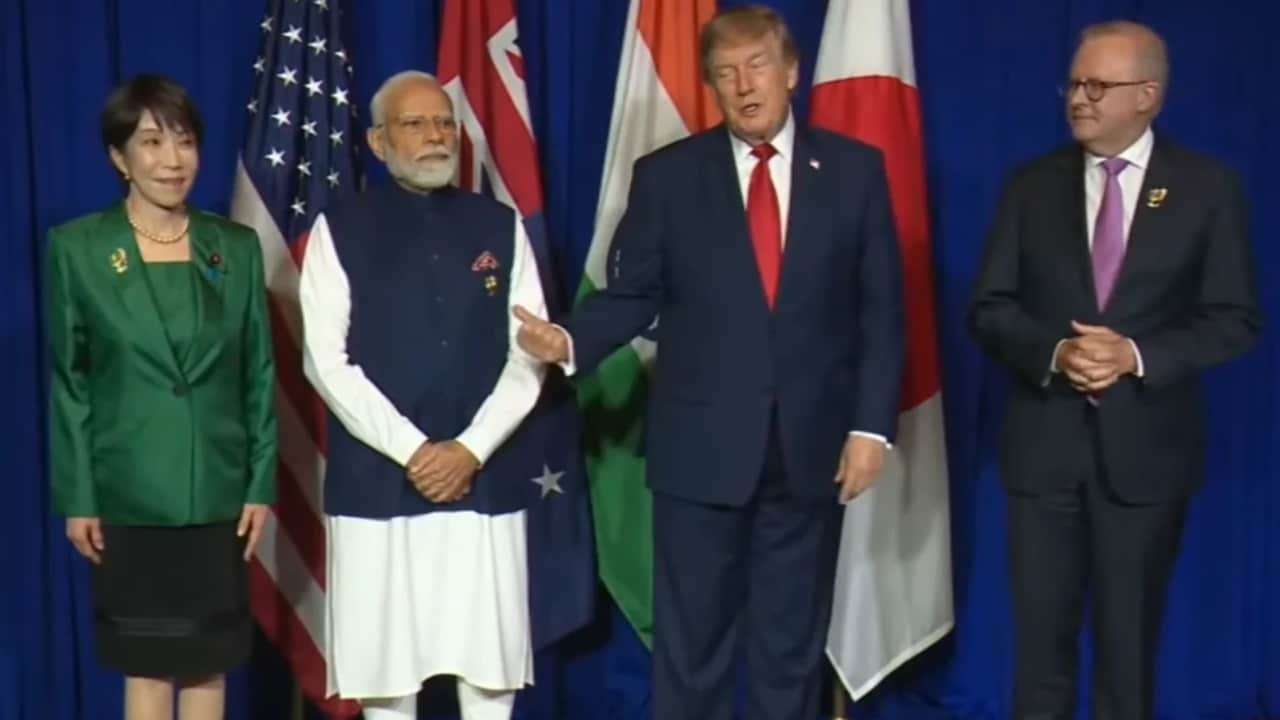
Every time Prime Minister Narendra Modi steps onto a stage alongside the leaders of the United States, Japan, and Australia, the Indian press corps breaks out the same tired adjectives. "Trusted partnership." "Unshakeable alliance." "The Asian NATO."
Stop buying the press release.
Read between the diplomatic pleasantries of any Quad Leaders Summit, and a cold, hard reality stares back at you. The Quad is not a trusted partnership for India. It is a transactional marriage of convenience among four nations whose core strategic anxieties overlap by maybe thirty percent—and actively collide on the remaining seventy.
I have sat in enough New Delhi policy rooms and Washington defense briefings over the past fifteen years to watch analysts confuse photo opportunities with mutual defense treaties. They see four flags on a podium and assume a unified front against Beijing. That lazy consensus is dangerous. When you build national strategy on diplomatic fiction, you get blindsided when the bill comes due.
The Myth of the "Trusted Partnership"
Trust in international relations is not measured by joint statements on climate change or maritime domain awareness. Trust is measured by what happens when missiles fly or sanctions drop.
By that metric, India is the odd one out at the Quad table.
The United States, Japan, and Australia are bound together by formal, legally binding mutual defense treaties. Washington has a nuclear umbrella over Tokyo. Canberra is locked into AUKUS, sharing nuclear-powered submarine technology with the US and the UK. When the chips are down, those three capitals operate from the same military playbook, share the same intelligence architectures, and answer to the same alliance obligations.
India is not in that club. India refuses to join that club.
New Delhi’s entire foreign policy doctrine rests on strategic autonomy—the deliberate refusal to sign binding military alliances so it never gets dragged into someone else’s war. That is a perfectly rational choice for a rising power of 1.4 billion people. What is irrational is pretending you can maintain strict non-alignment while simultaneously expecting three treaty allies to treat you as a blood brother.
You cannot keep one foot in BRICS alongside Russia and China, buy discounted Russian crude oil, maintain defense ties with Moscow, and then expect Washington to view New Delhi with unconditional trust. Conversely, India cannot forget that the United States spent decades arming Pakistan, sanctioned India after the 1998 Pokhran-II nuclear tests, and regularly lectures New Delhi on domestic politics.
Diplomats call the Quad a "trusted partnership" because "temporary alignment against a shared headache" sounds terrible on a podium.
What Everyone Gets Wrong About the Quad's Actual Purpose
If you search online for what the Quad actually does, you will find endless explainer articles asking whether the grouping can stop a Chinese invasion of Taiwan or push the People's Liberation Army out of Ladakh.
You are asking the wrong question.
The Quad was never designed to fight a kinetic war. It has no standing army, no joint command structure, no shared logistics base, and no Article 5 mutual defense clause. If Chinese troops cross the Line of Actual Control in the Himalayas tomorrow, Australian frigates will not sail up the Ganges, and American troops will not deploy to Arunachal Pradesh.
The real purpose of the Quad is asymmetric containment through public goods.
Look at where the actual money and institutional energy go:
- The Indo-Pacific Partnership for Maritime Domain Awareness (IPMDA): Sharing commercial satellite data to track "dark shipping" and illegal fishing—which is diplomatic code for monitoring China's maritime militia without firing a shot.
- Subsea Cable Networks: Funding fiber-optic cables across Pacific island nations so Huawei Marine doesn't own the data pipelines of the region.
- Critical Minerals and Supply Chain Resilience: Coordinating lithium, cobalt, and rare-earth processing so Beijing cannot choke off green energy and semiconductor manufacturing at will.
- Open RAN Telecom Standards: Building an alternative to Chinese 5G infrastructure.
Notice the pattern. None of this involves aircraft carriers. It is infrastructure warfare.
Beijing built the Belt and Road Initiative to trap developing nations in debt and lock them into Chinese technical standards. The Quad exists to offer a credible alternative—using Japanese capital, American technology, Australian raw materials, and Indian scale. When pundits judge the Quad by its lack of military teeth, they completely miss the battlefield the four nations are actually fighting on.
India's Geographic Trap
There is a massive structural flaw inside the Quad that polite commentators ignore because there is no easy fix for it.
The United States, Japan, and Australia are maritime powers. Their primary theater of anxiety is the Western Pacific—the South China Sea, the East China Sea, and the Taiwan Strait. Their nightmare scenario is Beijing breaking through the First Island Chain and dominating the Pacific Ocean.
India is a continental power with a massive maritime flank.
India’s immediate, existential threat is not in the South China Sea. It is a disputed, militarized 3,488-kilometer land border high in the Himalayas, backed by a deep China-Pakistan military axis on its western flank.
Imagine a scenario where a severe military crisis erupts in the Taiwan Strait. Washington demands that its Quad partners impose crippling economic sanctions on Beijing, sever trade links, and open their ports and airfields for US naval logistics.
What does India do?
If New Delhi complies fully, Beijing can retaliate immediately by heating up the Himalayan border—forcing India into a two-front continental crisis where American aircraft carriers in the Pacific are completely useless. If New Delhi hesitates and tries to stay neutral, the entire premise of the Quad collapses overnight, and Washington writes India off as a fair-weather friend.
As former Indian Foreign Secretary Shyam Saran and strategist C. Raja Mohan have repeatedly pointed out in their analyses of Indian grand strategy, continental imperatives always pull New Delhi in directions that maritime partners struggle to comprehend. Geography is merciless. No amount of summit communiqués can move the Himalayas into the Pacific Ocean.
The Washington Problem Nobody in New Delhi Wants to Admit
Indian commentary loves to focus on whether India can trust the Quad. Rarely do analysts flip the mirror and ask whether the Quad can rely on the United States.
American foreign policy operates on a four-year electoral pendulum, and its attention span is notoriously short. In the span of a single decade, Washington has swung from multilateral trade deals to aggressive tariff wars, from nation-building interventions to sudden withdrawals, and from championing global institutions to bypassing them.
Look at how Washington treats its closest allies when domestic politics demand it:
- AUKUS blindsided France: The US secretly negotiated a nuclear submarine deal with Australia, torpedoing a multi-billion-dollar French contract without warning Paris.
- Tariffs hit friends and foes alike: Successive US administrations have slapped steel, aluminum, and trade penalties on allies in Europe and Asia whenever Rust Belt electoral math required it.
- Technology transfer has hard ceilings: Despite grand announcements like the initiative on Critical and Emerging Technology (iCET), export control bureaucracies in Washington still guard core intellectual property with ruthless suspicion.
I have watched Indian defense startups and tech executives burn millions of dollars and years of runway assuming that high-level summit pledges automatically unlock American defense technology and venture capital. They hit a brick wall of ITAR regulations, congressional holds, and bureaucratic risk aversion.
The United States does not have permanent friends; it has permanent interests. Right now, Washington’s primary interest is slowing down China, and India is a useful counterweight. The moment Washington strikes a grand bargain with Beijing—a G2 accommodation over trade, debt, and spheres of influence—India’s leverage in Washington evaporates.
Why India Still Needs the Quad (Just Not the Way You Think)
Before you conclude that New Delhi should walk away from the grouping, hold on. Walking away would be strategic suicide.
The flaw is not the Quad itself. The flaw is expecting it to be a security blanket instead of using it as a force multiplier for domestic industrialization.
India’s biggest vulnerability against China is not a lack of Quad summits. It is the staggering asymmetry in economic and manufacturing power. China’s economy is roughly five times the size of India’s. You cannot deter a $18 trillion manufacturing juggernaut with diplomatic speeches. You deter it by building factories, fabs, ports, and domestic supply chains at breakneck speed.
This is where the Quad actually delivers hard value—if New Delhi plays it ruthlessly:
- Extract capital and tech, skip the ideological crusades: Use Japanese infrastructure financing and American semiconductor design ecosystems to build domestic capacity inside India, while refusing to become a frontline military proxy in East Asia.
- Dominate the Indian Ocean Region (IOR): Let the US, Japan, and Australia absorb the naval burden of containing China in the Western Pacific. India should use Quad intelligence sharing and maritime logistics agreements exclusively to lock down its own backyard—from the Strait of Malacca to the Persian Gulf.
- Weaponize the "Global South" bridge: Washington, Tokyo, and Canberra have a massive credibility deficit across Africa, Southeast Asia, and Latin America. India does not. New Delhi can position itself as the indispensable gatekeeper that translates Quad capital into projects developing nations actually accept—taking a strategic cut of influence along the way.
The Brutal Reality of Multipolarity
Let’s be honest about the downside of this cold-eyed, transactional approach.
If India treats the Quad strictly as a buffet—taking technology transfers, maritime intelligence, and supply chain investments while refusing military commitments in East Asia—Washington, Tokyo, and Canberra will notice. Friction is guaranteed. American lawmakers will continue to complain that India wants the benefits of alliance without the obligations. Progress on deep defense co-production will move slower than New Delhi wants, precisely because trust remains conditional on both sides.
Good. Let there be friction.
Friction is the natural byproduct of two sovereign nations negotiating their real interests rather than reciting scripted talking points. A mature partnership survives honest disagreement; a delusional one shatters the first time reality intrudes.
Stop reading the Quad Leaders Summit through the lens of brotherhood and shared democratic values. International politics is not a morality play. It is a balance-of-power ledger. Right now, the ledger balances because China’s aggression pushes four very different nations into the same room.
Enjoy the room. Take the technology. Use the intelligence. Build the factories.
Just never mistake the people sitting across the table for saviors—because the moment your interests diverge from theirs, you are on your own.