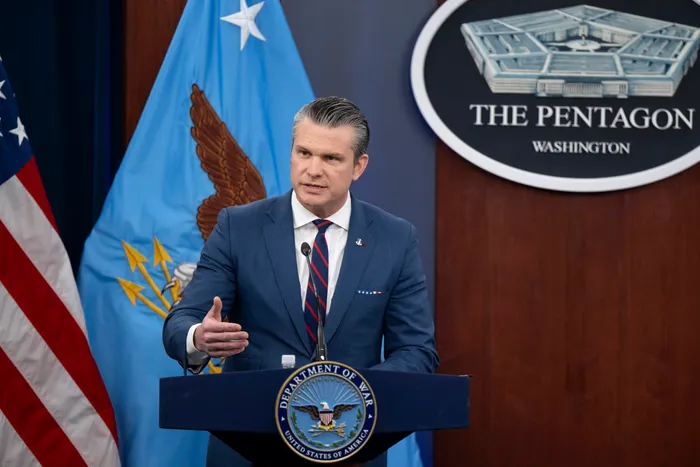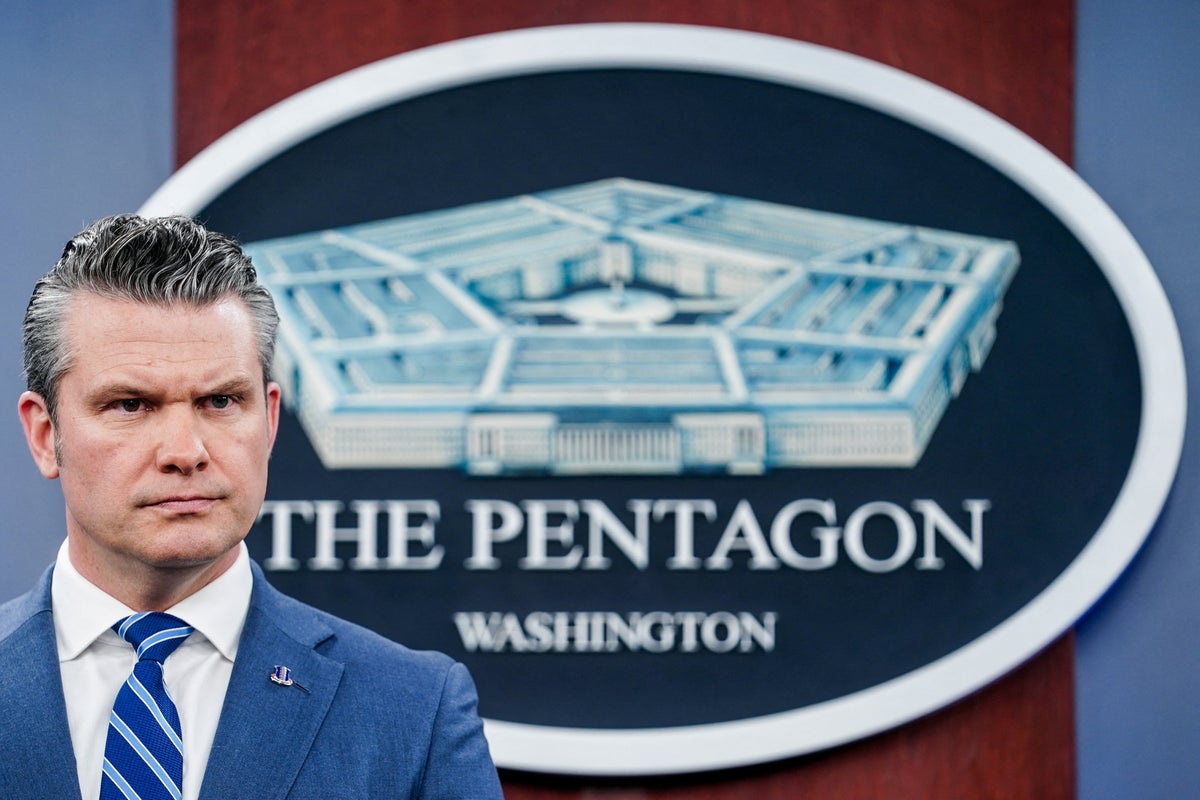
The room in the Pentagon briefing center usually smells of stale coffee and the clinical ozone of high-end air filtration. It is a place for the cold calculus of geography and the dry recitation of casualty estimates. But when Pete Hegseth stepped to the lectern to address the brewing storm with Iran, the air changed. It didn’t feel like a strategic update. It felt like a revival tent.
There is a specific kind of silence that falls over a room when the person in charge stops speaking the language of policy and starts speaking the language of destiny. Hegseth wasn't just talking about drone strikes or naval blockades. He was vibrating with a frantic, restless energy that suggested he wasn't just fighting a war on the map, but a war for the soul of the world. His hands moved in sharp, jagged arcs. His eyes darted. Also making news in related news: The 10-Day Delusion Why Short-Term Ceasefires are Geopolitical Theater.
This was the intersection of high-stakes military command and deep-seated religious conviction, and the collision was jarring.
To understand why this briefing felt so alien to the career officers and seasoned journalists in the room, you have to look at what was missing. Usually, these briefings are built on the bedrock of "proportionality" and "deterrence." These are boring words. They are safe words. They are the words that keep the machinery of global power from grinding itself into dust. Hegseth, however, seemed to have discarded the manual. Additional details into this topic are explored by USA Today.
He didn't want to talk about de-escalation. He wanted to talk about righteousness.
Consider a young intelligence analyst sitting in the back row, someone whose entire career has been dedicated to the objective analysis of satellite imagery and intercepted signals. For years, they have been taught that the enemy is a set of capabilities and intentions—a rational actor, even if a hostile one. Suddenly, their superior is at the microphone, framing the conflict not as a dispute over enrichment levels or regional proxies, but as a cosmic necessity.
The analyst watches the slides. The data points are there. The troop movements are verified. But the narrative being draped over those facts is woven from a different cloth entirely.
It was a performance defined by a peculiar kind of panic. Not the panic of a man who is afraid of losing, but the panic of a man who is afraid of being misunderstood. Hegseth’s defense of the administration’s posture toward Tehran wasn't built on a series of logical "if-then" statements. Instead, it was a rapid-fire sequence of grievances and theological assertions. He sounded less like a Secretary of Defense and more like a man who had seen a vision and was frustrated that the rest of the world was still looking at a spreadsheet.
The religious undertones weren't subtle. They were the pulse of the presentation. In the American political tradition, faith has always been a quiet passenger, a moral compass tucked in a pocket. Hegseth moved it to the driver’s seat. He spoke of the conflict with a fervor that suggested the borders of Iran were less important than the spiritual boundaries of the West. When a leader begins to view a geopolitical rival not just as a competitor but as a metaphysical evil, the rules of engagement shift.
Diplomacy requires a common language. It requires both sides to agree that survival is the ultimate goal. But if you believe you are fighting a holy war, survival becomes secondary to victory.
The danger of this rhetoric isn't just that it's "weird" or "painful to watch," as the critics claimed. The danger is that it creates a closed loop. If every action by the adversary is proof of their inherent depravity, then no olive branch can ever be real. Every diplomatic gesture becomes a trick. Every pause in the fighting becomes a chance for the enemy to regroup. It eliminates the "off-ramp," that crucial bit of psychological space that allows both sides to walk away from the brink without losing face.
Hegseth’s agitation seemed to stem from the friction between his worldview and the reality of modern warfare. Modern war is tedious. It is about logistics, supply chains, and the slow, grinding pressure of economic sanctions. It is rarely a cinematic clash between the children of light and the children of darkness. By trying to force the Iran situation into that heroic mold, he looked increasingly out of sync with the very department he was meant to lead.
The Pentagon is a cathedral of process. It is a place where every decision is vetted by legal teams and ethics advisors to ensure it aligns with international law and national interest. Hegseth’s briefing felt like a sledgehammer swung at those windows. He wasn't interested in the process. He was interested in the result, and he seemed convinced that the result was preordained by a higher power.
Watching him, you couldn't help but think about the soldiers on the ground—the ones who actually have to live inside the consequences of these words. For a 19-year-old Marine on a carrier in the Persian Gulf, the nuances of a briefing might seem distant. But the energy at the top always trickles down. When the leadership stops talking about stability and starts talking about crusades, the atmosphere in the barracks changes. The mission creeps. The stakes stop being about "returning home" and start being about "defeating the infidel."
This is how small skirmishes turn into generational catastrophes.
The most unsettling part of the briefing wasn't the anger or the religion. It was the frantic pace. Hegseth spoke as if he were running out of time, as if the window for action was closing and he was the only one who could see the countdown clock. This kind of urgency is infectious and terrifying. It overrides the skeptical parts of the brain. It demands immediate alignment.
"Are you with us, or are you with them?"
That is the subtext of every sentence he uttered. It is a binary world. There is no room for the gray areas where most of humanity actually lives. There is no room for the Iranian teenager who just wants to listen to Western music, or the American voter who is tired of seeing trillions of dollars disappeared into the sands of the Middle East.
We often think of war as a series of physical events—missiles launched, buildings leveled, territory seized. But war begins as a story. It begins with one person convincing another that the people on the other side of the line are fundamentally different, fundamentally broken, and fundamentally dangerous. Hegseth wasn't just briefing the press on military readiness. He was telling a story.
He was painting a portrait of an inevitable clash, one where the details of the "why" were less important than the conviction of the "must."
As the briefing ended and the lights in the room dimmed, the journalists scrambled to file their stories. They wrote about the "weirdness" and the "anger." They focused on the optics. But the real story was the shift in the foundation. The Pentagon, for better or worse, has always been a secular institution, grounded in the brutal reality of what is possible. Hegseth brought in the impossible.
He brought in the divine.
And when the divine enters the war room, the room gets very small, very fast.
There is a cost to this kind of rhetoric that isn't measured in dollars. It's measured in the erosion of our ability to see our enemies as humans. When we wrap our foreign policy in the shroud of religious destiny, we stop being a republic and start being a cause. Causes don't compromise. Causes don't negotiate. Causes just burn until there is nothing left to consume.
Hegseth eventually stepped away from the lectern, leaving a trail of unanswered questions and a palpable sense of dread. The maps were still there. The data was still there. But the spirit of the room had been moved. The coffee was still stale, the ozone was still sharp, but the mission had been reframed. It wasn't about oil, or nuclear enrichment, or regional hegemony anymore.
It was about something much older, and much more dangerous.
The sermon was over, but the echo was just beginning to ring through the halls of power, a high, thin sound that promised a storm for which no amount of armor plating could ever truly prepare us.