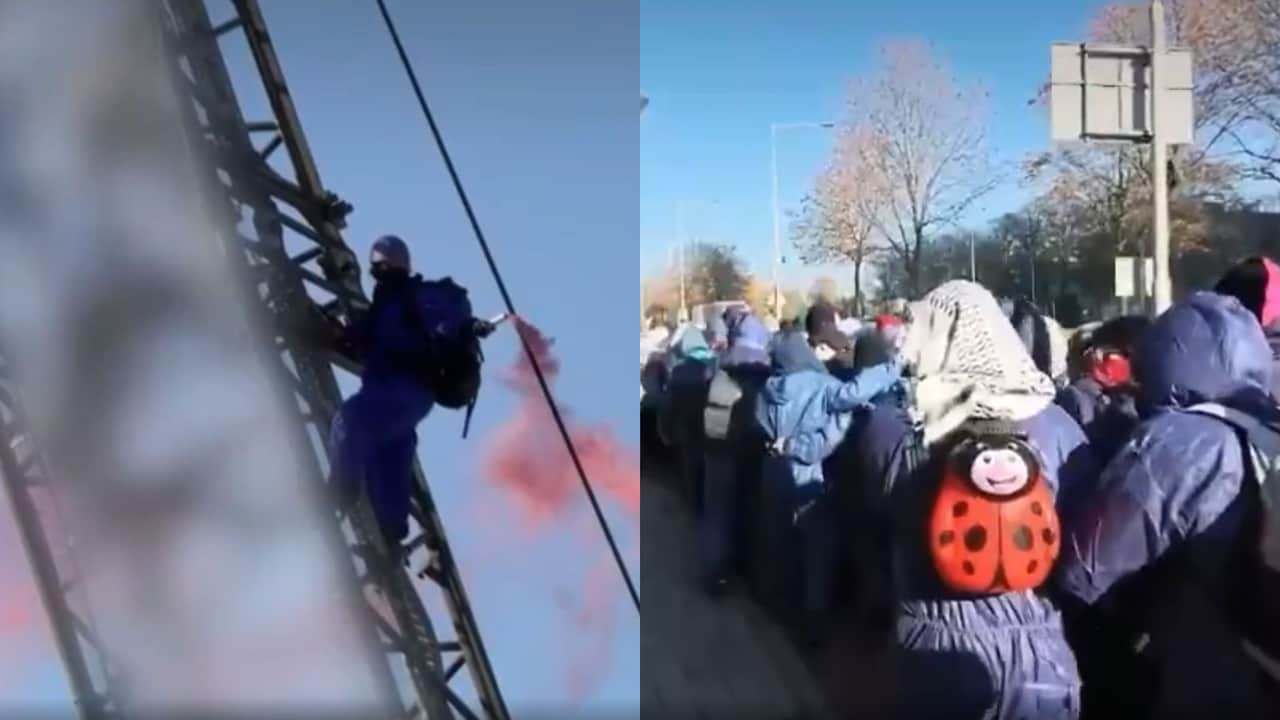
Activists scaling construction cranes and igniting flares at a Microsoft data centre site represent the sharp end of a global collision between artificial intelligence infrastructure, military cloud contracts, and local resource scarcity. While standard news coverage treats these occupations as isolated acts of trespassing, the reality on the ground is far more calculated. Demonstrators are targeting hyperscale construction zones because these physical facilities are the undeniable choke points of the modern tech economy, turning quiet suburban industrial parks into frontline battlegrounds over water rights, grid capacity, and state surveillance.
The Anatomy of a Crane Occupation
Climbing a tower crane is not an impulsive stunt. It is a deliberate tactical maneuver designed to halt multi-million-dollar construction schedules without causing permanent structural damage to the machinery.
When a handful of protesters breach perimeter fencing before dawn and ascend hundreds of feet into the steel latticework, site managers face an immediate legal and logistical freeze. Under standard occupational safety regulations across North America and Europe, heavy lifting operations cannot proceed while unauthorized personnel occupy the jib or operator cab. Every hour a crane remains locked down cascades into missed concrete pours, delayed steel deliveries, and penalty clauses for general contractors.
Flares serve a dual purpose in these operations. Visually, thick plumes of colored smoke pierce through morning fog and industrial fencing, ensuring that local television crews and smartphone cameras capture undeniable imagery from beyond the police cordon. Tactically, flares signal presence to site security immediately upon ascent, reducing the risk that an unaware crane operator powers up motors while climbers are still navigating the mast.
Police response follows a predictable, slow-moving playbook. Specialized rope-rescue units must be summoned, safety harnesses rigged, and negotiations initiated before a single arrest occurs. By the time officers bring demonstrators down in baskets, the visual message has already circulated across social media feeds and wire services, achieving maximum disruption with minimal physical footprint.
What Makes Microsoft Data Centres High-Value Targets
For decades, software felt weightless. Consumers uploaded photos, enterprises migrated databases, and the physical reality of computing remained hidden behind nondescript concrete walls. The generative AI boom shattered that illusion overnight.
Modern data centres built to train and run large language models require unprecedented concentrations of electricity, land, and cooling infrastructure. Microsoft, aggressively expanding its Azure cloud footprint to meet enterprise and government AI demand, has become one of the most visible builders of these massive campuses worldwide.
Activist coalitions have recognized a fundamental vulnerability in Big Tech's business model. You cannot boycott an enterprise cloud provider whose servers underpin municipal transit systems, hospital networks, and corporate payrolls. You can, however, physically obstruct the concrete and copper required to bring the next megawatt of compute capacity online.
Protesters generally converge on these sites from two distinct, increasingly overlapping movements.
Anti-Militarization and Defense Contracts
A primary driver behind direct action targeting Microsoft facilities stems from the company's deep integration with defense and intelligence agencies. Cloud computing is no longer merely back-office IT support; it is the foundational layer for modern battlefield logistics, satellite imagery processing, and automated targeting pipelines.
Groups like No Tech For Apartheid and broader anti-war collectives have systematically mapped out how commercial cloud infrastructure supports military operations abroad. When protests at corporate headquarters or developer conferences yield little more than polite security escorts and canned public relations statements, organizers pivot to physical supply chains. Blocking a crane at a regional server farm directly links abstract defense contracts to tangible local real estate.
Environmental and Grid Strain
Alongside geopolitical opposition sits a growing wave of local ecological resistance. Hyperscale data centres consume staggering volumes of power and water, often in regions already grappling with drought or aging electrical grids.
To understand the scale of local frustration, consider a hypothetical example of a mid-sized agricultural municipality approving a new 100-megawatt data centre campus. To keep thousands of high-density server racks from overheating during summer peaks, traditional evaporative cooling towers might draw millions of gallons of municipal water daily, competing directly with local farms and residential wells. Simultaneously, the utility grid must dedicate transmission capacity equivalent to tens of thousands of homes to a single facility that employs fewer than fifty permanent staff once construction finishes.
For environmental activists, halting construction machinery is framed as emergency self-defense for local watersheds and climate targets. When corporate sustainability pledges clash with rising fossil-fuel peaker plant usage needed to stabilize data centre loads, the construction crane becomes an obvious symbol of unchecked industrial expansion.
The Corporate and Regulatory Blind Spot
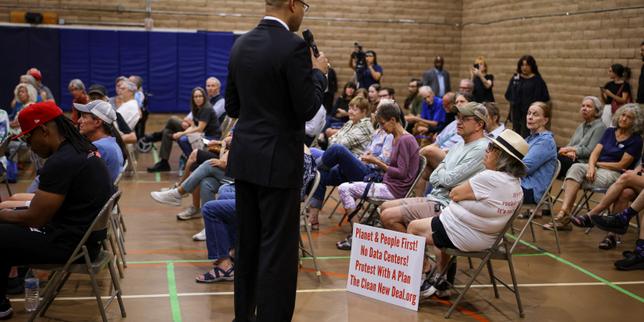
Tech executives and municipal planners routinely misread these protests as fringe disruptions rather than early warning signs of a deeper structural backlash. For years, data centre development operated under a cloak of strict non-disclosure agreements.
Local town councils often voted on zoning variances and tax abatements for massive industrial projects without knowing the end client's identity, hidden behind shell LLCs until the concrete foundations were already cured. That secrecy bought speed, allowing tech giants to erect server farms at breakneck pace. Yet it also bred deep public distrust.
When residents finally discover that the windowless megastructure rising next to their neighborhood belongs to a trillion-dollar corporation—and that its construction coincides with ratepayer hikes or water restrictions—traditional public comment periods have long since closed. Direct action fills the vacuum left by opaque permitting processes.
Security protocols at construction sites have struggled to adapt. General contractors budget for copper theft and routine vandalism, relying on chain-link fences, motion sensors, and overnight patrol guards. They are rarely equipped to deter disciplined activist cells trained in industrial climbing, lock-on devices, and coordinated media outreach.
The Economics of Disruption
Does climbing a crane actually stop a tech giant from building a data centre? No. The concrete eventually gets poured, the servers get racked, and the facility goes online.
Measuring the impact of these protests by whether a building gets canceled misses the actual economic mechanism at play. Direct action imposes friction costs across three specific dimensions that corporate risk analysts track closely.
- Insurance and Security Premiums: Repeated occupations force contractors to overhaul site security, deploying 24-hour perimeter surveillance, anti-climb sheathing on crane masts, and specialized private security details. These costs eat directly into construction margins and inflate future project bids.
- Schedule Cascading: Hyperscale data centre builds operate on razor-thin timelines dictated by chip delivery schedules and pre-sold cloud capacity. A two-day halt on a primary crane can push back electrical switchgear installation, delaying revenue generation by weeks.
- Reputational Contagion: Municipal politicians love ribbon-cutting ceremonies that promise tech-sector prestige. They despise headlines featuring riot police, aerial rescues, and smoke flares billowing over their districts. High-profile protests turn rubber-stamp zoning approvals into politically toxic debates in neighboring counties.
The Counter-Argument From Inside the Industry
Industry engineers and economic development officials view these blockades through a fundamentally different lens. From their perspective, halting data centre construction is performative sabotage that threatens critical digital infrastructure without solving any underlying geopolitical or environmental problems.
Modern society relies entirely on distributed cloud compute. Medical research, weather forecasting, financial clearinghouses, and everyday communications depend on expanding server capacity. Stopping a facility in one jurisdiction does not reduce global demand for cloud services; it simply pushes construction toward regions with weaker environmental oversight, cheaper coal-heavy electricity, and stricter anti-protest laws.
Furthermore, tech sector defenders point out that hyperscalers are among the largest corporate buyers of renewable energy globally, frequently underwriting new wind and solar installations that would otherwise struggle to secure financing. Next-generation cooling architectures, including closed-loop liquid cooling systems, are drastically reducing water consumption compared to older facilities. Blocking construction delays the deployment of newer, more efficient hardware that could replace aging, power-hungry legacy servers.
The New Reality of Digital Infrastructure
The era of invisible cloud computing is permanently over. Every AI query, cloud backup, and defense contract relies on physical steel, copper, concrete, and water anchored in specific communities.
As long as tech companies treat local permitting as a stealth operation and dismiss geopolitical dissent as mere public relations noise, activists will continue treating construction sites as legitimate targets. Reinforcing perimeter fences and prosecuting climbers for aggravated trespass may clear a crane for the next morning's shift, but security guards cannot solve the underlying friction between infinite digital ambition and finite physical resources. Until corporations and regulators bring genuine transparency to how data centres are sited, powered, and contracted, the flares on the skyline will keep burning.