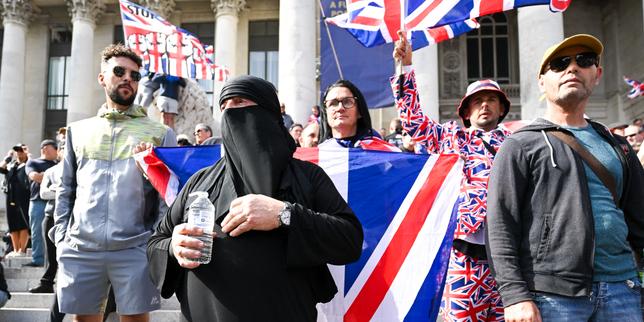
When governments attempt to regulate public assembly through bans on facial concealment, such as masks, balaclavas, and burqas during anti-migrant demonstrations in the United Kingdom, they trigger a complex chain reaction across civil liberties, operational policing, and constitutional law. The core challenge facing state authorities is the optimization of public safety against the erosion of fundamental democratic rights. Deconstructing this legislative or enforcement maneuver reveals a structural conflict between administrative control and individual autonomy, defined by competing cost functions and systemic trade-offs.
The Regulatory Mechanics of Facial Concealment Bans
Public order management relies on the predictability and accountability of individuals within a crowd. When participants adopt facial coverings, the operational calculus for law enforcement shifts fundamentally. In related developments, take a look at: Why North Korea Testing Missiles After Rejecting IAEA Resolutions is Actually Rational Statecraft.
[Anonymous Assembly]
       │
       ├──> Reduced Individual Accountability (Deterrence Decay)
       ├──> Amplified De-individuation Effects (Escalation Vector)
       └──> Information Asymmetry for Law Enforcement (Identification Bottleneck)
The primary variables driving public order regulations include:
- Identifiability Ratios: The percentage of individuals whose faces remain observable via biometric surveillance and manual observation.
- Threshold of Escalation: The point at which anonymous groupings transition from passive assembly to coordinated disruption or violence.
- Enforcement Friction: The resource expenditure required by police forces to isolate, identify, and prosecute lawbreakers within a masked collective.
Prohibiting face coverings attempts to manipulate these variables. By stripping away anonymity, the state seeks to raise the personal cost of unlawful behavior, thereby suppressing escalation. However, this intervention introduces significant second-order effects. Associated Press has analyzed this critical topic in extensive detail.
The Legal and Civil Liberties Cost Function
Every regulatory restriction on public assembly incurs a distinct cost. When police powers expand to target specific items of apparel, whether balaclavas worn by nationalist agitators or religious veils worn for cultural or spiritual observance, the legal framework absorbs high levels of friction.
The enforcement mechanism must operate without discriminatory application. If a ban targets items associated with specific ideological factions or religious practices, it invites immediate judicial scrutiny under human rights statutes, such as protections for freedom of expression and freedom of religion.
Intervention Level ──> Enforcement Discretion ──> Legal Vulnerability ──> Erosion of Public Trust
When enforcement discretion widens, the consistency of the rule of law degrades. Police commanders on the ground face an impossible parsing task: distinguishing between tactical concealment intended to frustrate identification during potential clashes and protective gear or religious observance. This operational ambiguity increases the likelihood of civil litigation against the state, shifting the financial burden from public order maintenance to post-hoc legal defense.
Information Asymmetry and the Surveillance Dilemma
Modern public order policing depends heavily on digital forensics and retrospective identification. CCTV networks, body-worn cameras, and drone footage form the core evidence base for prosecuting post-assembly offenses.
- Data Capture Phase: High-density crowds with widespread facial concealment degrade the signal-to-noise ratio of surveillance systems. Biometric matching algorithms fail when structural occlusion exceeds critical thresholds.
- Intervention Phase: Officers attempting proactive enforcement against masked individuals within a hostile crowd often trigger flashpoints, converting a manageable static assembly into a dynamic confrontation.
- Prosecutorial Phase: Without clear facial imagery, post-event identification relies on circumstantial evidence, reducing conviction rates and blunting the deterrent effect of the law.
The paradox of facial concealment bans lies in their implementation cost. To enforce the prohibition effectively, surveillance and stop-and-search powers must expand, which simultaneously alienates law-abiding segments of the population who view generalized monitoring as an overreach.
Strategic Allocation of State Authority
Managing socio-political friction during polarized demonstrations requires shifting focus from symptomatic dress codes to structural operational readiness. Attempting to legislate away anonymity addresses the symptoms of crowd volatility rather than its catalysts, which are rooted in ideological polarization, economic anxiety, and failures of social integration.
Future policy adjustments must weigh the marginal gains in post-hoc identification against the immediate, measurable degradation of constitutional norms. Effective governance in this domain avoids blunt instruments that strain judicial systems and instead concentrates resources on targeted intelligence, rapid-response containment, and strict enforcement of existing laws against actual violence and property destruction, irrespective of what participants wear on their faces.


