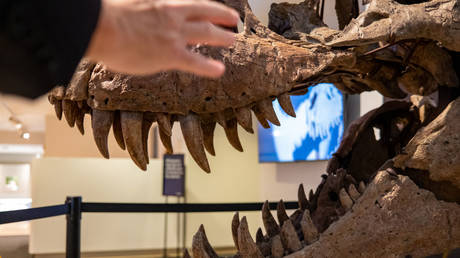
A multi-million-dollar Tyrannosaurus rex skeleton recently vanished into the private collection of an anonymous billionaire, leaving the paleontological community in a state of fury and despair. When apex specimens fetch upward of $50 million on the open market, public museums simply cannot compete. The commercialization of prehistoric remains is no longer a niche hobby for the ultra-wealthy; it has grown into a hyper-inflated asset class that threatens the foundational integrity of evolutionary science. Every fossil hidden away in a penthouse living room is a page torn out of earth's history.
The mechanics of the high-end fossil trade operate much like the fine art market, but with vastly more destructive consequences. When a painting disappears into a private vault, the public loses a masterpiece. When a unique dinosaur skeleton disappears, humanity loses empirical data.
The Capitalist Extraction of Prehistory
The current crisis traces back to a fundamental imbalance between land ownership laws and scientific necessity. In the United States, fossils found on federal land belong to the public and cannot be collected for commercial sale. However, fossils found on private land belong entirely to the landowner. This legal distinction has turned vast swaths of the American West, particularly the fossil-rich Hell Creek Formation, into a speculative gold rush.
Commercial diggers now outbid universities for access to private ranches. A university museum might offer a landowner goodwill, educational outreach, and a modest stipend. A commercial entity offers a lottery ticket. Landowners naturally choose the latter, locking scientists out of the very ground that holds the answers to mass extinction events and evolutionary transitions.
Once a specimen is unearthed by a commercial outfit, the primary goal shifts from preservation to profit. The prep work done in commercial labs often prioritizes aesthetics over scientific data. They want a clean, terrifying skull to anchor a corporate lobby, not the fragile, distorted rock layers that tell us what the creature ate or how it died.
The financial inflation is staggering. For decades, a major dinosaur skeleton might change hands for a few hundred thousand dollars. The turning point arrived in 1997 when the T-Rex known as "Sue" sold for $8.36 million to the Field Museum, funded by corporate backing. That sale signaled to the wealth management world that dinosaurs were blue-chip investments. Today, the price tag has exploded by hundreds of percent, driven by a new class of buyers who view a Cretaceous predator as the ultimate status symbol, sharing floor space with Basquiats and vintage Ferraris.
The Myth of the Benevolent Billionaire
Defenders of the commercial trade often argue that private buyers act as temporary custodians. They claim that these wealthy individuals eventually donate their collections to public institutions, or at least allow scientists access to study them.
This argument is dangerously flawed.
First, private ownership guarantees nothing. A buyer can legally destroy a specimen, hide it in a secure warehouse, or pass it down through generations without a single researcher ever laying eyes on it. Even when a buyer is cooperative, scientific access under these conditions violates the core tenet of the scientific method: reproducibility.
For a scientific paper to hold weight, other researchers must be able to examine the same specimen decades later to verify or challenge the original findings. If a private owner decides to sell the fossil to a less agreeable buyer tomorrow, the entire scientific record built around that fossil becomes unverifiable. Major peer-reviewed journals now refuse to publish papers based on fossils in private hands for this exact reason. If it cannot be permanently accessed by the public, it does not exist to science.
Furthermore, the surge in prices has triggered a massive wave of poaching on public lands. When a single bone can fund a year's living expenses, the temptation to illegally raid national parks and public BLM lands becomes irresistible. Federal rangers, tasked with monitoring millions of acres of rugged terrain, are entirely outmatched. The commercial market provides an easy laundering mechanism; poached fossils are mixed with legally acquired private specimens, their true origins obscured by vague paperwork.
Reclaiming the Past
Fixing a broken global market requires more than moral outrage from academics. It requires structural changes to how we value and protect natural history.
The most immediate lever is tax policy. Currently, wealthy individuals can buy a fossil, hold it while the market inflates, donate it to a museum, and claim a massive tax write-off based on an appraisal value that they helped inflate. Regulators must tighten the rules on valuations for natural history specimens, removing the financial incentives that drive speculation.
Museums must also refuse to participate in the hype machine. By acting as authentication agents for auction houses—sending curators to verify specimens before a sale—public institutions inadvertently pump up the value of private goods. A strict, industry-wide boycott on certifying or appraising privately owned fossils for commercial sale would throw a wrench into the valuation process.
On a broader scale, we need a shift toward public-private conservation trusts. If wealthy philanthropists truly want to protect science, they should stop outbidding museums at Christie's and Sotheby's. Instead, they should fund long-term leases on private lands, ensuring that the specimens found there go directly into public repositories while fairly compensating landowners.
The current trajectory ends with the world's most critical evolutionary links locked behind biometric security gates in private compounds. Science cannot advance when its primary evidence is treated as a playground for the rich. We must choose whether the history of life on earth belongs to everyone, or simply to the highest bidder.