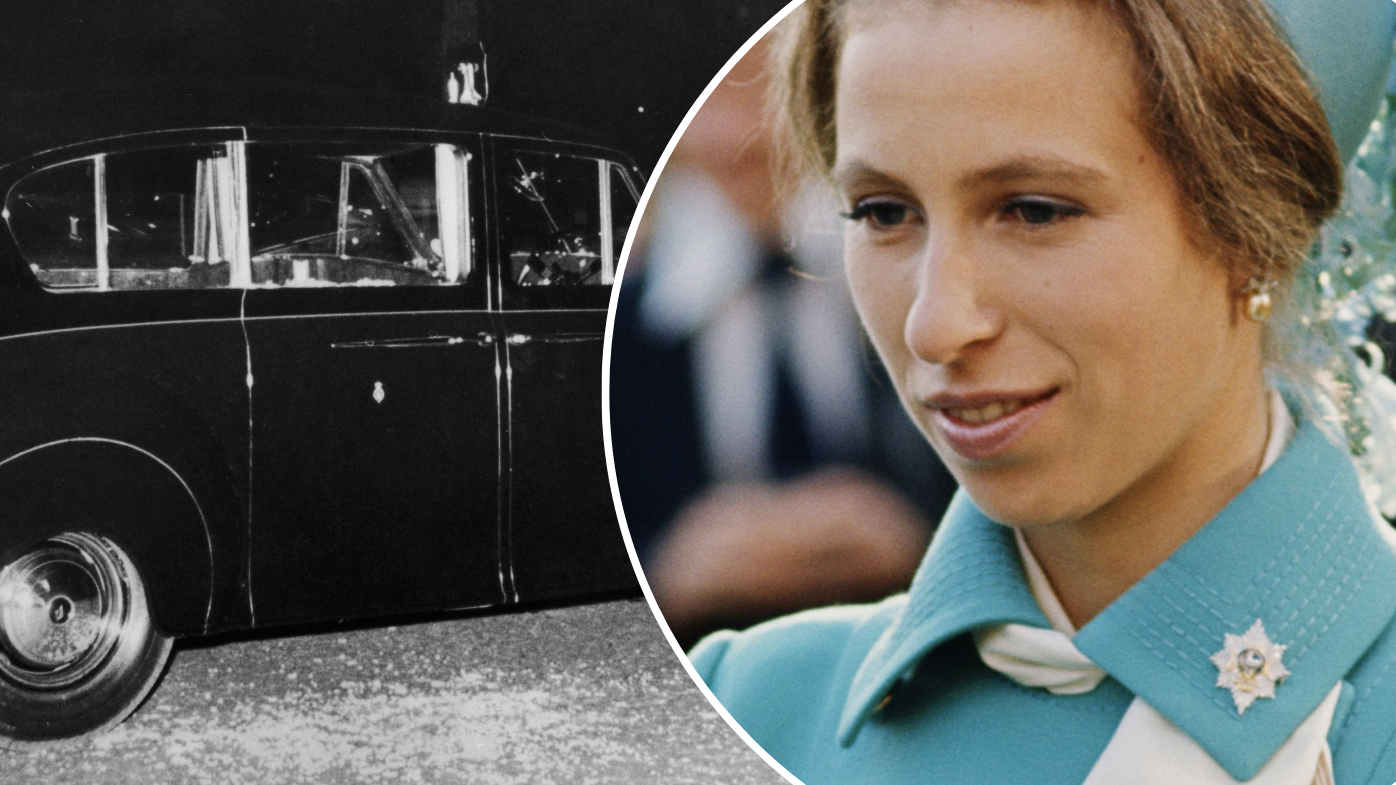
Most people think of royal security as an impenetrable bubble of bulletproof glass and stoic men in earpieces. On a cold March night in 1974, that bubble didn't just leak. It shattered. What happened next on Pall Mall remains the most insane attempted kidnapping in modern British history. It wasn't the police or a sudden stroke of luck that saved the day. It was the sheer, icy stubbornness of a 23-year-old woman who refused to be told what to do.
Princess Anne wasn't just a victim. She was an obstacle. When Ian Ball blocked her car and started shooting, he expected a terrified princess to crawl into his getaway vehicle. He didn't get one. Instead, he got a woman who looked him in the eye and uttered four words that have since become the gold standard for British defiance.
"Not bloody likely."
The Ambush on Pall Mall
It's easy to forget how different things were fifty years ago. Security was surprisingly lax. Princess Anne and her then-husband, Captain Mark Phillips, were heading back to Buckingham Palace after a charity film screening. They were in a custom Austin Princess, driving down the Mall, a stone's throw from home.
A white Ford Escort overtook them and slammed on the brakes. This wasn't a road rage incident. Ian Ball jumped out with two handguns. Jim Beaton, Anne’s personal police officer, stepped out to see what was happening. He got shot in the shoulder. When he tried to return fire, his Walther PPK jammed. It was a nightmare scenario. The protection officer was down, the chauffeur was wounded, and a man with a gun was ripping open the rear door of the royal limousine.
Ball didn't want a political statement. He wanted money. Five million pounds, to be exact. He had a ransom note addressed to the Queen in his pocket and a pair of handcuffs in his hand. He told Anne she had to come with him.
Anatomy of a Royal Refusal
This is where the story shifts from a tragedy to something almost absurdly heroic. Most people, staring down the barrel of a .38 revolver, would freeze. Panic is the physiological default. But Anne has always been built differently. She later recounted the exchange with a level of detachment that’s almost chilling.
She didn't scream. She didn't hysterical. She stayed in the car and argued.
Ball kept tugging at her arm, trying to pull her out of the vehicle. Mark Phillips was literally holding onto her from the other side, a grim tug-of-war with a Princess of the Realm as the rope. Anne’s dress was ripped. The situation was deteriorating fast. Ball told her she had to come.
"I said I didn’t think I wanted to go," she later told Parkinson in a 1980 interview. "I was scrupulously polite because I thought it was silly to be too rude at that stage."
The "not bloody likely" moment wasn't just a snappy comeback. It was a tactical refusal to cooperate. By staying in the car, she forced the confrontation to stay in a public space. She bought time. In any kidnapping, the "second location" is where victims die. Anne seemed to know this instinctively, or perhaps she was just too annoyed by the inconvenience to comply.
The Chaos Outside the Car
While the standoff continued inside the Austin Princess, the Mall turned into a battlefield.
- Brian McConnell, a journalist who happened to be in a taxi nearby, tried to intervene. Ball shot him in the chest.
- Ronald Russell, a former boxer driving home from work, saw the commotion. He didn't keep driving. He stopped, walked up to Ball, and punched him in the face.
- Officer Michael Hills arrived on the scene and was promptly shot in the stomach. He still managed to radio for backup.
It was a bloodbath. Four people were shot. Yet, throughout the entire ordeal, the target remained inside the car, anchored by her own refusal to move. Eventually, as more police sirens neared, Ball realized the window had closed. He fled into St. James's Park, where he was eventually tackled by DI Peter Edmonds.
Why Her Response Still Matters
We live in an era of highly curated royal personas. Everything is handled. Everything is softened. Princess Anne represents a direct link to an older, tougher version of the monarchy. She doesn't do "relatable." She does duty, and she does it with a bluntness that borders on the legendary.
The 1974 incident defined her public image for decades. It proved that the "Spare" of that generation—a title she never complained about—was perhaps the most resilient member of the firm. She didn't need a therapy session to process the trauma on camera. She went back to work.
There's a lesson here about the power of saying no. Ball had the gun, but Anne had the moral high ground and a terrifying amount of composure. She stripped him of his power by refusing to acknowledge his authority over her. It’s a masterclass in psychological resilience.
The Aftermath and Security Shifts
The botched kidnapping changed everything for the Royals. Before 1974, they moved through London with a level of freedom that seems suicidal today. After that night, the "thin blue line" became a thick wall of specialized protection.
All seven men who intervened that night were decorated for their bravery. Ronald Russell, the boxer who threw the winning punch, was awarded the George Medal. When the Queen presented it to him, she reportedly said, "The medal is from the Queen, but I want to thank you as Anne’s mother."
Ian Ball was eventually sent to Broadmoor Hospital under the Mental Health Act. He’s still there. He wasn't a mastermind; he was a desperate, mentally ill man with a disorganized plan. But disorganized plans are often the most dangerous because they’re unpredictable. Anne’s ability to remain predictable—to remain a fixed, stubborn point in the middle of a swirling crisis—is what kept her alive.
What You Can Learn from the Princess
You’re probably never going to be targeted by a kidnapper on the streets of London. But the "not bloody likely" mindset is worth adopting when things go sideways in your own life.
- Don't move to the second location. Whether it's a bad business deal or a toxic argument, don't let someone move the conflict to a place where they have the advantage. Stay on your own turf.
- Keep your cool. Panic narrows your vision. Anne’s ability to remain "scrupulously polite" while being shot at allowed her to see the gaps in Ball’s plan.
- Wait for the backup. You don't always have to win the fight alone. Sometimes you just have to not lose long enough for help to arrive.
If you want to understand the modern British monarchy, stop looking at the tabloids and start looking at the 1974 police reports. They show a woman who, when faced with a literal gun to her head, decided she simply had better things to do than be kidnapped.
If you’re interested in the history of royal security, your next step is to look up the 1982 Michael Fagan incident. It’s the only other time the Palace security failed this spectacularly, and it happened right in the Queen's bedroom.