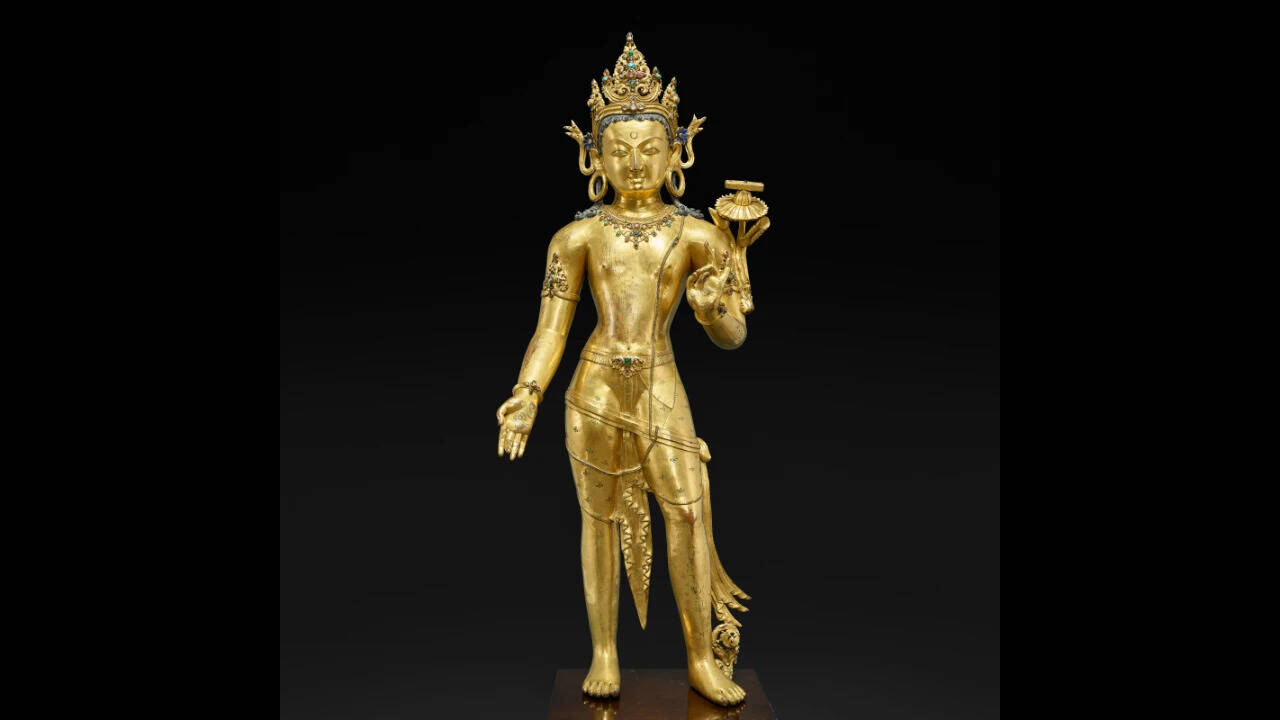
A twelfth-century gilt-bronze statue of Manjushri, originating from the Kathmandu Valley of Nepal, cleared the auction block in 2026 for approximately Rs 166 crore (roughly $19.5 million to $20 million USD depending on exact settlement exchange rates). Most market observers treat a price tag of this magnitude as an anomalous trophy purchase by an ultra-high-net-worth collector. That interpretation misses the structural mechanics of the high-end Asian antiquities market. The valuation of the 2026 Manjushri sale is the predictable output of four interacting variables: extreme supply inelasticity enforced by international cultural property law, the metallurgical and iconographic dominance of the early Malla and Transitional periods, institutional provenance arbitrage, and the function of museum-grade Himalayan bronzes as non-correlated stores of capital.
Understanding how an eight-hundred-year-old liturgical object commands nearly two hundred crores requires dissecting the valuation engine that governs top-tier South Asian and Himalayan art.
The Valuation Function of Himalayan Antiquities
In liquid financial markets, asset pricing relies on discounted cash flows or comparable multiples. In the market for museum-grade antiquities, where true comparables appear once per decade, auction houses and private advisors price assets using a multiplicative risk-and-scarcity model. When any single variable in this equation approaches zero, the asset becomes unsellable at the institutional level; when all variables max out simultaneously, price discovery disconnects from historical averages.
- Art-Historical Significance and Periodization ($S$): The twelfth century represents the apex of Nepalese metallurgy. Falling at the end of the Transitional Period (c. 879–1200 CE) and the dawn of the Early Malla Period, bronzes from this era exhibit a synthesis of Pala-dynasty Indian naturalism and indigenous Newar technical mastery.
- Physical Condition and Gilding Retention ($C$): Fire-gilding (mercury amalgam gilding) on copper-alloy sculptures degrades rapidly under ritual handling—specifically the application of vermilion paste, butter, and water during centuries of worship. High retention of original mercury gilding exponentially increases market value.
- Documented Provenance Depth ($P$): Under modern compliance regimes, an antiquity without an unbroken, verifiable ownership chain predating the 1970 UNESCO Convention carries severe legal and reputational liability. Clean provenance acts as a massive price multiplier because it unlocks institutional and compliant private capital.
- Scale and Iconographic Rarity ($R$): Small devotional bronzes (under 15 centimeters) are relatively common. Large-scale, complex cast-copper figures exceeding 40 centimeters require advanced lost-wax casting infrastructure that only royal or major monastic workshops possessed.
The Rs 166 crore realization occurred because the 2026 Manjushri scored at the absolute ceiling across all four parameters simultaneously.
Supply Inelasticity and the 1970 Compliance Wall
The primary driver of price acceleration in Nepalese sculpture is not rising demand alone, but a legally mandated supply freeze. Following the adoption of the 1970 UNESCO Convention on the Means of Prohibiting and Preventing the Illicit Import, Export and Transfer of Ownership of Cultural Property, alongside Nepal’s Ancient Monument Preservation Act of 1956 (and its subsequent strict enforcement amendments), the legal export of twelfth-century Nepalese artifacts ceased entirely.
This regulatory framework split the global inventory of Himalayan art into two distinct asset classes with radically different liquidity profiles:
- Non-Compliant Inventory: Objects that surfaced on the international market after 1970 without documented export permits. Major auction houses refuse to handle these works, museums cannot acquire them under Association of Art Museum Directors (AAMD) guidelines, and sovereign repatriation task forces actively target them for seizure. Their market value is functionally impaired.
- Grandfathered "Legacy" Inventory: Objects that left Nepal prior to 1970—typically via nineteenth-century British diplomatic missions, early twentieth-century European explorers, or mid-century collectors—and possess airtight archival documentation (exhibition catalogs, customs declarations, dated photographs).
Because the pool of grandfathered twelfth-century Nepalese bronzes is strictly finite and steadily shrinking as private collectors donate works to tax-exempt public museums, the supply curve is completely vertical. Every time a museum acquires a documented piece, it is permanently removed from commercial circulation. Consequently, when a legacy-provenanced masterpiece enters the open market, bidders are not merely buying a sculpture; they are competing for one of the last legally tradable tier-one assets in the category. The Rs 166 crore price reflects a scarcity premium driven by legal quarantine.
Metallurgical Mastery of the Kathmandu Valley
To understand why a twelfth-century Nepalese Manjushri outprices comparable works from neighboring regions, one must examine the material science of Newar metalwork. During the twelfth century, the Kathmandu Valley functioned as the premier artistic foundry for the entire Buddhist world, exporting both finished bronzes and master craftsmen to Tibet and the Mongol court.
Newar artisans rejected the high-tin or brass alloys common in North India, favoring instead nearly pure copper (often exceeding 95 percent copper content). Pure copper presents severe technical challenges in lost-wax (cire perdue) casting due to its high melting point (1,085°C) and tendency to absorb gases, which causes porosity and casting flaws. Newar masters overcame this through precise mold venting and core stabilization, producing hollow-cast figures with remarkably thin, uniform walls.
The choice of high-purity copper served a specific aesthetic and economic purpose: it provided the ideal substrate for fire-gilding. Artisans dissolved gold in mercury to form a paste, applied it to the chased copper surface, and heated the bronze until the mercury vaporized, leaving behind a molecularly bonded layer of pure gold. On a Manjushri—the Bodhisattva of Transcendent Wisdom, iconographically defined by the upraised sword (khadga) that cuts through ignorance and the Prajnaparamita manuscript resting on a lotus—this warm, reddish-gold surface creates an unmatched visual luminance.
In the auction market, condition reports focus heavily on the preservation of this gilding and the integrity of the inlaid semiprecious stones (typically turquoise, lapis lazuli, and rock crystal) set into the crown and jewelry. Extensive rubbing of the face and chest indicates centuries of active worship, which, while culturally meaningful, diminishes sculptural crispness. A twelfth-century bronze retaining over 80 percent of its original mercury gilding and crisp cold-worked chasing along the dhoti hem commands an exponential premium over a worn example of identical age.
Provenance Arbitrage and Repatriation Risk Pricing
A critical failure in superficial art-market reporting is treating the final hammer price as a pure reflection of aesthetic quality. In 2026, a substantial percentage of a Rs 166 crore valuation represents a compliance insurance premium.
Over the past decade, aggressive enforcement by the Manhattan District Attorney’s Antiquities Trafficking Unit, Homeland Security Investigations, and dedicated citizen-researcher networks (such as the Nepal Heritage Recovery Campaign) has dismantled the "don't ask, don't tell" culture that previously characterized the Asian art trade. Numerous high-profile sculptures have been seized from major museums and private collections after researchers matched them to archival photographs of Kathmandu shrines from the 1960s and 1970s.
This enforcement reality creates a sharp risk-pricing spread:
- The Repatriation Discount: An object with a gap in its ownership history between 1950 and 1990 carries a high probability of total capital loss through legal forfeiture. Sophisticated buyers discount such assets heavily or avoid them entirely.
- The Clean-Title Premium: When a bronze comes to market with documented proof that it resided in an established Western collection prior to 1970—and has been vetted against photographic archives of Nepalese temples without raising a match—the risk of sovereign seizure drops near zero.
Buyers bidding in the Rs 150 crore to Rs 170 crore range are paying for title certainty. They are willing to deploy massive capital precisely because the asset has survived modern forensic provenance due diligence. The auction house’s role in this transaction is less about marketing and more about underwriting legal title through exhaustive archival research.
Macro Capital Flows and Alternative Asset Allocation
The timing of the Rs 166 crore sale in 2026 aligns with broader structural shifts in global wealth management. Traditional Western Impressionist and Modern art markets have experienced cyclical saturation, with top-tier supply bottlenecked in ultra-expensive estates and price growth flattening for mid-tier works. Simultaneously, sovereign wealth funds, family offices, and billionaire collectors across Asia—particularly in Greater China, Singapore, and India—have shifted capital allocation toward culturally resonant historical assets.
Within this macro environment, museum-grade Himalayan bronzes perform three distinct portfolio functions:
- Inflation Hedge with Zero Carrying Cost: Unlike real estate, yachts, or thoroughbreds, a compact bronze sculpture requires minimal maintenance, zero property tax, and negligible climate-control overhead. Storage and insurance costs are fractional relative to a Rs 166 crore principal value.
- Cross-Border Capital Portability: High-value antiquities concentrate immense financial density into a small physical footprint. A single statue weighing under 30 kilograms encapsulates nearly $20 million in globally recognized value, convertible into liquidity in New York, London, Hong Kong, or Zurich.
- Geopolitical Neutrality: Unlike equities or sovereign debt tied to specific national jurisdictions and currency regimes, a twelfth-century Buddhist sculpture holds universal cultural prestige across East, South, and Southeast Asia, insulating its valuation from localized currency devaluations.
Furthermore, the buyer pool for a Rs 166 crore Manjushri is bifurcated between private collectors seeking status and generational wealth preservation, and private museums (a rapidly expanding sector across Asia) requiring anchor masterpieces to establish institutional credibility. When two buyers with different mandates—one optimizing for private capital preservation, the other for public institutional prestige—compete in the same saleroom, bidding discipline evaporates and price discovery enters uncharted territory.
Limitations of the Trophy Antiquities Thesis
While the Rs 166 crore benchmark demonstrates extraordinary upside for top-decile Nepalese bronzes, treating this market as a frictionless upward trajectory ignores severe structural vulnerabilities.
First, liquidity is strictly episodic. An asset worth Rs 166 crore at a flagship evening sale cannot be liquidated in thirty days without suffering a 40 to 60 percent haircut. Exiting a position at full valuation requires aligning with a biannual Asia Week auction cycle, securing favorable catalog placement, and hoping at least two motivated underbidders remain active in the category.
Second, provenance standards are retroactive and tightening. A provenance dossier deemed acceptable in 2015 may be rendered toxic in 2030 if newly digitized photographic archives from mid-century anthropologists surface and link the piece to a specific Kathmandu courtyard (bahal). Buyers face permanent tail risk: cultural property law does not operate under standard commercial statutes of limitations when theft from a religious monument is proven.
Third, attribution risk remains binary. The valuation gap between a genuine twelfth-century Newar masterwork and a seventeenth-century Tibetan revival piece made in the Nepalese style (Nepalese-style versus Nepalese) exceeds an order of magnitude. While thermoluminescence testing of clay cores and X-ray fluorescence (XRF) alloy analysis provide empirical guardrails, final authentication still relies heavily on connoisseurship, creating sharp valuation cliffs if scholarly consensus shifts.
Capital Deployment Protocol for High-Value Antiquities
For family offices, institutional endowments, and private collectors evaluating entry into the upper tier of South Asian and Himalayan antiquities following the 2026 Manjushri benchmark, disciplined capital allocation requires strict adherence to a four-step acquisition protocol:
- Enforce a Hard 1970 Provenance Floor: Reject any asset lacking verifiable, third-party archival documentation (published exhibition catalogs, dated insurance schedules, or customs records) proving physical presence outside the country of origin prior to November 14, 1970. Never rely solely on dealer warranties or vague "private European collection" labels.
- Commission Independent Scientific Core and Alloy Testing: Prior to bidding, mandate X-ray radiography to inspect internal casting armatures and repair histories, paired with XRF metallurgy and clay-core thermoluminescence analysis (where accessible) to confirm twelfth-century material signatures and rule out modern over-gilding.
- Cross-Reference Temple Archives: Retain independent provenance researchers to screen the object against digitized archives of the Kathmandu Valley—specifically the Ulrich von Schroeder photographic documentation and local bahal inventories—to eliminate latent repatriation exposure before capital is committed.
- Concentrate Capital in the Top 1 Percent of Condition: Avoid mid-tier, heavily worn, or restored examples regardless of discount. In an illiquid, trophy-driven market, capital appreciation and downside protection concentrate exclusively in pieces retaining intact gilding, original stone inlays, and royal-workshop casting scale.