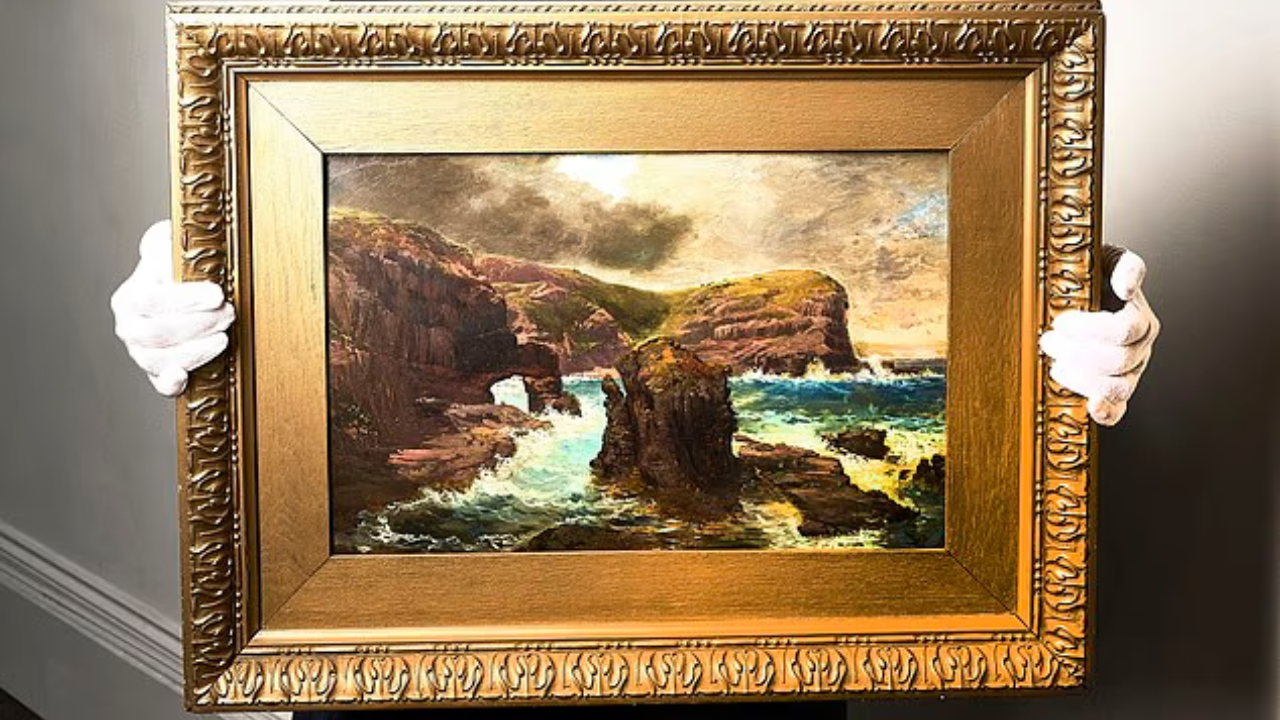
The discovery of a lost 19th-century painting by Nicholas Chevalier in a British charity shop—purchased for £20 and estimated to reach £20,000 at a December auction—is not a fluke of luck. It is a predictable outcome of severe information asymmetry across tiered secondary markets. When an asset moves from an uncurated liquidation channel to a specialized auction house, its valuation undergoes a 1,000x correction because the pricing mechanisms of the two environments operate on incompatible variables.
The Structural Economics of Thrift Store Mispricing
Charity shops and thrift retailers are not asset-valuation engines; they are high-volume inventory liquidation pipelines. Their operational objective is rapid floor turnover to convert donated physical goods into immediate liquidity while minimizing storage overhead. To achieve this, retail managers rely on heuristic pricing models based on superficial physical attributes rather than provenance or historical significance.
In this lower tier of the secondary market, a painting is priced according to three visible proxies:
- Frame condition and material: Gilded, intact frames trigger slightly higher baseline prices, whereas worn or unframed canvases are treated as low-tier decorative clutter.
- Surface aesthetics: Bright, modern-looking compositions often command higher shelf prices in thrift stores than dark, aged 19th-century varnishes, which retail staff frequently misinterpret as grime or amateur damage.
- Size-to-wall-space ratio: Large canvases occupy disproportionate floor or wall real estate, incentivizing managers to price them aggressively low to clear square footage.
Under these constraints, a £20 price tag represents a rational allocation of retail space by a non-specialist seller. The charity shop lacks both the institutional mandate and the specialized labor required to conduct forensic art history research on every donated canvas. Consequently, high-value assets slip through the intake filter priced identically to mass-produced commercial prints.
Information Asymmetry and the Arbitrage Gap
The transition from a £20 retail purchase to a £20,000 auction estimate illustrates classic market arbitrage driven by asymmetric knowledge. George Akerlof’s theory of market lemons demonstrates how uncertainty regarding quality depresses prices when buyers and sellers lack equal information. In a charity shop, both parties operate in a state of mutual ignorance, locking the asset's price at its lowest utility value—wall decoration.
The arbitrage event occurs the moment a buyer introduces specialized domain knowledge into the transaction. Recognizing the stylistic markers of an established 19th-century painter—such as Chevalier’s specific handling of light, brushwork, and topographic realism—immediately alters the asset's risk-reward profile. The buyer absorbs the cost of verification and authentication, effectively capturing the spread between the uninformed liquidation price and the informed collector market price.
This arbitrage gap persists because the cost of acquiring art-historical expertise exceeds the expected return of screening thousands of low-value donations. For a charity organization, hiring a full-time fine art appraiser would destroy unit economics across 99.9% of donated inventory. Therefore, occasional mispricings of five-figure assets are not operational failures; they are an acceptable mathematical byproduct of an optimized, low-margin retail model.
The Three Pillars of Art Valuation Mechanics
Once an unattributed canvas exits the thrift channel and enters a specialist auction house, its valuation is reconstructed from scratch. Auction specialists strip away the superficial metrics of the retail floor and apply an institutional framework built on three core pillars: attribution, scarcity, and historical provenance.
1. Forensic Attribution and Stylistic Verification
An unsigned or obscurely signed painting holds minimal market liquidity until specialists establish a defensible link to a known artist. Authentication relies on cross-referencing physical evidence with archival records. Specialists examine the weave of the canvas, the chemical composition of the pigments, and the specific mechanical habits of the artist's brushwork. For a painter like Nicholas Chevalier—a Russian-born artist of Swiss and French descent who achieved prominence in Victorian Britain and Australasia—specialists compare the topographic accuracy and atmospheric perspective against cataloged works held in institutional collections.
2. Market Scarcity and Supply Constraints
The auction estimate of £20,000 reflects the supply-and-demand dynamics governing works by an artist whose prime output is largely locked in museums or long-term private collections. Chevalier’s documented works reside heavily in major public institutions across Australia, New Zealand, and the United Kingdom. When a painting remains unseen for 160 years, it represents fresh-to-market supply. Private collectors and institutional buyers compete aggressively for newly surfaced works because they offer a rare opportunity to acquire an authentic piece without bidding against established gallery markups.
3. The 160-Year Provenance Gap
In standard art market operations, a 160-year gap in ownership history acts as a valuation discount due to legal risks surrounding title and authenticity. However, when a work can be anchored to a specific historical period—such as Chevalier’s mid-19th-century output—the narrative of rediscovery shifts from a liability to a commercial catalyst. Auction houses use the confirmed attribution to neutralize the provenance gap, positioning the piece as a historical recovery rather than an undocumented orphan work.
Operational Friction and the Cost Function of Discovery
Popular narratives around thrift store discoveries omit the massive survivorship bias and operational friction involved in executing successful art arbitrage. Turning a £20 purchase into a £20,000 auction realization requires navigating a rigorous multi-stage verification pipeline where most candidates fail.
To replicate this outcome systematically, a buyer must absorb several hidden operational costs:
- Search and Acquisition Overhead: Sourcing requires inspecting thousands of worthless canvases across dozens of locations, resulting in significant time expenditure and sunk capital in misidentified items.
- Conservation and Restoration Risk: Paintings stored in attics, basements, and charity backrooms suffer from flaking paint, oxidized varnish, and canvas tears. Improper cleaning destroys surface glazes and permanently erases market value, forcing the buyer to fund professional conservation before an auction house will accept the consignment.
- Authentication Bottlenecks: Leading auction houses enforce strict intake thresholds. If an artist’s estate or recognized catalog raisonné committee refuses to endorse a work, its market value collapses instantly back to decorative levels regardless of stylistic similarity.
- Transaction Friction: Auction houses charge seller commissions, photography fees, and insurance premiums, while buyers pay a buyer's premium on top of the hammer price. A £20,000 hammer price yields significantly less net capital to the consignor once institutional fees and conservation costs are deducted.
Why Victorian-Era Artists Generate High Arbitrage Yields
Nicholas Chevalier’s career trajectory explains why his works are uniquely susceptible to misidentification in the United Kingdom while commanding strong prices at specialized sales. Born in St. Petersburg in 1828, Chevalier trained in Lausanne, Munich, and Rome before migrating to Australia in 1854 and eventually settling in London in 1870, where he received commissions from Queen Victoria.
Because Chevalier operated across multiple continents and artistic traditions, his stylistic signature lacks the immediate visual recognition of domestic British icons like J.M.W. Turner or John Constable among general retail staff. A landscape painted by Chevalier carries European academic precision combined with Antipodean or British subjects. To an untrained charity shop worker, an unsigned or faintly signed Chevalier resembles a generic 19th-century European souvenir painting.
However, among specialist collectors of Victorian and colonial art, Chevalier’s cross-continental stature creates multi-regional demand. Buyers in the United Kingdom compete directly against collectors and institutions in Australia and New Zealand, where Chevalier is regarded as a foundational figure in 19th-century art history. This geographic bidding tension drives auction estimates upward once the attribution is publicized.
limitations of the Secondary Market Arbitrage Model
Treating charity shops as reliable sourcing channels for fine art is a flawed capital allocation strategy. The systemic inefficiencies that allowed a £20,000 painting to sell for £20 are actively shrinking due to technological intervention in retail intake processes.
Major charity chains increasingly deploy centralized triage hubs staffed by trained e-commerce listers equipped with reverse-image search tools and auction database subscriptions. When an unusual oil painting arrives at a regional donation center today, automated visual recognition software frequently flags stylistic matches before the item ever reaches a local shop floor. High-value donations are diverted immediately to online auction portals or regional fine art auctioneers, bypassing the £20 price tag entirely.
Furthermore, the binary nature of art attribution creates extreme downside variance. If the December auction fails to attract two competing bidders who trust the attribution, the painting risks failing to meet its reserve price—resulting in a "bought-in" status that publicly taints the asset's market record and depresses future resale value.
Strategic Execution for Asset Discovery
Buyers and analysts operating in uncurated secondary markets must abandon speculative hunting in favor of disciplined pattern recognition. Focus acquisition exclusively on physical construction markers that precede modern mass production: hand-stretched canvases with wooden keys in the corners, period-accurate stretcher bars showing natural oxidation, and hand-ground pigment textures visible under raking light. Ignore signatures during initial triage, as signatures are easily forged or obscured by dirt, and instead evaluate the anatomical and architectural competence of the brushwork. When a candidate passes physical inspection, bypass generalist local appraisers and submit high-resolution macro photography directly to departmental specialists at tier-one or specialized regional auction houses to establish attribution before committing capital to restoration.