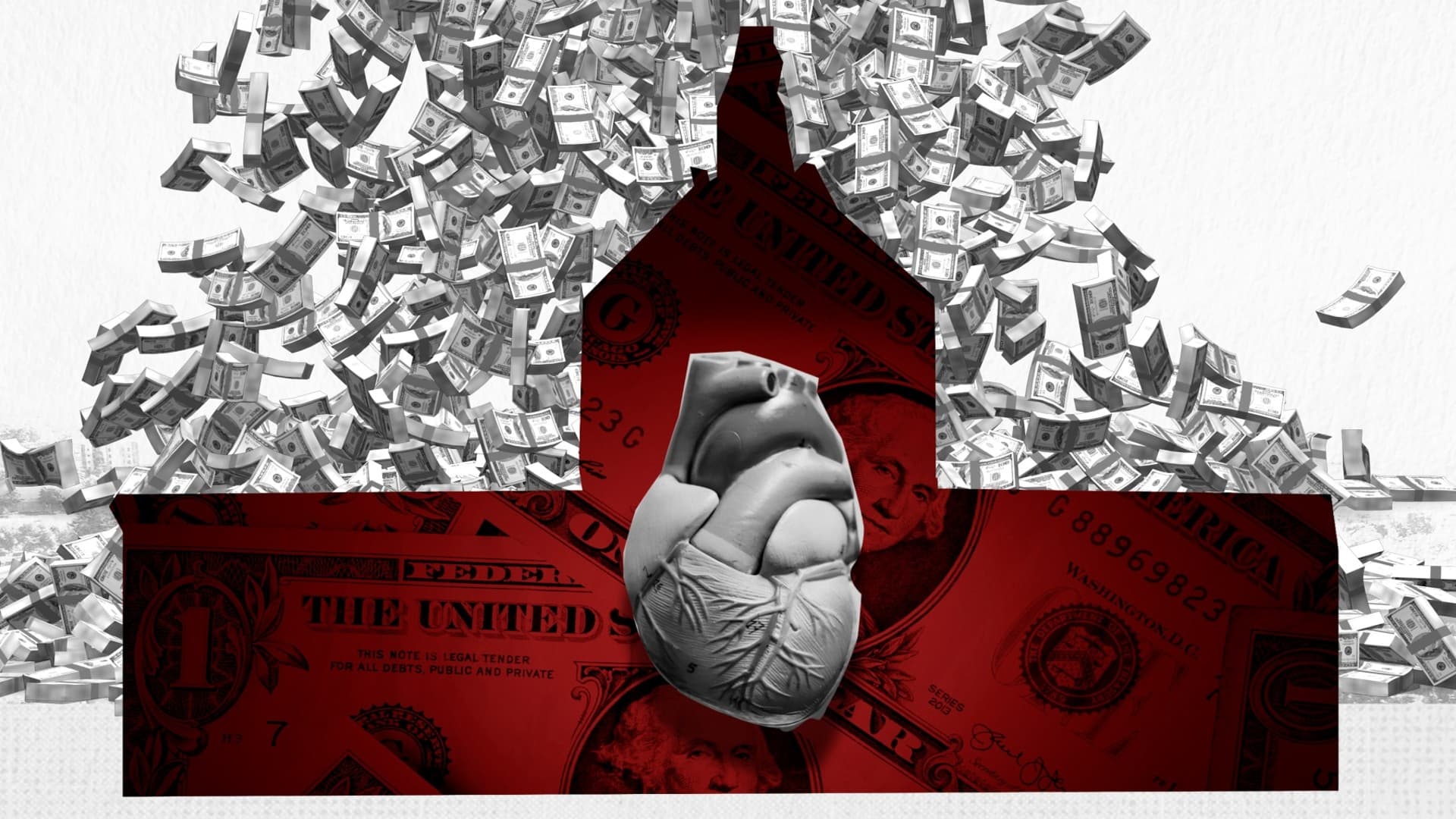
The sound of a pen scratching across a ledger in Washington D.C. rarely carries the weight of a mortar shell in Ukraine or the silent desperation of a darkened hospital in Gaza. Yet, they are inextricably linked. When Ajay Banga, the President of the World Bank, stands before a podium and speaks of $100 billion, most people see a figure too large to comprehend. It is an abstract integer, a row of zeros that exists only in the digital ether of international finance.
But money is not just math. In the context of war, money is the difference between a generation of children who learn to read and a generation that learns only how to hide. Also making headlines in related news: The Red Sea Shell Game Why Ship Seizures are the Global Economy's Best Friend.
Consider a woman named Elena. She is hypothetical, but her story is written in the rubble of every conflict zone from Eastern Europe to sub-Saharan Africa. Elena does not care about debt-to-GDP ratios or the capital adequacy frameworks of multilateral development banks. She cares about the fact that the bridge connecting her farm to the market was vaporized three months ago. She cares that the power grid is a skeleton of copper and charred remains. For Elena, the world has shrunk to the size of her immediate survival. When the guns fall silent, or even during the uneasy lulls between the noise, the true devastation begins to settle. It is the rot of stalled development.
This is where the World Bank is attempting to change its own DNA. Historically, these institutions were built for stability. They were designed to lend to countries with predictable futures. War is the antithesis of predictability. War is a black hole for investment. More details into this topic are explored by The Wall Street Journal.
The Math of Human Ruin
The "standard" way of looking at conflict-affected states is to wait for the dust to settle before writing a check. You wait for a peace treaty. You wait for a stable government. You wait for "certainty."
The problem is that certainty never comes to a graveyard.
If you wait five years to rebuild a school, you have lost a five-year-old child’s entire window for primary education. That child does not get those years back. The "human capital," as the economists call it—though let’s call it what it is: a soul's potential—is permanently diminished. This creates a feedback loop. Poverty breeds resentment; resentment breeds conflict; conflict breeds more poverty.
Banga’s proposal to mobilize up to $100 billion over the next decade is an admission that the old playbook is broken. It is a massive, high-stakes bet that the bank must become a first responder, not just a cleanup crew.
The mechanics of this are complex, but the logic is visceral. The bank intends to use its balance sheet more aggressively. By stretching its existing capital and bringing in private investors who are usually terrified of war zones, it aims to create a financial shield. Think of it as a form of global social insurance. If a country is hit by a catastrophe—whether it is a literal invasion or the economic shockwave of a neighbor’s collapse—this funding acts as a stabilizer. It keeps the lights on so the society doesn't completely liquefy.
The Invisible Stakes of a Shifting Ledger
Why should a taxpayer in a peaceful, prosperous nation care if $100 billion is directed toward the wreckage of far-off wars?
It isn't just about altruism. It is about the terrifying interconnectedness of the modern world. When a state fails, it doesn't fail in a vacuum. It exports its misery. It exports refugees. It exports radicalization. It exports supply chain disruptions that make the price of bread rise in a bakery five thousand miles away.
We often view these funds as "aid," a word that suggests a one-way street of charity. In reality, this is a defensive investment in global architecture. If the World Bank can keep a war-torn country's basic infrastructure from disappearing, it prevents that country from becoming a permanent ward of the international community. It preserves a future market. It maintains a shred of the rule of law.
But there is a friction here. The World Bank is owned by its member countries, and many of them are wary. They worry about risk. They worry about "moral hazard." They ask: if we make it easier to fund the aftermath of war, do we somehow make war more palatable?
It is a cynical question, but an honest one. However, it ignores the reality on the ground. No leader starts a war because they think the World Bank will give them a favorable loan for a sewage treatment plant three years later. The people who suffer from war have no say in its initiation, yet they are the ones who pay the "interest" on the destruction for decades.
The Alchemy of Risk
To get to that $100 billion figure, the bank has to perform a kind of financial alchemy. It is looking at "hybrid capital"—a way of raising money that sits somewhere between debt and equity. It is looking at "portfolio guarantees," where wealthy nations promise to step in if a loan goes bad, which allows the bank to lend far more than it actually has in the vault.
It sounds like dry accounting. It feels like the kind of talk that happens in wood-panneled rooms over expensive coffee.
Yet, imagine the impact of that alchemy on a single town.
With this funding, a municipal water authority in a conflict-adjacent zone can secure a loan that would otherwise be denied by every commercial bank on earth. They can fix the pipes. This means the children in that town don't get cholera. Because they don't get cholera, their parents can go to work. Because they can go to work, the local economy keeps a pulse. That pulse is the only thing that stands between a recovering society and a failed state.
We are currently witnessing a period of "polycrisis." The term is trendy in Davos, but it's terrifying in practice. It means that climate change, pandemic ripples, and systemic warfare are hitting all at once. The old thresholds for lending are simply too low for the height of the waves we are facing.
Banga’s shift is an attempt to turn a massive, slow-moving tanker of an institution into something more like a fleet of rescue boats. He is pushing for the bank to be "bigger and better," but "faster" might be the most important metric. In a war zone, time is a physical commodity. A dollar today is worth ten dollars three years from now, because three years from now, the talent has fled, the buildings have crumbled beyond repair, and the social fabric has been shredded.
The Weight of the Gavel
There is a deep, underlying tension in this movement. The World Bank was born out of the ashes of World War II. Its original mission was the reconstruction of Europe. In a sense, Banga is trying to return the institution to its roots, but on a global, much more volatile scale.
The challenge is that the world is no longer unipolar. The consensus that once drove these decisions is fraying. Every dollar allocated to a war-torn region is a dollar that some other country feels is being taken away from their own development needs. The competition for resources is fierce.
This is where the human element becomes a political tool. When we talk about $100 billion, we are talking about a choice. We are choosing to believe that the future of a child in a war zone is worth a financial risk. We are choosing to believe that stability is something that can be bought back, piece by piece, brick by brick.
The skepticism remains. Critics argue that the bank is becoming too political, or that it is taking on risks that could eventually threaten its own AAA credit rating. If the bank loses that rating, its ability to borrow cheaply on global markets vanishes, and the whole house of cards collapses. It is a tightrope walk over a chasm of human suffering.
The Silence After the Announcement
After the press releases are filed and the analysts have finished their spreadsheets, a quiet reality remains. $100 billion is a staggering amount of money, but the cost of the war in Ukraine alone is estimated to be over $400 billion for reconstruction. The gap between what is needed and what is available is still a canyon.
But the importance of Banga's move isn't just in the dollar amount. It is in the signal it sends. It tells the private sector that the world's most powerful developmental lender is willing to stand in the breach. It tells Elena, our hypothetical farmer, that the world hasn't entirely looked away.
Money is a language. For too long, the language of international finance has said: "You are too risky to save."
Now, the dialect is shifting. It is starting to say: "You are too important to lose."
As the negotiations continue and the capital frameworks are debated in those quiet rooms in Washington, the echo of that $100 billion is already traveling. It travels through the halls of ministries in Kiev, through the tents of displaced families in Sudan, and through the boardrooms of London and New York. It is a fragile, expensive hope.
The true test will not be found in the announcement, nor in the signing of the documents. It will be found in the first bridge that is rebuilt while the smoke is still clearing on the horizon. It will be found in the first school that opens its doors in a province that everyone else had written off as a total loss.
We have spent centuries perfecting the way we fund the destruction of the world. Perhaps we are finally getting serious about how we fund its repair. The ledger is open, the pen is moving, and the stakes are nothing less than the heartbeat of the next century.