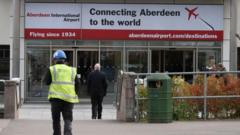
The plastic trays at airport security are strangely democratic. They do not care if you are flying first class to Dubai or catching a budget flight to London. Everyone strips away their outer layers. Everyone watches their keys, their shoes, and their loose change slide down the metal rollers into the dark mouth of the X-ray machine.
For the passengers rushing through Aberdeen Airport, this process is an annoyance. It is a minor friction point in a day defined by schedules, digital boarding passes, and the quiet anxiety of departures. But for the people standing on the other side of that conveyor belt, those plastic trays represent something else entirely.
They represent a breaking point.
When the news broke that security staff at Aberdeen Airport voted overwhelmingly to go on strike, the public reaction followed a predictable script. Commuters groaned. Vacationers checked their travel insurance. Airline executives scrambled to draft contingency plans. On paper, it looks like a simple labor dispute, a mathematical disagreement over percentages, hourly wages, and shift patterns.
The spreadsheets, however, are lying.
To understand why an airport stops moving, you have to look past the flight boards and focus on the eyes of the person asking you to take off your belt.
The Invisible Wall
Consider a hypothetical security officer. Let us call her Fiona. She has worked at the airport for seven years. She knows the exact weight of a bag that will cause the rollers to stick. She can spot a forgotten bottle of water through a lead-lined screen in less than half a second.
Fiona wakes up at four in the morning. The Scottish air is cold, a heavy gray mist rolling off the North Sea. By five, she is in uniform, standing beneath the harsh fluorescent lights of the terminal. Her job is a relentless paradox. She must be incredibly fast to keep the queues moving, yet impossibly meticulous to ensure that nothing dangerous gets onto an aircraft. One mistake can be catastrophic.
For this crushing weight of responsibility, Fiona earns a wage that has failed to keep pace with the reality outside the airport terminal. While the cost of gas, groceries, and rent in Aberdeen soared, her purchasing power shriveled.
The numbers tell a stark story, but the human reality is lived in the aisles of the local supermarket. It is the moment of quiet panic at the checkout line when the total screen flashes a number higher than expected. It is the decision to turn off the heating an hour earlier at night.
When a group of workers decides to strike, they are not looking for a holiday. They are trading their wages—money they desperately need—for a chance to be heard. A strike is an act of economic desperation masquerading as a logistical headache.
The Rhythm of the Terminal
An airport is an ecosystem of anticipation.
Step into Aberdeen Airport on any given Tuesday morning. The air smells of burnt espresso and jet fuel. The soundscape is a mix of rolling suitcase wheels, whispered goodbyes, and the chime of the PA system. It is a place designed for motion.
Security staff are the valves that regulate this motion. When they work effectively, they are invisible. You pass through, complain about having to take your laptop out of its sleeve, buy a magazine, and board your plane. You do not think about the person who checked your boarding card. You do not think about the physical toll of standing on a hard floor for an eight-hour shift, or the emotional toll of dealing with hundreds of stressed, angry, and impatient travelers every single day.
Then, the valve closes.
The decision to strike disrupts this rhythm entirely. The lines that usually snake efficiently through the stanchions begin to bulge. They spill out into the main check-in hall. The atmosphere changes from hurried anticipation to palpable anxiety.
Consider what happens next. The tension does not stay contained within the terminal walls. It ripples outward. Aberdeen is not just any regional airport; it is the gateway to the North Sea oil and gas industry. The flights leaving these runways carry engineers, technicians, and specialists to offshore platforms. A delay here does not just mean a missed weekend break in Amsterdam. It means a crew rotation on a rig ninety miles out at sea is broken. It means multi-million-pound operations are forced to pause because the human pipeline has dried up.
This is the hidden leverage of the security guard. The modern world likes to pretend that automation and technology run the show. We have self-service check-in kiosks, biometric facial scanners, and automated baggage drops. But when the human beings who operate the safety valves walk away, the entire multi-billion-pound apparatus grinds to a halt.
The Friction of Living
The debate surrounding the strike often centers on the concept of fairness. Management points to the economic pressures facing the aviation sector, the rising costs of operation, and the need to keep Aberdeen competitive. They offer percentages that sound reasonable in a boardroom.
But those percentages dissolve when they collide with the kitchen table.
Imagine sitting down with a calculator every month, trying to balance a budget that refuses to stay balanced. The frustration builds slowly. It is not a sudden explosion; it is a slow leak. It is the feeling of working harder and longer, taking on extra shifts, only to find that you are standing in the exact same place—or worse, slipping backward.
The security teams look at the executives who run the aviation hubs, individuals whose compensation packages are insulated from the price of a loaf of bread, and they see a profound disconnect. The strike is an attempt to bridge that gap. It is a physical manifestation of a simple question: What is our security worth to you?
We live in an era that demands total security but hesitates to pay the people who provide it. We want the skies to be perfectly safe, the lines to be perfectly short, and the tickets to be perfectly cheap. Something has to give. For years, the element that gave way was the well-being of the frontline staff. They absorbed the pressure. They took the verbal abuse from late passengers. They accepted the stagnant pay because a job is a job, and Aberdeen has known its share of economic downturns.
That tolerance has evaporated.
The Silence of the Runway
There is a specific kind of quiet that settles over an airport during an industrial action. It is unnatural. Runways are meant to roar. The terminal building is meant to hum with the collective energy of thousands of distinct human journeys.
Instead, there is a standstill.
The upcoming strike dates mean that for certain blocks of time, the normal chaos of travel will be replaced by a tense waiting game. Travelers will arrive hours earlier than usual, their faces tight with worry. Picket lines will form outside the terminal. Neighbors who pass each other in the local shops will find themselves on opposite sides of a security fence—one wearing a high-visibility vest holding a sign, the other clutching a passport and a suitcase, just trying to get to work.
It is easy to blame the workers for the chaos. It is easy to write angry social media posts about ruined holidays and disrupted business trips. But that blame is misplaced. The workers did not create the conditions that led to this vote. They did not cause the inflation that ate their wages, nor did they choose to ignore the warning signs that have been flashing for months.
A strike is a failure of communication long before it is a failure of transportation. It means that every meeting, every negotiation, and every compromise fell through. It means that the people who hold the keys to the gate felt they had no other choice but to lock it.
When the security gates slow down at Aberdeen Airport in the coming weeks, take a moment to look at the empty trays. They are a reminder that behind every flight, every trip, and every economic statistic, there is a human engine. If you do not maintain the engine, the machine stops running.