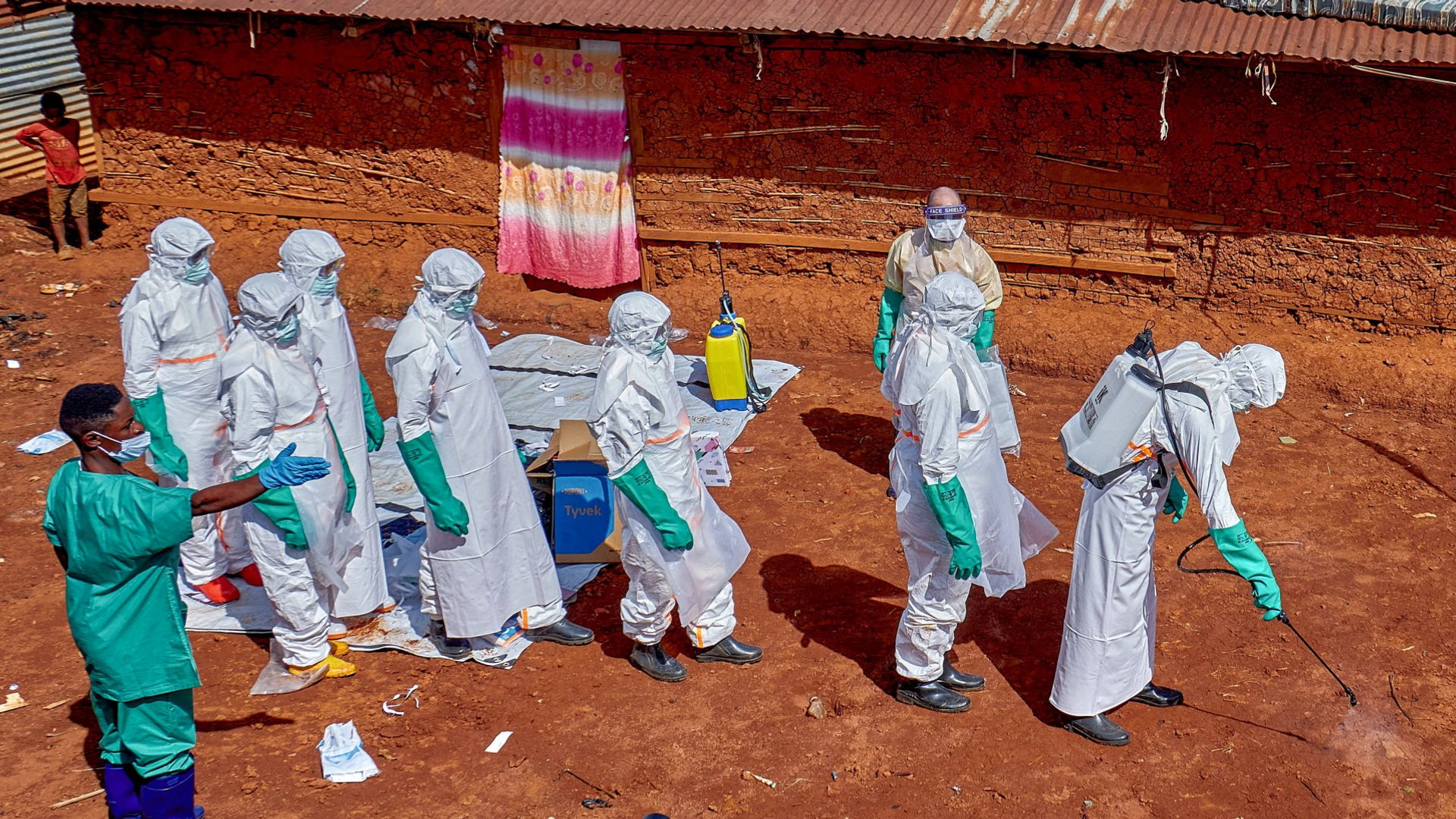
The plastic on a biohazard suit has a specific sound. When the air inside is suffocatingly hot and the humidity wraps around you like a wet blanket, every movement produces a sharp, rhythmic crinkle. It becomes the soundtrack to your survival.
For Dr. Amara Diallo—a composite of the countless underfunded physicians currently staring down outbreaks in West and Central Africa—that sound is currently accompanied by a silence that scares him much more. It is the silence of an empty supply closet.
Outside the makeshift clinic, the red dirt of the courtyard is baking under a merciless sun. Inside, Amara is staring at a single box of nitrile gloves. There are twelve pairs left. He needs eighty just to get through the afternoon shift safely. This is what an international aid cut looks like on the ground. It is not a line item in a government ledger or a percentage drop discussed in a sterile European briefing room. It is a doctor deciding which patient he can afford to touch.
When the global community decides to scale back funding for health crises, the decision is usually framed in the language of fiscal responsibility. Budgets must tighten. Priorities must shift. But viruses do not read balance sheets. They do not pause their replication because a foreign ministry changed its political alignment. Instead, they exploit the gaps left behind.
The Arithmetic of an Outbreak
To understand how a virus like Ebola tears through a community, think of a dam.
A virus is a massive, relentless body of water pushing against the wall. The frontline response—the epidemiologists tracing contacts, the community leaders distributing soap, the burial teams working in protective gear—is the concrete. When international aid cuts hit, they do not just shrink the overall size of the dam. They drill holes straight through the middle of it.
Consider the basic logistics of contact tracing. When a single person tests positive for Ebola, a clock begins to tick. Workers must track down every single individual that person interacted with over the past three days. In rural provinces, this means dispatching motorbikes across miles of unpaved, washed-out roads.
Last year, a fully funded regional response team had twenty motorbikes and a guaranteed supply of fuel. Today, after the latest round of international pullbacks, they have four. Two of them have bald tires. The fuel is rationed so strictly that tracers sometimes have to stop short of remote villages, turning back because the dial is dipping toward empty.
The math is brutal and unforgiving. If a tracer misses just one person—a cousin who rode on the back of a moped, a market vendor who swapped cash with the patient—the chain of transmission stays alive. The single spark becomes a brushfire.
The numbers back this up with terrifying clarity. Historical data from previous outbreaks shows that when surveillance funding drops by even fifteen percent, the time required to isolate a new case increases by nearly four days. In the world of hemorrhagic fevers, four days is an eternity. It is the difference between a contained medical anomaly and a regional catastrophe that threatens international borders.
The Human Cost of Calculated Risks
We often treat public health as a science of certainties, but on the frontline, it is an agonizing game of probability.
Imagine standing at the entrance of a treatment center. A mother arrives with her seven-year-old son. The boy has a burning fever and has been vomiting for twelve hours. These could be the early signs of Ebola. They could also be malaria, or typhoid, or a severe bout of gastroenteritis.
In a properly funded facility, the boy is placed immediately in a high-tech isolation unit. A rapid diagnostic test is run in an on-site laboratory, yielding results in a matter of hours. The staff wears fresh, heavy-duty personal protective equipment for every single interaction.
But when the funding dries up, the laboratory run times slow down because reagents are backordered. The isolation units are full, or worse, unstaffed because local nurses have gone weeks without their hazard stipends.
Amara has to make a choice. Does he put the boy in the general ward, risking the infection of dozens of vulnerable patients if the child does have Ebola? Or does he isolate him with confirmed Ebola patients, effectively handing the boy a death sentence if his original illness was just a standard case of malaria?
These are not the kind of choices taught in medical school. They are choices forced by the cruel geometry of scarcity.
The burden does not stop with the clinical decisions. It erodes the most fragile asset in any health campaign: public trust. When international organizations suddenly pack up their SUVs and pull out their staff due to sudden budget rescissions, the local population does not see a bureaucratic shift. They see abandonment. They begin to whisper that the medicine was a lie, that the foreign doctors came to harvest blood, and that the sudden disappearance of aid proves the conspiracy theories right.
Once trust evaporates, the frontline becomes a war zone. Communities stop reporting sickness. They hide their dead. They wash the bodies of their loved ones in secret, adhering to traditional burial customs that, while beautiful and sacred, act as a super-spreader event for a virus that remains highly contagious even after its host has died.
The Illusion of Separation
There is a comfortable fiction that wealthy nations tell themselves when they slash foreign aid budgets. It is the belief that distance creates security. We tend to view these crises through a lens of geographic isolation, as though an outbreak in a remote forest village is contained by the sheer physics of distance.
It is an illusion.
We live in a world where an individual can board a flight in a rural province and walk through the terminal of a major international hub less than twenty-four hours later. The frontline of an Ebola crisis is not thousands of miles away. It is a single airline ticket away from your local airport.
When we defund the organizations fighting the virus at its source, we are not saving money. We are simply delaying the payment, and the interest rate is paid in human lives.
Defunding the response teams also halts the vital work of preventive research and clinical trials. During periods of robust funding, researchers can run adaptive trials for new therapeutics and vaccines directly in the affected zones. When the money vanishes mid-cycle, those trials stall. The knowledge is lost. The next time a variant emerges, we find ourselves starting from scratch, scrambling to reinvent the tools we should have perfected years ago.
It is easy to look at the statistics and feel a sense of detachment. The numbers are so large, the geography so unfamiliar, the medical terms so clinical. But the reality is found in the small, quiet moments that never make the evening news.
It is found when Amara takes off his protective goggles at the end of a fourteen-hour shift. The rubber has dug deep, painful welts into his skin. His eyes are bloodshot from the fumes of the chlorine spray used to decontaminate his boots. He sits on a plastic crate, drinks a cup of lukewarm water, and looks at his phone.
He reads an article about a political debate in a capital city thousands of miles away, where politicians are applauding themselves for cutting foreign expenditure by a fraction of a percent to balance a domestic budget. Then he looks back at his supply closet, calculating how many pairs of gloves he can stretch through tomorrow morning by washing them in bleach—a practice he knows is dangerous, a practice he knows breaks every protocol, but a practice that is currently his only choice.
The true cost of cutting aid is not a drop in a country's gross domestic product. It is the weight of that silence in the supply room, and the terrifying knowledge that the concrete in the dam is beginning to crack.