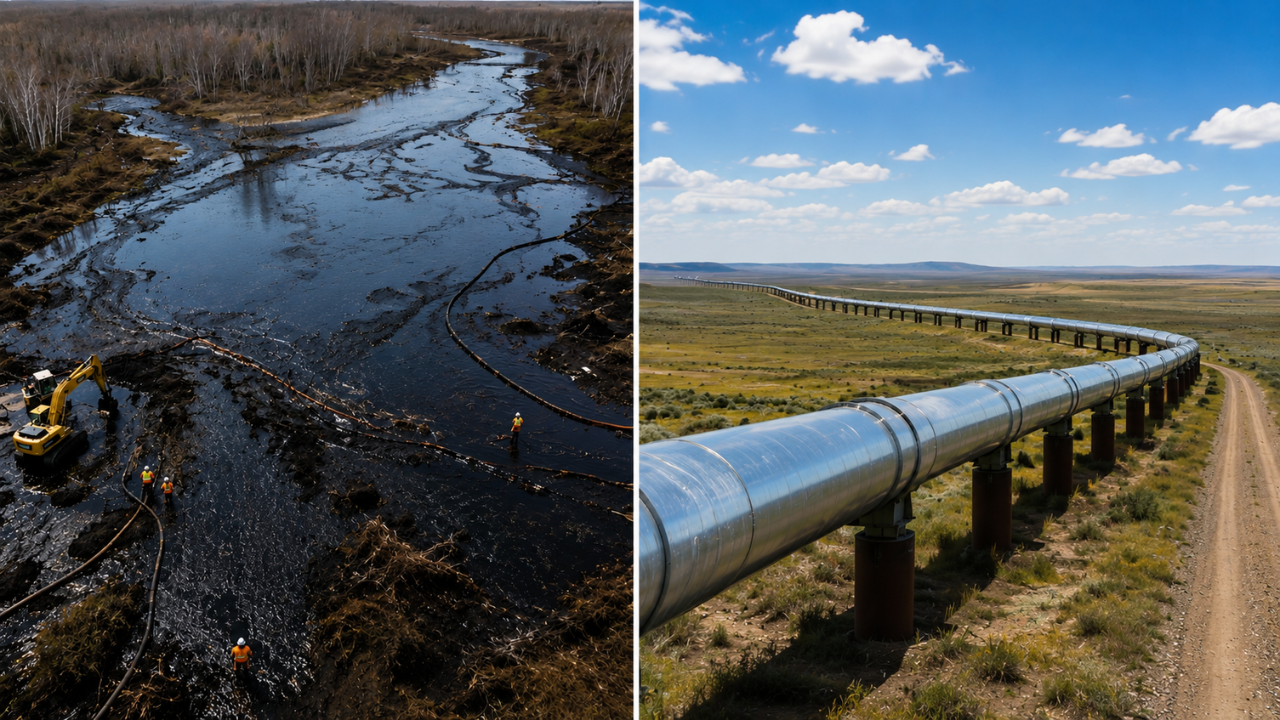
The dirt in Washington County, Kansas, has a memory. For generations, it has done exactly what it was asked to do: hold up the roots of winter wheat, drink the erratic Midwestern rain, and keep the secrets of the families who work it. But in December 2022, the earth here was forced to swallow something entirely foreign.
Nearly 13,000 barrels of heavy crude oil tore through a ruptured seam in the Keystone pipeline system. It didn't just spill; it pressurized, bursting into the freezing air and coating the tallgrass prairie in a thick, suffocating black sheet. It was the largest domestic oil spill in nearly a decade. You might also find this related coverage interesting: Why Donald Trump Threatens Canada Over Wildfire Smoke Ahead of the World Cup Final.
For the people living nearby, the immediate aftermath wasn't measured in corporate press releases or stock market fluctuations. It was measured in the smell. A heavy, chemical stench that clung to the back of the throat, turning the crisp winter air into a hazard. Mill Creek, a vital vein of water slicing through the local farmland, became a dark, stagnant mirror of a disaster.
The Quiet Mechanics of a Disaster
To understand how a creek in Kansas becomes a multi-million-dollar crime scene, you have to look beneath the topsoil. The Keystone pipeline is a steel artery. It moves hundreds of thousands of barrels of oil per day from the tar sands of Alberta, Canada, down to the refineries on the US Gulf Coast. It is designed to be invisible. As highlighted in recent reports by Reuters, the results are significant.
When it fails, the invisibility shatters.
The rupture occurred because of a combination of high welding stresses and bending fatigue. In plain terms, the pipe was under too much physical pressure, bending in ways it shouldn't have until the steel simply gave up. When that happened, the Canadian operator, TC Energy, found itself facing an environmental and logistical nightmare.
Consider a hypothetical farmer named John. John's family has run cattle near Mill Creek for eighty years. His grandfather built the fences; his children swim in the local ponds. On the morning after the spill, John doesn't see a corporate liability. He sees black sheen on the water where his livestock drink. He sees emergency response trucks rolling down gravel roads that usually only see tractors. The abstract concept of "energy independence" suddenly looks like a dead creek.
The cleanup effort was monumental. Crews descended on the rural area, setting up booms, vacuuming up the heavy oil, and excavating tons of contaminated soil. The federal government watched closely. The Environmental Protection Agency and the Department of Transportation’s Pipeline and Hazardous Materials Safety Administration launched investigations.
The immediate cleanup cost the company over $480 million. But the story didn't end when the last truck of soiled dirt drove away.
The Bill Comes Due
The true financial reckoning for environmental negligence often moves slower than the oil itself. Years after the initial rupture, the legal system finally caught up to the damage done to Washington County.
The Canadian pipeline firm agreed to pay a $26.9 million civil penalty to settle violations of the Clean Water Act.
Keystone Pipeline Spill Financial Impact
--------------------------------------------------
Immediate Cleanup Costs:      $480,000,000+
Federal Civil Penalty:        $26,900,000
Total Corporate Impact:       $506,900,000+
This fine represents a massive regulatory statement. Under the consent decree filed in federal court, the penalty is a direct consequence of discharging oil into navigable waters of the United States without a permit. The money is meant to punish, but also to deter.
But look closer at the numbers. To a massive multinational energy infrastructure corporation, $26.9 million is a line item. It is a cost of doing business, a predictable risk factored into quarterly spreadsheets. For the ecosystem of Mill Creek, however, the math is entirely different.
The heavy crude that spilled is not normal oil. It is diluted bitumen, or "dilbit." It is dense. Unlike conventional crude that floats on top of water, dilbit can sink when the lighter chemicals mixed into it evaporate. When it sinks, it settles into the riverbed, embedding itself in the sediment, suffocating the macroinvertebrates, and poisoning the food chain from the bottom up.
A settlement cannot instantly scrub the sediment clean.
The Invisible Stakes
Every time a pipeline is buried, a quiet bargain is struck between a community and a corporation. The community accepts the risk of a catastrophe in exchange for the promise of safe operation and economic utility. The corporation promises that its technology is foolproof.
The Kansas spill proved that the bargain is fragile.
The federal investigation revealed that the bend in the pipe had been deformed during construction or installation back in 2010. For twelve years, that hidden flaw sat underground, enduring the rhythmic pulsing of millions of gallons of pressurized oil. It was a ticking clock buried in the Kansas mud.
No one noticed until the clock ran out.
The settlement requires the pipeline firm to implement specific safety measures, including enhanced pipeline inspections and data analysis. They have to look harder at the steel buried beneath the earth. They have to ensure that another latent defect isn't waiting to tear open in another quiet county.
But the real problem lies elsewhere. The regulatory fines go into the federal treasury, specifically the Oil Spill Liability Trust Fund. This fund helps pay for future cleanups when responsible parties cannot be found or cannot afford to pay. It is a safety net for the country.
Yet, for the people who look out their kitchen windows and see the hills where the cleanup crews worked for months, the federal fund feels incredibly distant. They are left with the lingering anxiety that the ground beneath their feet is inherently volatile. They wonder if the next weld to fail will be closer to their homes, or closer to the shallow aquifers that supply their drinking water.
The Memory of Water
Environmental recovery is not like fixing a road. You cannot pour new asphalt over a damaged ecosystem and call it a day. Nature heals on a timeline that defies corporate schedules and judicial consent decrees.
Today, Mill Creek looks mostly recovered to the untrained eye. The trucks are gone. The bright yellow containment booms have been packed away. The grass is growing back over the scarred earth where the heavy machinery sat.
But if you dig a few inches into the mud along the banks, or if you test the organisms that rely on the water flow, the signature of December 2022 remains. The heavy metals and residual hydrocarbons leave a ghost footprint.
The $26.9 million penalty is a closing chapter for the lawyers in Washington, D.C., and the executives in Calgary. The case is resolved. The docket is closed. The fine will be paid, the compliance reports will be filed, and the oil will keep pumping through the repaired line, rushing southward at incredible pressure to satisfy an insatiable demand for energy.
On the prairie, a red-tailed hawk circles over the creek bed, looking for movement in the grass. The water flows south, past the invisible scar in the earth, carrying the quiet, permanent memory of the day the modern world broke through the soil.