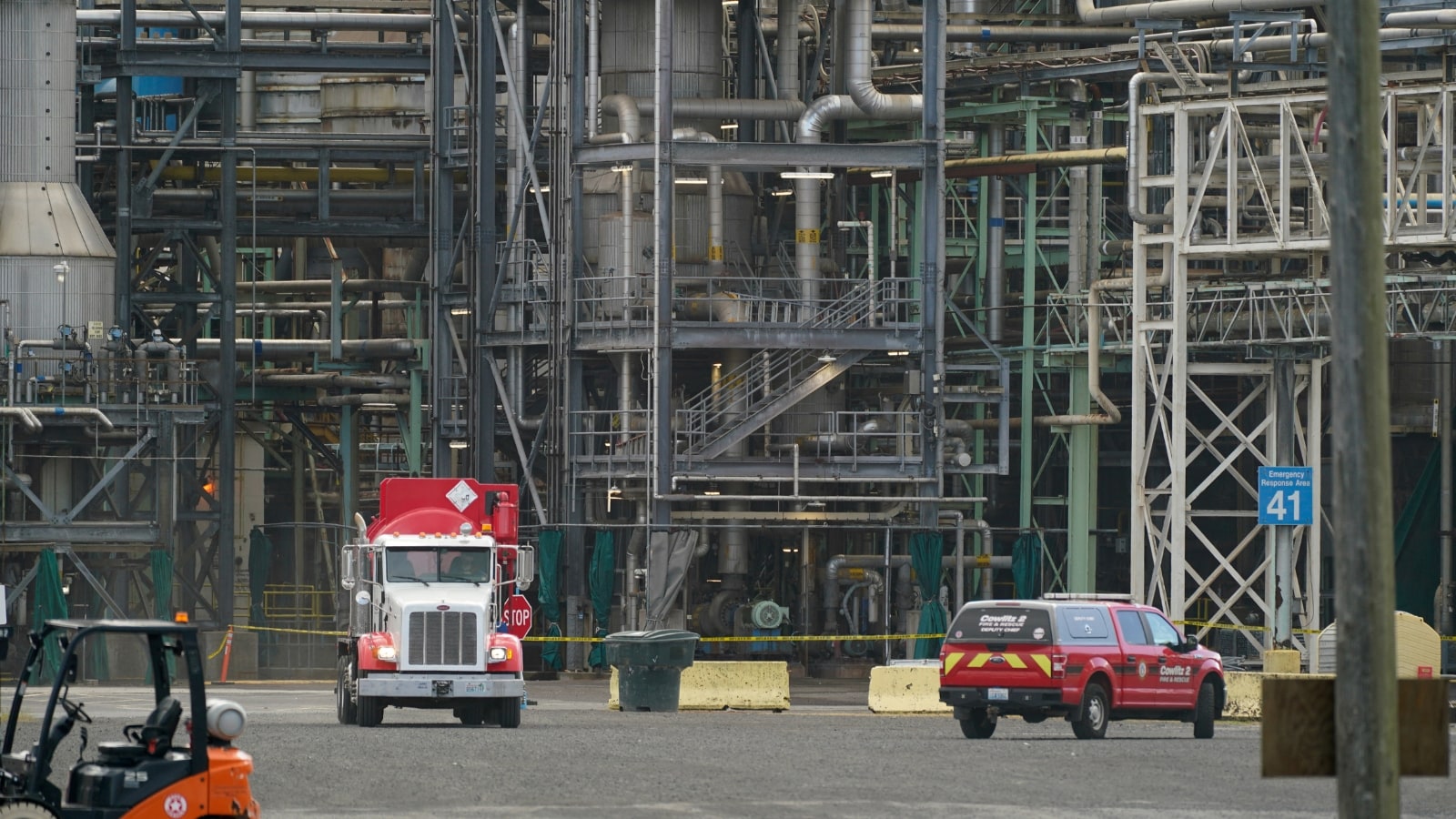
The shift change at 6:00 AM always tastes like stale coffee and cold air. It is the quietest hour in any manufacturing hub, that fragile window where the night crew hands off the burden of heavy machinery to the day shift. On a crisp Tuesday morning in Washington State, the workers walking through the gates of the industrial park were thinking about normal things. Text messages left on unread. Groceries to buy after work. The persistent, low-grade hum of the factory floor was just background noise, as familiar as a heartbeat.
Nobody looks at a steel chemical storage tank and sees a bomb.
They see infrastructure. They see the rigid, unyielding geometry of modern industry. We trust steel because it feels permanent, an absolute barrier between human skin and the volatile elements required to fuel our modern lives. But industrial disasters are rarely born from sudden, catastrophic failures of imagination. They are born from the silent accumulation of pressure, from a sequence of events so mundane that nobody notices the trap snapping shut until the metal begins to tear.
Then comes the flash.
The Anatomy of an Echo
When a pressurized chemical tank ruptures, the sound travels faster than the shockwave can destroy the ears that hear it. It is a dense, metallic roar that rattles the teeth in your skull.
To understand what happened in that Washington industrial corridor, you have to look past the breaking news banners and the flashing red lights of the first responders. You have to look at the physics of a containment failure. Inside those massive cylindrical structures, liquids and gases exist in a delicate, artificial equilibrium. Temperature, volume, and pressure are locked in a continuous dance, governed by strict mathematical laws. If a single valve fails to actuate, or if an exothermic reaction slips its leash by a fraction of a degree, the equilibrium vanishes.
Imagine blowing air into a balloon until the rubber grows translucent. Now imagine that balloon is made of multi-layered industrial steel, and the air inside is a toxic cocktail of chemical compounds.
When the structural integrity of the hull fails, the release of energy is instantaneous. The expanding gas doesn't just escape; it weaponizes the container itself. Shrapnel weighing hundreds of pounds cuts through concrete walls like cardboard. The blast wave creates a vacuum, shattering windows for blocks and knocking grown men flat on their backs before they even comprehend the light.
For the people on the floor that morning, the world simply ceased to make sense. One moment they were holding clipboards and checking gauges. The next, the ceiling was gone, replaced by a columns of black smoke that blotted out the Pacific Northwest sky.
The Toll Behind the Numbers
The initial radio dispatches from the scene were fragments of chaos. Multiple casualties. Structural collapse. Mass casualty incident. Media outlets quickly reduced the tragedy to a tidy set of data points: a specific number of dead, a specific number of injured rushed to regional trauma centers, a geographic coordinate on a map. But statistics are a defense mechanism. They protect us from the agonizing reality of what those numbers actually mean.
Every digit in a casualty count represents an empty chair at a dinner table. It represents a family waiting behind police tape, staring at the flashing lights, praying for a text message that will never arrive. The workers who died in the blast were specialists, mechanics, parents, and neighbors. They were people who knew the specific quirks of that factory, who knew which floorboards creaked and which vending machine took your dollar without giving you a soda.
Consider the survivors who were pulled from the wreckage.
The physical injuries from a industrial explosion are complex and brutal. There are the thermal burns from the immediate flash of heat. There is the blunt force trauma from flying debris. But the invisible injury, the one that lingers long after the skin heals, is the barotrauma. When a blast wave passes through a human body, it violently compresses the air-filled organs—the lungs, the eardrums, the delicate tissue of the gut. It is an internal bruising that cannot be bandaged.
Outside the perimeter, the air smelled of scorched insulation and chemical acridity. Sirens rose and fell in a panicked chorus as emergency crews from three different counties cut through the twisted metal. For hours, the priority was simple: triage and recovery. But as the smoke began to clear, the collective focus of the community shifted from the immediate horror to a deeper, more troubling question.
How did the safeguards fail?
The Illusion of Absolute Safety
We live in an era of redundant engineering. Every industrial facility of this scale is wrapped in layers of protection designed to prevent exactly this scenario. There are mechanical relief valves engineered to pop open when pressure crosses a specific threshold. There are automated digital sensors that log data every millisecond, programmed to trigger emergency shutdowns if a trend line moves too fast. There are human operators trained to spot anomalies before they escalate.
Yet, disasters happen.
The terrifying truth of modern industrial infrastructure is that we have created systems so complex that their failure modes are sometimes impossible to predict. It is rarely a single, catastrophic mistake. Instead, it is what safety theorists call the "Swiss cheese model."
Think of every safety measure as a slice of cheese with holes in it. Usually, the holes don't align. A mechanical valve might stick, but the digital sensor catches the spike. A sensor might fail, but the alert human operator pulls the manual override. But occasionally, under the right circumstances, the holes line up perfectly. A delayed maintenance cycle combines with an anomalous temperature swing, which coincides with a miscalibrated instrument.
Suddenly, the hazard passes straight through every single layer of defense.
The investigation into the Washington facility will take months, perhaps years. Federal agencies like the Chemical Safety Board will meticulously reconstruct the fragments of the ruptured tank, analyzing the grain structure of the steel to see if metallurgical fatigue played a role. They will audit maintenance logs, interview survivors, and dissect the software code that governed the facility's operations.
But that forensic dissection offers cold comfort to a community dealing with the immediate aftermath of loss. It reveals a fundamental tension at the heart of our technological society: our appetite for production often outpaces our commitment to vigilance.
The Ghost Shift
In the days following an industrial catastrophe, a strange quiet settles over the surrounding town. The factory, once a bustling engine of economic life, becomes a crime scene, surrounded by chain-link fences and private security. The smoke eventually dissipates, leaving behind a scarred skeleton of steel and concrete that stands as a grim monument to a terrible Tuesday morning.
The economic ripple effects will be felt for years. Jobs are lost, supply chains are disrupted, and corporate entities will engage in prolonged legal battles over liability and negligence. The regulatory fines will be levied, and safety protocols will be rewritten in the blood of the people who didn't come home.
But the real legacy of the explosion isn't found in the courtrooms or the regulatory filings.
It is found in the quiet anxiety of every industrial worker who punches a timecard the following week at a similar plant across the country. It is the sudden, sharp intake of breath when a steam pipe hisses a little too loudly, or when a floor vibration feels slightly different than it did the day before. We want to believe that the world is entirely within our control, that our calculations are perfect and our structures are infallible.
The twisted metal in Washington reminds us of the true cost of that illusion. We tame volatile forces to build our world, but those forces are always looking for a weakness, always searching for the tiniest crack in the steel, waiting for the pressure to rise.