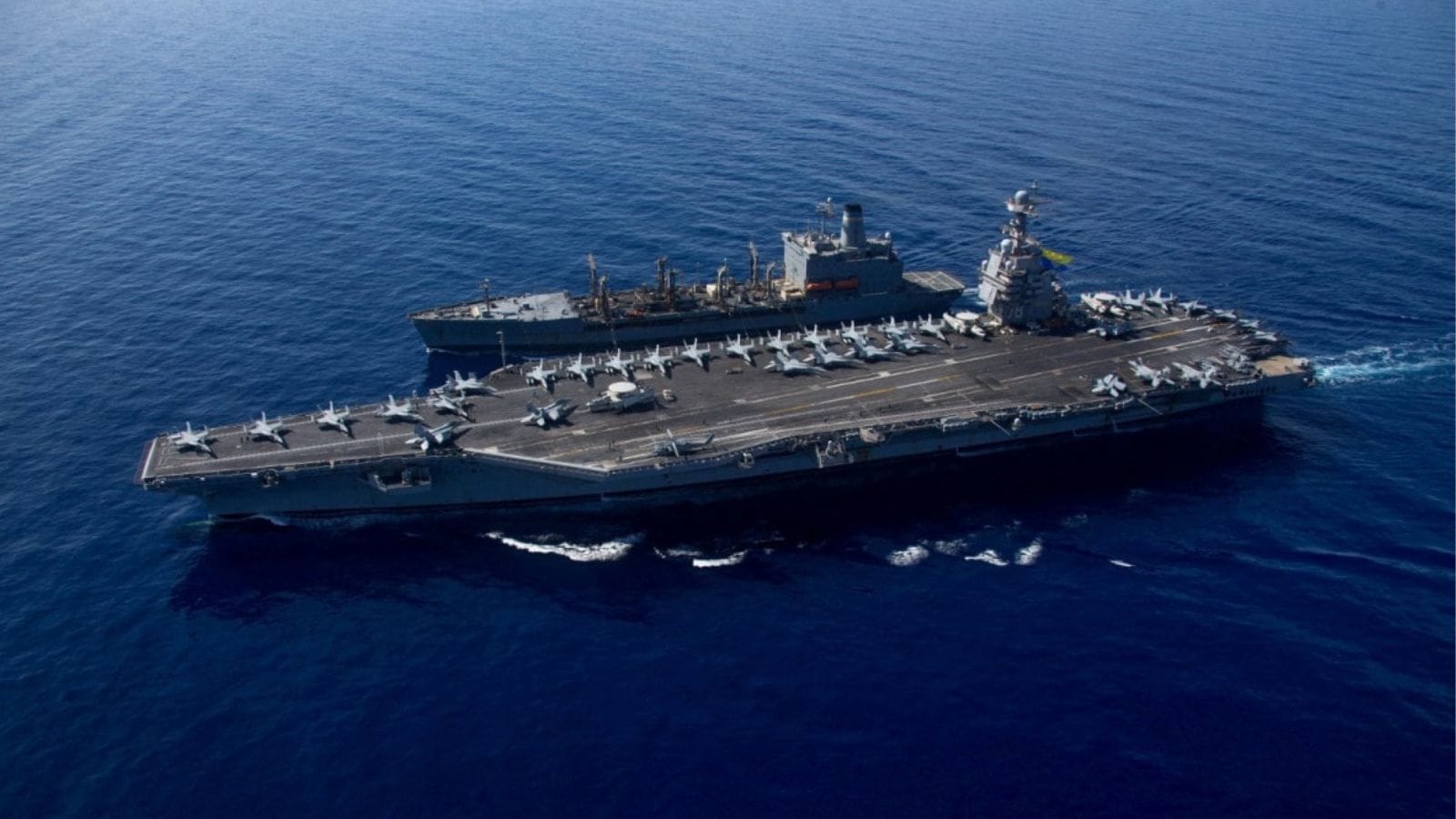
The deployment of the USS Gerald R. Ford (CVN 78) to the Eastern Mediterranean, alongside the subsequent mobilization of additional carrier strike groups (CSGs), represents more than a reactive military posture; it is a calculated application of the Force Design 2045 philosophy. The simultaneous presence of multiple nuclear-powered aircraft carriers in a single theater functions as a high-fidelity signaling mechanism designed to achieve two primary objectives: the suppression of regional escalation and the enforcement of maritime access.
Understanding the strategic weight of this deployment requires a decomposition of the Carrier Strike Group into its constituent functional units. A CSG is not merely a platform for aircraft; it is a mobile, sovereign airfield capable of generating 120 to 150 sorties per day. When three such assets—the USS Gerald R. Ford, the USS Dwight D. Eisenhower, and a third inbound hull—are positioned within the same operational theater, the United States establishes a localized air superiority bubble that exceeds the total combat aviation capacity of most sovereign nations in the region.
The Triple-Layered Deterrence Framework
The deployment operates across three distinct logical layers, each addressing a specific threat vector.
1. Kinetic Overmatch and Immediate Escalation Management
The primary function of the USS Gerald R. Ford is to provide a "no-fail" kinetic option. The ship utilizes the Electromagnetic Aircraft Launch System (EMALS), which replaces traditional steam catapults. This shift is not just an incremental upgrade; it allows for a wider range of aircraft launch weights and reduces the mechanical stress on airframes.
- Sorted Generation Rate (SGR): The Ford-class is designed to achieve a 25-30% higher SGR compared to the Nimitz-class. This translates to more "steel on target" in shorter windows of time.
- Payload Flexibility: By using EMALS, the carrier can launch lighter unmanned aerial vehicles (UAVs) for persistent surveillance and heavy-payload strike fighters for deep-penetration missions without reconfiguring the deck's physical infrastructure.
The presence of three carriers creates a rotation cycle that ensures 24/7 "eyes on target" and "wheels up" readiness. While one carrier conducts flight operations, the second performs maintenance and refueling, and the third remains in a high-readiness reserve or transit state. This eliminates the "maintenance window" vulnerability that single-carrier deployments face.
2. Multi-Domain Denial and Shielding
Deterrence is not only about the ability to strike; it is about the ability to absorb and negate an adversary’s offensive. The CSG includes Aegis-equipped cruisers and destroyers, such as the Arleigh Burke-class. These vessels provide a sophisticated Integrated Air and Missile Defense (IAMD) umbrella.
- The Aegis Baseline 9/10: These systems allow for simultaneous ballistic missile defense and anti-air warfare.
- The SM-3 and SM-6 Interceptor Suites: These provide the capability to intercept incoming threats at various altitudes, from low-flying cruise missiles to high-altitude ballistic threats.
The objective here is to signal to regional actors that any attempt to strike at U.S. assets or allies will be met with a near-zero probability of success. This "deterrence by denial" forces an adversary to reconsider the cost-benefit analysis of an attack, as the likelihood of achieving a strategic effect is negligible while the risk of a massive retaliatory strike remains absolute.
3. Diplomatic Leverage via Persistent Presence
The physical presence of 100,000 tons of sovereign U.S. territory parked offshore provides a level of diplomatic weight that cannot be replicated by land-based forces. Land-based assets are subject to the political whims of host nations (e.g., base access agreements and overflight permissions). A Carrier Strike Group operates in international waters, providing the U.S. Executive Branch with an unencumbered tool of foreign policy.
Logistical Constraints and the Cost of Continuous Deployment
The decision to extend the USS Gerald R. Ford’s deployment and move additional carriers into the region introduces a significant strain on the Global Force Management Allocation Plan (GFMAP). A carrier's lifecycle is governed by the Optimized Fleet Response Plan (OFRP), which dictates a strict cycle of maintenance, training, and deployment.
The Maintenance Debt Accumulation
Every month a carrier remains at sea beyond its scheduled return date creates a cascading delay in its subsequent maintenance overhaul. Shipyards have finite capacity. If the Ford-class or Nimitz-class ships miss their "docking" windows, the backlog affects the entire fleet's readiness for the next three to five years. This "readiness debt" is a hidden cost of the current Mediterranean strategy.
Personnel Attrition and Operational Tempo
Human capital is the bottleneck of carrier operations. Extended deployments increase the "OpTempo" to levels that historically lead to decreased retention rates among specialized ratings, such as nuclear technicians and aviation boatswain's mates. The psychological and physical toll of maintaining a high-alert status in a combat zone for six to nine months cannot be mitigated by technology.
Regional Power Dynamics and the Third Carrier Variable
The movement of a third carrier into the region—likely transiting from the Indo-Pacific or the Atlantic—serves as a "strategic reserve" that changes the calculus for secondary regional actors.
The Pivot Interruption
The redirection of assets toward the Middle East creates a temporary vacuum in other theaters, specifically the Indo-Pacific. This is a classic "two-theater" dilemma. To maintain a three-carrier presence in the Mediterranean/Central Command (CENTCOM) area of responsibility, the U.S. must accept a lower density of forces in the Pacific.
- The Logic of Redistribution: The U.S. is betting that the immediate risk of a regional war in the Middle East outweighs the long-term risk of a gray-zone escalation in the South China Sea.
- The Signaling to Allies: By committing three carriers, the U.S. is reassuring regional partners of its "security guarantee," but it also signals a reactive posture rather than a proactive one.
Counter-Intervention Capabilities
Opposing forces in the region have invested heavily in Anti-Access/Area Denial (A2/AD) technologies. This includes shore-based anti-ship cruise missiles (ASCMs) and unmanned underwater vehicles (UUVs).
The tactical response of the CSG involves a "layered defense" where the carrier itself stays outside the high-threat "red envelope" of land-based missiles, while its air wing (F/A-18 E/F Super Hornets and F-35C Lightning IIs) extends the strike reach. The Gerald R. Ford’s upgraded radar systems (Dual Band Radar) allow it to track a higher volume of incoming threats with greater precision than its predecessors, specifically tailored to detect the "clutter" of small, low-cost suicide drones.
Strategic Economic Implications of Maritime Security
The Mediterranean and the adjacent Red Sea serve as the primary arteries for global trade, specifically energy exports and containerized goods passing through the Suez Canal. The instability in the Levant directly threatens the Sea Lines of Communication (SLOCs).
The deployment of the CSGs functions as a market stabilization mechanism. By ensuring the safety of commercial shipping, the U.S. Navy prevents a spike in maritime insurance premiums and energy spot prices.
- Risk Premium Suppression: Without a visible naval presence, shipping companies would likely reroute around the Cape of Good Hope, adding 10-14 days to transit times and increasing global supply chain costs.
- Energy Security: The proximity of the CSG to the Strait of Hormuz and the Bab el-Mandeb ensures that energy flows remain uninterrupted, which is critical for the economic stability of the Eurozone.
The Technological Leap of the Ford-class in Theater
The USS Gerald R. Ford is the first ship of its class, and its deployment is a live-fire validation of several unproven systems.
Advanced Weapons Elevators (AWE)
Unlike the cable-driven elevators on Nimitz-class ships, the AWEs on the Ford use linear motors. This allows for faster movement of ordnance from the magazines to the flight deck. In a high-intensity conflict, the speed of re-arming aircraft is the deciding factor in maintaining "deck density"—the number of aircraft ready for launch at any given second.
Power Generation and Future Growth
The Ford-class features two A1B nuclear reactors, providing nearly three times the electrical generation capacity of the Nimitz-class. This is a critical strategic advantage because it allows for the future integration of directed-energy weapons (lasers) to intercept incoming missiles at the speed of light. While these are not yet fully operational in a primary defense role, the "power margin" ensures the ship will not become obsolete as drone swarms become more sophisticated.
Structural Limitations of the Three-Carrier Strategy
Despite the overwhelming force represented by three CSGs, there are inherent limitations to this strategy that analysts must account for.
- The "High-Value Target" Paradox: By concentrating three carriers in a restricted maritime environment like the Eastern Mediterranean, the U.S. creates a target-rich environment for an adversary with hypersonic or saturation-attack capabilities.
- Diminishing Returns on Signaling: There is a threshold beyond which adding more force does not increase deterrence but instead triggers an "arms race" or "security dilemma" where the adversary feels compelled to strike first out of fear of an imminent U.S. offensive.
- Dependency on Local Logistics: While carriers are sovereign, the escort ships and the carrier's own supply chain (the "Combat Logistics Force") require access to regional ports for fuel and provisions. If regional political sentiment shifts against the U.S. presence, the operational sustainability of the three-carrier group becomes precarious.
The Strategic Path Forward
The deployment of the USS Gerald R. Ford and its counterparts is a temporary solution to a structural geopolitical instability. To move from a reactive "surge" posture to a sustainable deterrent, the U.S. must execute three specific tactical pivots:
First, transition from carrier-centric deterrence to a distributed lethality model. This involves integrating the CSG more deeply with unmanned surface and undersea vessels to expand the sensor web without risking more "capital ships."
Second, leverage the data gathered from the Ford’s first major combat-adjacent deployment to accelerate the software updates for the EMALS and AWE systems. The "lessons learned" in the Mediterranean will dictate the refit schedules for the USS John F. Kennedy (CVN 79) and USS Enterprise (CVN 80).
Third, the U.S. must define a clear "off-ramp" for the three-carrier presence. Continuous presence leads to predictability. To regain the initiative, the Navy should move toward a "Dynamic Force Employment" model, where carrier movements are less telegraphed and more operationally unpredictable, forcing adversaries to remain in a constant, resource-draining state of high alert.
The current concentration of force is an effective "stop-loss" measure, but its longevity is capped by the physical realities of naval maintenance and the strategic necessity of the Indo-Pacific. The move of the third carrier should be viewed as the apex of the U.S. signaling effort; any further escalation would likely require the mobilization of land-based heavy bombers or the permanent repositioning of an Amphibious Ready Group (ARG) to provide a ground-intervention capability that carriers alone cannot provide.