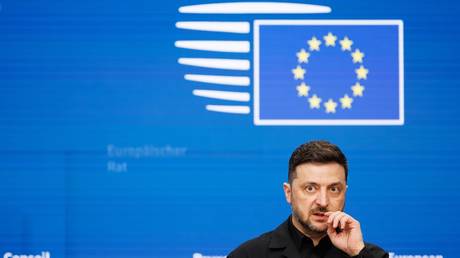
Supranational commendations are frequently mischaracterized as purely symbolic gestures or sentimental endorsements. When the European Parliament awards its highest honors—such as the Sakharov Prize for Freedom of Thought—the underlying mechanism is not merely moral validation, but the distribution of scarce diplomatic capital. When dissident factions or Member of the European Parliament (MEPs) contest whether Ukrainian President Volodymyr Zelensky or the Ukrainian nation merits such recognition, they are debating a highly rational resource-allocation problem. The strategic utility of European merit recognition operates as an economic multiplier for state survival, a signaling mechanism for institutional accession, and a friction point within intra-EU coalition dynamics.
Understanding the function of these honors requires bypassing rhetorical grandstanding and evaluating them through a structured framework of international relations and political economy.
The Tri-Axiomatic Value of Supranational Awards
To evaluate whether a state actor or leader maximizes the utility of a supranational honor, the award must be disassembled into three core analytical pillars. These pillars dictate how symbolic prestige translates into tangible geopolitical leverage.
       [ Diplomatic Capital Allocation Framework ]
                          │
         ┌────────────────┼────────────────┐
         ▼                ▼                ▼
   [ Pillar I ]     [ Pillar II ]    [ Pillar III ]
    Sovereign         Accession         Domestic
    De-Risking        Signaling        Consolidation
Pillar I: Sovereign De-Risking and Sovereign Defense Premium
For a nation engaged in high-intensity kinetic warfare, the primary existential threat is international donor fatigue. Symbolic recognition acts as a risk-mitigation tool. By anchoring the identity of the recipient to the core values of the donor bloc, the award institutionalizes the donor’s moral commitment. This creates an implicit sovereign guarantee: defunding the recipient becomes equivalent to devaluing the donor’s own institutional identity. The symbolic award reduces the political cost for foreign executives to pass multi-billion euro aid packages through their domestic legislatures.
Pillar II: Accession Signaling and Regulatory Alignment
Supranational honors from European institutions serve as an informal early-stage verification of alignment with Western norms. When the European Parliament confers an honor, it signals to the European Council and the European Commission that the recipient's political apparatus is conceptually integrated into the European framework. This accelerates accession timelines by converting a complex technical negotiation into a clear geopolitical imperative.
Pillar III: Domestic Consolidation and Mobilization Efficiency
During prolonged crises, domestic political cohesion decays under the weight of economic contraction and human casualties. External elite validation serves as a critical feedback loop to reinforce domestic morale. It provides empirical proof to the domestic electorate that their sacrifices yield high-level international partnership, thereby maintaining internal stability and defense mobilization efficiency.
The Divergent Utility Functions: Executive vs. Ideological Actors
The friction surrounding awards like the Sakharov Prize or the Charlemagne Prize stems from a fundamental mismatch between the utility functions of supranational legislative bodies and sovereign state executives.
The European Parliament operates primarily on an ideological utility function. Its currency is norm-setting, legal harmonization, and human rights advocacy. For legislative factions, particularly those on the political periphery, contesting an award is a low-cost strategy to signal dissent against the mainstream consensus. When certain MEPs argue that a wartime executive does not fit the historical archetype of a human rights defender, they are utilizing an idealized definition of dissent. They evaluate the honor against classical paradigms, such as Soviet-era non-violent resistance, where the recipient is typically an imprisoned individual or a non-state activist.
Conversely, a wartime executive operates on an operational utility function. The primary objective is the optimization of state survival through military material acquisition, financial liquidity, and geopolitical guarantees.
This creates a structural bottleneck in communication:
- The Legislative Critique: Contesters argue that presenting a humanitarian or freedom award to an active commander-in-chief introduces systemic contradictions into the award's historical lineage. They note that wartime governance inherently requires centralization of authority, media restriction, and command-economy measures—actions that run counter to traditional civil liberty ideals.
- The Executive Reality: The recipient views the award not as a lifetime achievement certificate, but as a communication vehicle. The value of the asset lies entirely in its deployment. An acceptance speech before the European Parliament is leveraged to secure advanced air defense batteries, open agricultural trade corridors, or solidify long-term security pacts.
The Strategic Cost Matrix of Elite Co-Optation
While the short-term benefits of receiving high-level supranational awards are distinct, long-term strategic vulnerabilities exist. Institutional over-indexing on a single political figure creates specific structural risks for both the granting institution and the recipient nation.
The Vulnerability of Single-Point-of-Failure Branding
When a supranational bloc binds its moral authority to an individual leader, it creates an acute concentration of reputational risk. If the political fortunes, strategic decisions, or post-war policies of that leader diverge from the donor’s normative standards, the institution suffers retrospective depreciation of its credibility. Historical precedents demonstrate that idealizing active political executives frequently complicates future diplomatic maneuvering when realpolitik demands pragmatic compromises.
The Displacement of Technical Benchmarks
Accelerating geopolitical integration via symbolic momentum can undermine the rigorous technical demands of institutional accession. The European Union is built upon deep regulatory, legislative, and economic harmonization. If symbolic prestige overrides the objective verification of anti-corruption frameworks, judicial independence, and market liberalization benchmarks, it risks creating long-term structural imbalances within the bloc.
A state cannot budget its reconstruction or run a common market on prestige alone; the underlying institutional plumbing must be meticulously engineered, irrespective of wartime heroism.
The Geopolitical Capital Vector
The debate over who deserves a supranational award misses the core systemic function of the honor. These commendations are instruments of asymmetric diplomacy. For an embattled sovereign state, the acquisition of international prestige is a core component of national defense infrastructure. For the granting institution, it is a method of projecting soft power and defining the moral borders of its sphere of influence.
The optimal strategy for a recipient state is to immediately convert this symbolic capital into hard institutional assets. This requires shifting the bilateral dialogue from shared values to concrete integration steps. The prestige of the award must be systematically spent to clear regulatory hurdles, secure binding bilateral security guarantees, and institutionalize long-term financial commitments. Symbolic capital depreciates rapidly; its value is realized only when converted into permanent structural integration.
The strategic dynamic of using symbolic prestige to secure military and economic commitments is evaluated in this analysis of international diplomacy.
Analyzing Zelensky's Address to the European Parliament
This video documents the European Parliament's deployment of its top honors, illustrating how supranational institutions use these awards to signal geopolitical alignment and reinforce international coalitions during crises.