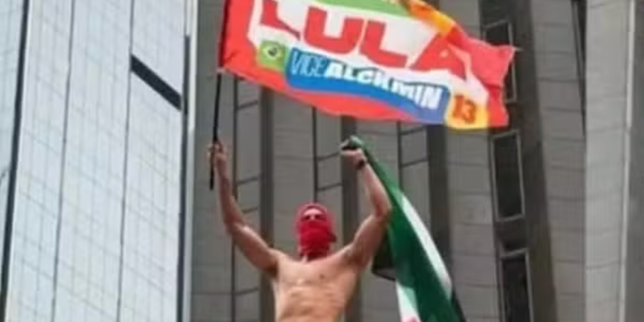
Political movements lose market share when their visual identity and communication channels fail to match the consumption habits of younger demographics. In Brazil, the resurgence of leftist street mobilization along São Paulo's Avenida Paulista demonstrates a deliberate shift from traditional union-based agitation to aesthetic-driven political marketing. By centering campaigns around charismatic, visually appealing figures—colloquially dubbed the "beau gosse de la Paulista" (the handsome guy of Paulista) in French media coverage—organizers have engineered a low-friction entry point for politically disengaged citizens. This strategy reduces the cognitive and social cost of political participation, transforming ideological alignment into an aspirational lifestyle signal.
The Mechanics of Aesthetic Mobilization
Traditional leftist organizing in Latin America relied heavily on class-consciousness framing, dense theoretical rhetoric, and institutional labor structures. While effective for securing core industrial demographics, this model creates high barriers to entry for urban service-sector workers and digital natives. Aesthetic mobilization inverts this funnel by leading with visual appeal and cultural resonance before introducing policy platforms.
The operational logic rests on three distinct mechanisms:
- Parasocial Trust Transfer: Audiences conditioned by algorithmic social media feeds evaluate credibility through visual polish and perceived authenticity rather than institutional credentials. When a political communicator mirrors the aesthetic codes of mainstream lifestyle influencers, viewers transfer the trust normally reserved for peer recommendations onto political messaging.
- De-stigmatization of Ideological Labels: Following years of intense polarization and the conservative consolidation of national symbols—such as the Brazilian flag and national football jersey—leftist symbols carried high social friction in middle-class urban spaces. Associating progressive causes with conventional attractiveness and aspirational urban culture neutralizes negative stereotypes of the left as overly academic, austere, or disconnected from mainstream tastes.
- Algorithmic Amplification: Social media recommendation engines prioritize high-engagement visual content, particularly short-form video featuring clear facial expressions, dynamic urban backdrops like Avenida Paulista, and emotional hooks. A visually compelling spokesperson generates higher completion rates and share velocity, subsidizing organic reach that would otherwise require massive paid media expenditure.
Spatial Semiotics of Avenida Paulista
The geographic anchor of this phenomenon—Avenida Paulista—is not incidental. As São Paulo's primary financial artery and cultural thoroughfare, the avenue functions as a neutral, high-visibility stage where socioeconomic classes intersect.
Unlike peripheral neighborhoods or university campuses, which signal pre-existing ideological alignment, Avenida Paulista operates as an open-air broadcast studio. Street interviews, spontaneous debates, and visual demonstrations filmed on this corridor inherit the legitimacy of Brazil's economic engine. When a communicator commands attention in this space, the visual framing communicates competence and mainstream viability. The street becomes a testing ground for message-market fit, where immediate physical reactions from passersby validate the content before it is packaged for digital distribution.
The Conversion Funnel from Attention to Political Capital
Generating viral attention is a vanity metric unless converted into durable political capital—defined as voter turnout, organizational membership, or sustained narrative control. The transition from aesthetic appeal to ideological commitment follows a structured four-stage conversion funnel:
- Stage 1: Hook Acquisition. Short-form video clips utilize visual contrast—pairing conventional, polished aesthetics with sharp, accessible critiques of economic inequality, labor conditions, or urban infrastructure. The viewer stops scrolling due to the messenger's appearance and delivery cadence.
- Stage 2: Cognitive Validation. Once attention is captured, the messaging avoids arcane ideological jargon. Instead, it frames leftist economic policies around tangible daily friction points: commuting times, purchasing power, healthcare access, and housing costs. This validates the viewer's lived experience without demanding immediate ideological self-identification.
- Stage 3: Identity Integration. Through repeated exposure, the viewer adopts the communicator's vocabulary and framing. Sharing the content becomes a low-risk method of signaling moral and cultural sophistication within the viewer's peer network.
- Stage 4: Offline Activation. Digital engagement is periodically converted into physical presence at rallies, cultural events, or electoral campaigns on Avenida Paulista. Physical attendance reinforces group solidarity and locks in voter commitment.
Structural Vulnerabilities of Personality-Driven Politics
While aesthetic mobilization accelerates top-of-funnel acquisition, relying on individual charisma introduces severe structural vulnerabilities into a political movement. Strategists must account for three primary failure modes:
Single-Point-of-Failure Risk
When political appeal is concentrated in an individual's persona rather than an institutional platform or policy framework, the movement inherits that individual's personal liabilities. A single reputational misstep, personal scandal, or shift in public taste can collapse the entire communication channel overnight. Institutional movements absorb individual failures; personality-driven networks fracture when the central node is compromised.
Ideological Dilution
Optimizing messages for algorithmic virality and broad aesthetic appeal forces communicators to simplify complex structural arguments. Nuanced policy debates regarding fiscal policy, tax reform, or state capacity rarely perform well in 30-second video formats. Over time, this creates a gap between the simplified promises made during the acquisition phase and the difficult trade-offs required during actual governance. Voters acquired through aesthetic framing exhibit lower retention rates when confronted with legislative compromise.
Counter-Mobilization and Parody
Aesthetic positioning is easily weaponized by political opponents. Rival campaigns routinely deploy irony, caricature, and counter-framing to rebrand charismatic leftist figures as superficial, elitist, or performative. In Brazil's hyper-polarized digital ecosystem, right-wing networks possess mature meme-warfare infrastructure capable of rapidly inverting positive visual tropes into symbols of metropolitan detachment—labeling urban progressive communicators as "esquerda caviar" (champagne socialists) disconnected from working-class realities.
Comparative Dynamics in Asymmetric Information Environments
To understand why this tactic gained traction in Brazil specifically, one must examine the broader information asymmetry between the Brazilian right and left over the past decade. Conservative movements achieved early dominance on encrypted messaging applications and video platforms by utilizing decentralized networks, emotional outrage triggers, and anti-establishment framing.
The traditional Brazilian left initially attempted to counter this advantage through fact-checking initiatives, institutional media appearances, and legacy union mobilization. These methods failed because they operated on asymmetric terrain—attempting to win an emotional, visual attention war using slow, text-heavy, institutional tools. The emergence of aesthetically polished, street-level communicators represents a necessary adaptation: matching the opponent's medium and emotional velocity while substituting outrage with aspiration and seduction.
Operationalizing Aesthetic Strategy Without Institutional Hollowing
Political organizations seeking to replicate the success of Avenida Paulista's aesthetic mobilization without succumbing to personality-driven fragility must separate top-of-funnel acquisition from bottom-of-funnel retention.
First, campaigns must deploy charismatic communicators strictly as acquisition channels rather than policy architects. Their operational mandate is to capture attention from non-aligned demographics and direct that traffic toward structured educational ecosystems, community assemblies, and concrete local initiatives. Second, media teams should decentralize the talent pool by training multiple regional spokespeople across diverse demographic profiles, preventing single-node dependency and ensuring the visual aesthetic reflects the actual breadth of the electorate. Finally, messaging frameworks must maintain strict discipline by anchoring every visually appealing hook to a verifiable material policy demand, ensuring that the power of seduction serves durable political organization rather than transient digital celebrity.