The wind off the Adriatic Sea carries the sharp, clean scent of salt and wild herbs, cutting through the heavy summer heat of the Vjosa-Narta lagoon. For centuries, this wetlands sanctuary in southwestern Albania has belonged to silence. It belonged to the shifting tides, the local fishermen casting shallow nets, and, above all, the flamingos. Thousands of them. When they lift off simultaneously, the sky turns a startling, bruised shade of pink, a living cloud masking the horizon.
But lately, that silence is shattered by the mechanical scream of excavators.
The concrete is coming. Specifically, it arrives in the form of a massive international airport, championed by Albanian Prime Minister Edi Rama as a golden ticket to economic modernity. To the administration in Tirana, the lagoon is an underutilized asset, a blank canvas for luxury tourism and global connectivity. To the people who live along its edges, and the activists now flocking to their side, it is an existential battleground. They call it the Flamingo Revolution. What started as localized environmental friction has hardened into a fierce, nation-defining standoff against an increasingly autocratic government.
Consider what happens when a state decides that its natural heritage is currency.
The Cost of a Runway
Ardian has spent fifty-four years navigating the marshy labyrinth of Narta. He is a hypothetical composite of the men you meet in the tavernas of Zvërnec, men with skin cured by salt and eyes permanently squinted against the Adriatic sun. He remembers when the only threat to the birds was the occasional poacher. Today, he stands near the edge of the construction site, watching heavy trucks dump tons of crushed stone into the wetlands.
"They say the planes will bring wealth," Ardian says, gesturing toward the skeletal frame of the rising terminal. "But what happens to the water? What happens to the birds? When the flamingos leave, they take the soul of this place with them."
The math behind the project is seductive on paper. The Vlora International Airport promises to bring hundreds of thousands of tourists directly to the Albanian Riviera, bypassing the congested capital. Rama’s government argues that a developing nation cannot afford to preserve every acre of wilderness at the expense of its people's prosperity. Tourism is Albania's oil.
But the real problem lies elsewhere. The Narta lagoon is not just a pretty backdrop; it is a critical pit stop on the Adriatic Flyway, a migratory highway utilized by millions of birds traveling between Europe and Africa. Building an airport here is not merely an ecological gamble. It is a logistical nightmare.
Ornithologists have repeatedly warned of the extreme risk of bird strikes. A flock of European flamingos, each weighing up to nine pounds, colliding with a commercial airliner traveling at two hundred miles per hour is a recipe for catastrophe. Yet, the construction press onward. The political stakes have become too high for the government to back down.
The Artist and the Iron Fist
To understand how Albania arrived at this flashpoint, one must understand Edi Rama. A painter and former avant-garde artist, Rama burst onto the political scene decades ago by painting Tirana’s drab, communist-era apartment blocks in vibrant, psychedelic colors. He was heralded as a creative visionary, a leader who understood that aesthetics could reshape national morale.
Over his long tenure as Prime Minister, however, that artistic impulse has morphed into a obsession with grand, top-down infrastructure projects. Critics argue that his vision of progress is superficial, characterized by glittering high-rises and luxury resorts that benefit a small circle of oligarchs while the average Albanian struggles with inflation and stagnant wages.
The Flamingo Revolution has become a lightning rod for this broader discontent. It is no longer just about environmental conservation. It is a proxy war over the state of Albanian democracy.
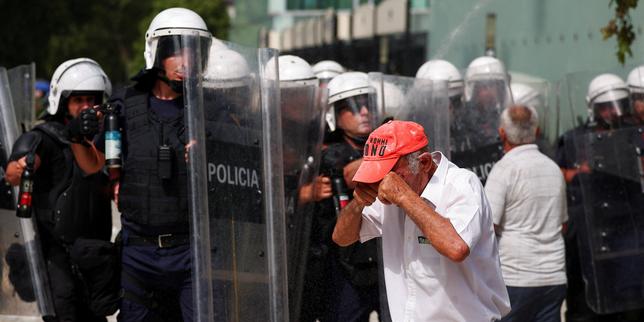
When activists first gathered to protest the airport, they used peaceful, creative methods. They wore pink masks, staged silent sit-ins, and painted murals of birds on the concrete barriers surrounding the construction zone. The response from Tirana was cold indifference, followed by administrative crackdowns. Permits for gatherings were denied. Local activists faced intimidation.
The indifference hardened the movement. The soft-spoken environmentalists have been joined by student groups, anti-corruption watchdogs, and disillusioned citizens who see the lagoon’s destruction as a mirror of their own disenfranchisement. The pink flamingo has been transformed from an ecological symbol into an emblem of defiance.
Shadows on the Water
The conflict exposes a profound generational divide. Older Albanians, who survived the brutal, isolationist communist dictatorship of Enver Hoxha, often view any development as a sign of safety. For decades, Albania was locked away from the world, impoverished and paranoid. To some of that generation, a modern airport is proof that they have finally arrived on the global stage.
But younger Albanians see a different reality. They see a country being sold off piece by piece to foreign investment firms and local tycoons, while the rule of law is eroded. They look at the coastal town of Vlora, already choking on poorly planned concrete hotels, and they fear that Narta will suffer the same fate.
Listen to the rhetoric coming from the prime minister's office. Rama frequently dismisses opponents of the project as backward-looking obstructionists who want to keep Albania poor. He frames the airport as an act of national pride.
But true pride does not require the erasure of identity.
The European Union, which Albania desperately wishes to join, has weighed in with uncharacteristic sharpness. EU officials and international environmental bodies have declared the construction a direct violation of international conventions on wildlife preservation. They have hinted that the project could stall Albania's accession talks.
Tirana's response has been a shrug of defiance. The government has doubled down, accelerating construction schedules as if to present the international community with a fait accompli. The message is clear: the concrete is poured, the runway is set, and there is no turning back.
The True Measure of Progress
What happens when the machinery wins?
Imagine standing on the salt flats five years from now. The roar of a jet engine drowns out the sound of the surf. The shallow waters, once stained pink by thousands of wading birds, are slick with aviation fuel residue. The tourists arrive, checking into resorts owned by multinational corporations, completely unaware of what lies buried beneath the asphalt.
The people of the lagoon are not against prosperity. Ardian wants his grandchildren to have jobs. He wants them to stay in Albania instead of joining the massive exodus of young people fleeing to Western Europe. But he believes that true progress cannot be built on a foundation of destruction.
"If we destroy everything that makes Albania beautiful just to prove we are modern," Ardian whispers, his fingers tracing the rough wood of his boat, "then we are just a copy of everywhere else. We lose ourselves."
The standoff at Vjosa-Narta is reaching its crescendo. Protests are growing larger, spilling out of the wetlands and into the streets of Tirana. The activists are no longer just pleading for the birds; they are demanding accountability, transparency, and a voice in how their country is shaped.
A single flamingo is a fragile thing. Its legs are like reeds, its neck a delicate curve. But thousands of them moving together can alter the horizon. The people of Albania are discovering that same collective strength. They are standing in front of the bulldozers, testing whether a government built on concrete can be swayed by a movement born of wings.