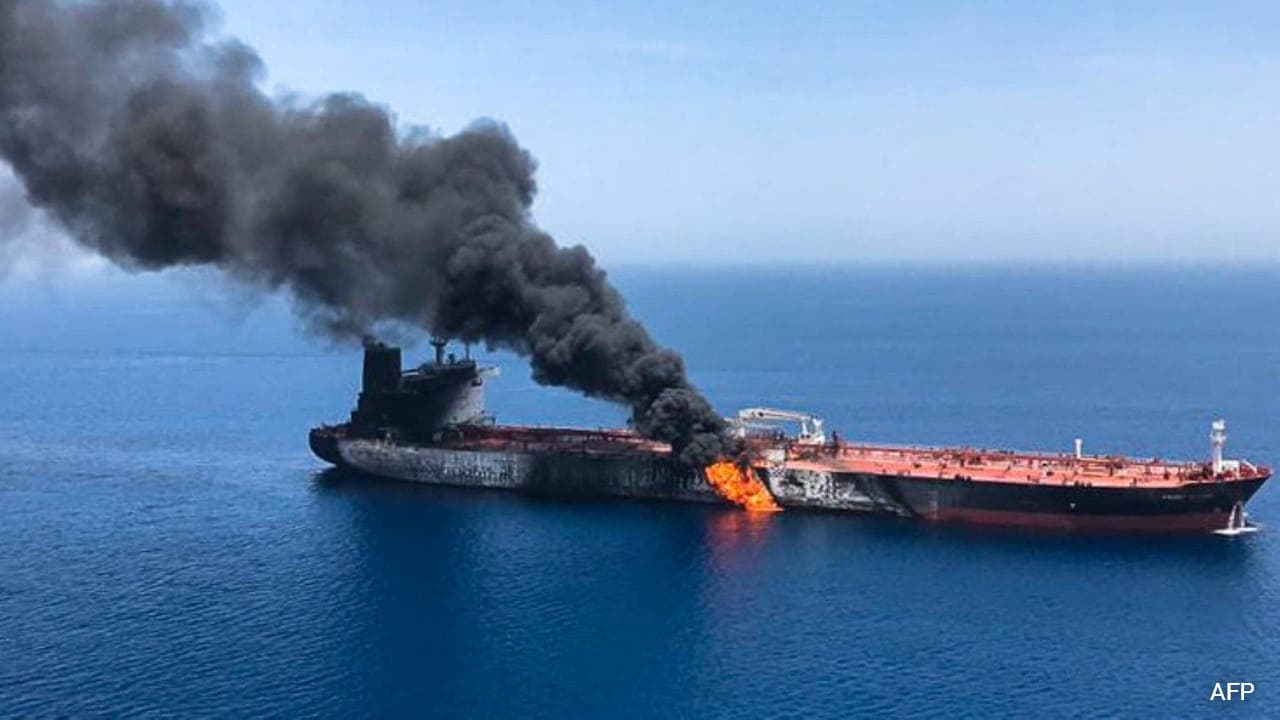
Four oil tankers hit by explosions in the Strait of Hormuz sounds like the start of a global oil panic. That's the exact reaction wire headlines want when Tehran announces another round of burning vessels in the Gulf.
Look closer at what is actually happening in the water right now, and a very different picture emerges. In November 2026 alone, Iran's Islamic Revolutionary Guard Corps Navy issued repeated statements claiming groups of two, three, and four tankers struck sea mines or suffered severe explosions after ignoring Tehran's transit rules. Wire reports covering the November 13, 2026 announcement noted that the IRGC claimed multiple tankers were struck by explosions after defying warnings against using what Iran called an "unauthorised route," disabling supertankers and forcing others to turn back.
Most news coverage stops right after repeating Tehran's press release. That leaves readers with half the story and none of the context that actually explains why these attacks are happening, why oil markets aren't behaving like they used to, and what shipping operators are doing on the water.
Why Iran Keeps Announcing Tanker Explosions in the Strait of Hormuz
You can't understand a single headline about oil tankers struck by explosions in the Strait of Hormuz without looking at the war that started in February 2026. After the US-Israeli military campaign against Iran began early in the year, Tehran moved to restrict commercial traffic through the strait, while US forces imposed a counter-blockade on Iranian ports. Even after Washington and Tehran signed a Memorandum of Understanding in June 2026 to pause hostilities and hold talks, freedom of navigation in the strait remained the core unresolved fight.
By November 2026, ceasefire negotiations had deadlocked again. US strikes hit targets on Iran's Qeshm Island earlier in the month, and Tehran responded by tightening its chokehold on the waterway.
Here is how Iran's transit rulebook works in practice right now:
- Mandatory coordination: The IRGC insists every vessel transiting the strait must coordinate passage with Iranian authorities and stick to a Tehran-approved lane.
- Selective exemptions: Tehran has publicly exempted certain countries, including India and China, from its transit restrictions while treating uncoordinated Western-linked or undeclared vessels as fair game.
- Mine warfare as a legal shield: Notice the wording in almost every Iranian state media dispatch. Tehran rarely says its fast-attack boats fired a missile at a merchant ship. Instead, IRGC statements repeatedly claim "violating" tankers struck naval mines while sailing through restricted zones with their transponders switched off.
Calling an explosion a mine strike gives Tehran plausible deniability while still proving it can shut down a lane at will.
The Verification Gap Nobody Mentions
If you've ever tracked maritime security bulletins from the Gulf, you learn quickly to separate three distinct voices: Iranian state media, the United Kingdom Maritime Trade Operations, and US Central Command. They rarely tell the exact same story.
Take the string of November 2026 incidents. On November 13, Reuters and wire services carried IRGC claims that four oil tankers were struck by explosions in the Strait of Hormuz after ignoring route warnings, with two supertankers disabled. Days later, on November 17, UKMTO logged four separate maritime incidents within 24 hours near Oman. Then on November 24 and 25, Iranian outlets like IRNA, Tasnim, and Fars again reported two to four tankers catching fire after hitting mines east of the strait or near Oman's Khasab port.
Meanwhile, US Central Command has repeatedly disputed Tehran's claims that the waterway is riddled with active minefields, stating that US naval forces have cleared underwater explosives and escorted massive volumes of Gulf crude safely through the channel. In early September 2026, the US military flatly called an Iranian claim of a vessel attack in the strait a "total lie".
Why is independent verification so messy right now?
First, Automatic Identification System (AIS) tracking in the Strait of Hormuz has been unreliable since the conflict began in February 2026. Commercial captains routinely switch off their AIS transponders—going "dark"—to avoid becoming easy targets. The U.S. Energy Information Administration explicitly warned in its November 2026 Short-Term Energy Outlook that Hormuz tanker-tracking numbers require constant revision because signal data is so degraded.
Second, maritime insurers and flag states often delay naming damaged vessels until crews are evacuated to ports in Oman or the United Arab Emirates. When Iranian media claims four tankers were hit in a single wave, independent monitors might only confirm two projectile strikes and an engine-room fire hours later. Treating Tehran's initial tally as gospel—or dismissing it completely—misses how information warfare operates at sea.
Why Oil Prices Haven't Spiraled Out of Control
In 2019, when limpet mines damaged two tankers in the Gulf of Oman, war-risk insurance premiums for supertankers jumped from $50,000 to $185,000 overnight and crude markets panicked. Seven years later, amid actual wartime explosions in the Strait of Hormuz, global oil markets are reacting very differently.
Look at the numbers from the U.S. Energy Information Administration's November 2026 data. Before the war, roughly 21.1 to 21.6 million barrels per day of crude, condensate, and petroleum products moved through the Strait of Hormuz. When fighting erupted in the second quarter of 2026, Hormuz flows crashed to just 5.1 million barrels per day, and Middle East producers shut in 10.9 million barrels a day of output at the May peak.
Yet by the third quarter of 2026, Hormuz shipments rebounded to 9.1 million barrels per day, and overall Middle East crude production climbed back to 23.1 million barrels per day in October. Brent crude, which averaged $124 a barrel in October 2026, actually dropped sharply in November despite fresh headlines about burning tankers.
Three structural shifts explain why four burning tankers no longer break the global energy system:
1. Overland Bypass Pipelines Are Running Hot
Gulf exporters spent years building pipelines specifically to bypass Hormuz, and in 2026 they pushed them to the limit. Saudi Arabia ramped up its East-West Petroline capacity to 7 million barrels per day, moving roughly 60 percent of the kingdom's pre-war exports straight to the Red Sea without touching the Strait of Hormuz. The UAE's Abu Dhabi Crude Oil Pipeline to Fujairah similarly routes crude directly to the Gulf of Oman, outside the chokepoint.
2. Ship-to-Ship Transfers Changed the Playbook
Instead of sending massive Very Large Crude Carriers directly through the narrowest, most heavily mined corridors near Iran's coast, operators began using smaller shuttle tankers to hug safer waters out of the Persian Gulf and perform ship-to-ship crude transfers onto supertankers waiting in the Gulf of Oman. That workaround helped lift collective Middle East chokepoint flows by 19 percent in the third quarter of 2026.
3. Global Demand Destruction
High prices earlier in 2026 took a heavy bite out of consumption. The International Energy Agency projected global oil demand to drop by 2.68 million barrels a day across 2026 to 102.3 million barrels a day. When demand shrinks and non-OPEC supply stays resilient, traders care more about impending crude surpluses than isolated attacks on dark-fleet vessels.
The Human Toll on Commercial Seafarers
News reports love talking about barrels per day and Brent futures. They rarely spend enough time on the crews trapped inside steel hulls when a mine or projectile tears open an engine room.
Commercial shipping through the Persian Gulf relies heavily on international crews, particularly Indian, Filipino, and Eastern European seafarers. Throughout the autumn of 2026, maritime alerts repeatedly documented merchant mariners caught in the crossfire. In September 2026, an attack on a Panama-flagged tanker left an Indian crew member missing, prompting sharp diplomatic condemnation from New Delhi. In October, a vessel carrying 27 Indian crew members was struck by limpet mines in the strait, while another crew of 22 had to be rescued off Ras Al Khaimah. On November 6, a missile strike on the empty Marshall Islands-flagged tanker Velos Sapphire killed a sailor en route to Bahrain.
When a tanker transits Hormuz right now, the captain faces an impossible choice. Keep the AIS transponder on, and Iranian shore batteries or naval patrols can track every degree of your heading. Turn it off to evade detection, and you risk colliding with unlit vessels, drifting into uncleared mine zones, or giving the IRGC an excuse to label your ship a "rogue" target.
What Actually Happens Next in the Waterway
Nothing about the Strait of Hormuz standoff is accidental. Tehran uses selective tanker strikes as a calibrated pressure valve—dialing up explosions whenever diplomatic talks stall or US airstrikes hit Iranian coastal infrastructure, while keeping just enough exemptions open for Asian buyers like China and India to avoid total economic isolation.
If you're tracking this conflict for energy markets, supply chain risk, or geopolitical analysis, stop reacting to raw casualty counts from single-source wire flashes. Instead, watch three concrete indicators over the coming weeks:
- Cross-check IRGC claims against UKMTO and CENTCOM advisories: Only treat a vessel strike as confirmed when independent maritime monitoring centers verify hull damage, fire, or crew evacuation.
- Track Gulf of Oman ship-to-ship transfer rates and Red Sea pipeline throughput: As long as Saudi and Emirati bypass routes keep pumping near capacity, localized tanker incidents won't trigger a sustained oil price spike.
- Watch diplomatic backchannels in Oman and Qatar: Tehran has already signaled through regional mediators that it can reopen normal Hormuz traffic within 48 hours if Washington meets its ceasefire terms. Until those talks move, every uncoordinated ship entering the strait is sailing through an active minefield.