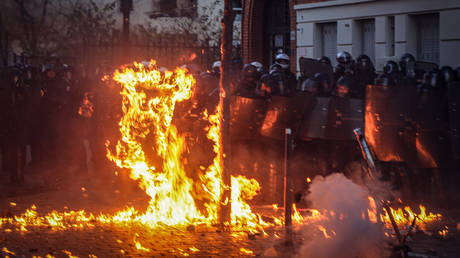
Viral clips of French police officers engulfed in flames during street protests shock millions of viewers within minutes, yet almost every news summary leaves out why these incidents keep happening and what the footage actually shows. You've probably seen the raw video feeds from Paris, Lyon, or Nantes. A Molotov cocktail arcs over a line of riot shields, shatters against polycarbonate armor, and suddenly a uniformed officer is running backward while colleagues frantically beat at the fire with gloved hands.
It looks like total chaos. Honestly, that's exactly what the people throwing the incendiary devices want you to think.
When you strip away the sensational headlines and look at the actual history, tactical reality, and legal fallout of attacks on French law enforcement, a much clearer picture emerges. The URL provided in the reference prompt didn't point to a specific live article, so we're looking directly at the broader pattern of documented incidents in France—most notably the May Day clashes in Paris, the 2016 Viry-Châtillon ambush, and the recurring urban unrest that has put French policing under a microscope for a decade.
Why Incendiary Attacks Happen in French Protests
Most outside observers assume French protests are just louder versions of demonstrations anywhere else in Western Europe. They aren't. France has a distinct, deeply entrenched culture of street confrontation where radical factions—often referred to by authorities as the Black Bloc or ultra-left militants—use mainstream labor marches or civil unrest as cover.
Here's how it usually unfolds on the ground. Thousands of peaceful union workers, students, or pensioners march along a pre-approved boulevard. Mixed into the flanks or trailing near the back are small, organized groups dressed in identical black clothing, wearing goggles, respirators, and reinforced gloves. They carry backpacks filled with paving stones, mortar fireworks, and homemade gasoline bombs.
Police units, typically the Compagnies Républicaines de Sécurité (CRS) or the Gendarmerie Mobile, form static cordons to block access to government buildings or commercial districts. That static posture makes them sitting targets. When a glass bottle filled with a gasoline-and-oil mixture hits a shield wall, the burning liquid splashes downward onto boots, legs, and groin areas—the exact spots where standard riot padding leaves gaps so officers can still run.
In May 2023, during massive pension reform demonstrations in Paris, a CRS officer suffered severe burns to his hands and face after a Molotov cocktail exploded directly at his feet near Place de la Nation. Footage of that exact moment spread globally within hours. Interior Minister Gérald Darmanin publicly confirmed the injuries, noting that dozens of officers were hurt that single afternoon. Yet if you only watched the ten-second clip on social media, you missed the tactical bottleneck that trapped that squad in a narrow intersection for forty minutes prior to the throw.
The Turning Point at Viry-Châtillon
You can't understand the current tension between French police unions and the public without looking back at October 2016 in Viry-Châtillon, a suburb roughly 20 miles south of Paris. That incident changed everything for French law enforcement.
Four police officers were sitting inside two patrol cars near a troubled housing estate, guarding a surveillance camera that had repeatedly been vandalized to protect local drug-trafficking routes. Around twenty attackers surrounded the vehicles, smashed the windows, and threw lit Molotov cocktails inside. They held the doors shut from the outside so the officers couldn't escape.
Two officers suffered life-threatening burns. One, a 28-year-old named Vincent, was placed in an induced coma with severe burns across his hands, torso, and face, requiring dozens of skin grafts and years of rehabilitation.
I've followed European security policy for years, and the psychological shock of Viry-Châtillon inside French police stations still hasn't faded. Before 2016, officers viewed firebombs mostly as property-destruction tools aimed at banks, bus shelters, or empty vehicles. After Viry-Châtillon, every patrol unit in France started treating incendiary devices as direct attempts at homicide.
That shift explains why French riot police respond with aggressive tear gas barrages, stun grenades, and baton charges the second they spot bottles being prepped in a crowd. Critics see disproportionate force. Officers see survival.
What Viral Protest Videos Get Wrong About Police Gear
Look closely at any video where a French officer catches fire, and you'll notice something counterintuitive. The flames often flare up violently for three to five seconds, then die down faster than you'd expect from regular clothing.
That's not luck. Following the spike in burn injuries between 2016 and 2019, the French Ministry of the Interior overhauled the flame-retardant standards for riot uniforms. Modern CRS suits use specialized aramid fibers—similar to the Nomex material worn by race car drivers and firefighters—designed to resist ignition and prevent synthetic fabric from melting onto skin.
Still, gear has hard limits.
- Visors and helmets protect the skull and eyes, though burning liquid can seep under the chin strap if an officer looks upward when a bottle shatters.
- Tactical vests shield the chest and back, yet standard utility belts and nylon holsters don't always carry the same heat resistance as the underlying jumpsuit.
- Gloves and boots take the heaviest hit because gasoline pools on the asphalt and splashes upward during foot advances.
Even when an officer walks away without third-degree burns, the secondary trauma is brutal. Inhaling superheated fumes or burning chemical accelerants scorches the airway. Panic inside a tight helmet visor disorients even veteran squad leaders, forcing entire units to break formation to drag a burning colleague to safety.
The Legal and Political Fallout Nobody Talks About
Whenever footage of burning police officers hits the news cycle, politicians from every party rush to microphones to condemn the violence. Then the cameras leave, and the court cases drag on for years.
Take the Viry-Châtillon trial. It took nearly five years to reach a final appellate verdict in 2021. Out of thirteen defendants initially brought to trial, eight were acquitted on appeal due to lack of individual DNA or video proof linking them to the specific throws, while five received sentences ranging from six to eighteen years in prison. Police unions were furious. They argued that requiring forensic proof of who lit the match in a coordinated mob ambush makes convictions nearly impossible.
Legal scholars point out the opposite problem. Under French criminal law, collective guilt doesn't fly—prosecutors must prove individual intent and participation beyond a reasonable doubt, even when attackers wear masks and destroy their phones beforehand.
Meanwhile, the political debate gets stuck in a loop:
- Police unions demand stricter mandatory minimum sentences for anyone caught carrying incendiary components near a protest.
- Civil liberties groups warn that preemptive arrests and heavy-handed crowd control sweep up peaceful demonstrators and journalists.
- Government officials increase equipment budgets while struggling to address the underlying social grievances—pension age hikes, inflation, or resentment over police conduct in marginalized suburbs—that fill the streets in the first place.
How to Verify Protest Footage Before Sharing It
Social media algorithms reward outrage, which makes protest videos prime targets for recycled misinformation. Every time unrest flares up in France, accounts routinely repost clips from 2017, 2019, or 2023 and claim they happened ten minutes ago.
If you want to know whether a viral clip of French police under attack is genuine and current, run through a quick verification check before passing it along:
- Check the uniform insignia and vehicle markings. France updated its national police vehicle livery from older blue-and-red striping to a newer gray-and-blue reflective design starting around 2020. Older white cars with thin stripes usually signal archival footage.
- Look at the weather and foliage. May Day clips show green trees and light jackets; winter pension strikes show heavy coats and bare branches. It sounds obvious, yet misdated winter videos go viral every summer.
- Cross-reference with official prefecture statements. The Préfecture de Police in Paris and regional prefectures regularly publish verified injury counts and arrest totals on their official channels within hours of major incidents.
- Watch for cropped watermarks. Accounts often zoom in to cut off television news tickers from BFMTV, France 24, or LCI so viewers can't see the original broadcast date.
Raw footage shows you the visceral reality of street violence in France, and seeing a human being set on fire in uniform is genuinely horrifying. Just don't let a fifteen-second clip replace the full context of how those clashes start, why the tactics on both sides have hardened, and what happens long after the smoke clears from the boulevard.