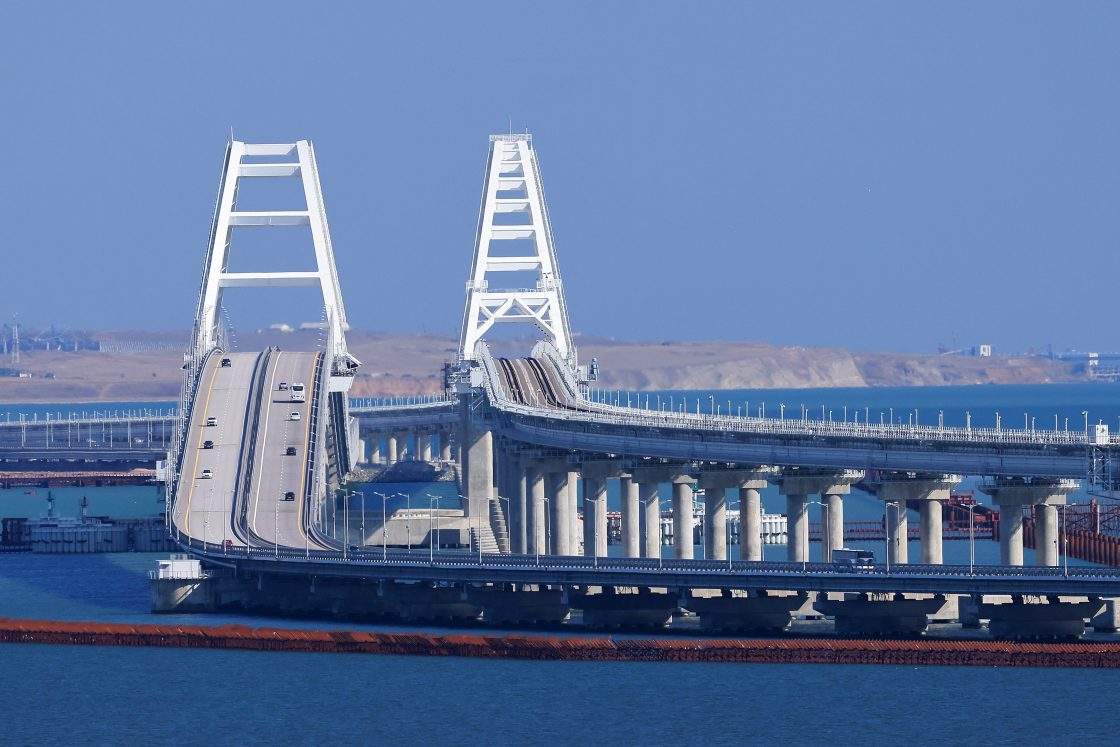
You probably saw the viral video of steel collapsing into the Kerch Strait and assumed a lucky drone got through. It didn't.
What actually happened between November 16 and November 19, 2026, wasn't a lucky shot or a simple overnight raid. When Ukrainian drones destroyed part of the bridge linking Russia to occupied Crimea, they were executing the final phase of a seven-stage military operation that spent weeks systematically blinding Russian radar networks before a single warhead ever touched concrete. Also making waves lately: What Conventional Pundits Missed About the Midterm Electorate.
Most news coverage treats this like a repeat of the 2022 truck bombing or the 2023 naval drone strike. That completely misses why this attack matters. For the first time since Vladimir Putin personally drove a Kamaz truck across the opening span in 2018, the bridge hasn't just been scarred—it's been structurally severed in ways Russia can't easily patch up.
Why the November 2026 Crimean Bridge Strike Was Different
If you want to understand why Moscow's usual repair playbook is failing right now, look at what actually fell into the water. Additional information into this topic are covered by Reuters.
In past strikes, Russian engineering crews worked around the clock to replace damaged concrete deck sections within months. This time, the combined Ukrainian drone and missile barrage collapsed a major roadway span and took down the massive steel arch structure. Even Russian Deputy Prime Minister Marat Khusnullin, who oversees construction, tried to downplay the blow by calling the arch and span beam merely "damaged". Satellite imagery and local reports quickly exposed that spin—both structures broke apart and sank straight into the Kerch-Yenikale Canal.
Here's the catch that military analysts at the Royal United Services Institute (RUSI) immediately pointed out. You don't just bolt a new steel arch onto a bridge over open water. The original arch had to be fabricated on dry land, floated out on specialized barges, and hoisted into place under peaceful conditions. Try doing that in late 2026 when Ukrainian long-range drones and cruise missiles can reach the Kerch Strait any night they choose. Any floating crane or barge sitting stationary in that strait is basically a giant, slow-moving target.
Worse still for Moscow, those sunken steel sections are now sitting on the seabed of the primary shipping channel connecting the Black Sea and the Sea of Azov. By knocking down the bridge, Ukraine inadvertently created an underwater blockade that chokes off maritime cargo movement right alongside road traffic.
How Ukraine Bypassed Satellite Outages and Russian Jamming
One of the biggest untold stories of this strike is how Ukrainian operators kept control of their weapons without relying on Western satellite networks.
For years, mid-range Ukrainian strike teams depended heavily on Starshield—the military-grade version of SpaceX's Starlink—to guide drones into occupied territory. With SpaceX satellite connectivity faltering and restricted, Kyiv had to solve a brutal physics problem. Radio signals travel in straight lines, meaning the curvature of the Earth normally cuts off communication with low-flying drones long before they cross the 150-kilometer corridor of occupied territory leading to the Kerch Strait.
Ukrainian engineers solved it by turning their own drones into a flying Wi-Fi mesh network.
According to insiders from the 7th Deep Strike Centre—part of the famed "Magyar's Birds" unmanned systems brigade founded by Robert Brovdi—the operation launched in staggered waves from multiple locations. The first waves weren't even aimed at the bridge. Their sole job was to overwhelm and bait Russian air defenses across Crimea.
Right behind them came a second wave carrying airborne radio repeaters. Instead of relying on stationary ground antennas or vulnerable satellites, these aircraft bounced signals from one drone to another across a broad frequency spectrum. When Russian electronic warfare units tried to jam a channel, the airborne relays automatically hopped frequencies. That kept live video feeds streaming straight back to Ukrainian command centers, allowing operators to manually steer heavy warheads onto exact structural weak points.
The Seven-Stage Operation Behind the Headlines
You can't fly bulky, explosive-laden drones 500 kilometers across the Ukrainian steppe and the Black Sea if Russia's S-400 batteries and radar stations are wide awake. President Volodymyr Zelenskyy confirmed after the strike that the November 16–17 breakthrough was actually the seventh stage of a multi-week campaign.
Before the main strike package ever lifted off, Ukrainian forces spent weeks hunting down Russian radar arrays, air defense launchers, and electronic warfare stations across southern Ukraine and Crimea. Timing here is everything. As military officers familiar with the operation noted, you can't blow a hole in an air defense network too early, or enemy commanders will simply drag reserve batteries in to plug the gap. Kyiv had to blind the corridor just hours before the main swarm arrived.
When the corridor opened, Ukraine threw a coordinated mix of 11 different weapon systems at the target—10 of which were domestically built:
- Decoy and saturation drones forced Russian interceptors to burn through millions of dollars in surface-to-air missiles. Over two consecutive nights, Russia's Defense Ministry claimed it downed more than 2,700 Ukrainian drones nationwide—1,336 on the first night and 1,441 on the second—including hundreds aimed toward Moscow and deep-rear oil refineries.
- Long-range strike drones, including domestically developed systems like the FP-1 and An-197 alongside Palyanitsa and Ruta platforms, slammed into the roadway deck and support structures.
- Heavy cruise missiles, specifically Ukrainian-made Neptune missiles and precision-guided Flamingo missiles, delivered the knockout blows against the hardened steel arch and railway section on November 17 and again during a follow-up strike on the night of November 19.
Honestly, the sheer scale of domestic manufacturing on display here changes the math of the war. Just two years ago, Kyiv had to beg Western capitals for every long-range Storm Shadow or ATACMS missile and accept strict rules on where they could be fired. By November 2026, Ukrainian factories were producing enough indigenous drones and heavy cruise missiles to overwhelm Moscow's densest air defense umbrella on their own terms.
Does Destroying the Kerch Bridge Actually Break Russian Logistics?
Here's where we need to separate political theater from battlefield reality. If someone tells you that collapsing the Kerch Bridge instantly starves Russian troops in southern Ukraine, they're overselling it.
Back in 2022, the Kerch Bridge was the absolute lifeline for Moscow's southern front. Today, it isn't. Over the past few years, Russia poured billions of rubles into building a 630-kilometer overland highway and rail corridor stretching from Russia's Rostov region along the Sea of Azov coast through Mariupol and Melitopol straight into Crimea. Russian logistics commanders knew the bridge was a sitting duck, so they built a backup route on dry land.
Does that mean the bridge strike was pointless? Not even close.
First, war is a game of bottlenecks. Taking out the Kerch Bridge roadway forces every military fuel truck, ammunition convoy, and supply van onto that single overland corridor. And Ukraine isn't leaving that backup route alone either. Since early October 2026, Ukrainian forces have hit at least six bridges along that exact Rostov-to-Crimea land corridor, burning supply trucks and creating massive traffic chokepoints. When you squeeze an army's supply lines into one narrow hallway and then start dropping grenades in that hallway, everything slows down.
Second, the railway span—while still standing—suffered severe damage to its arch area, forcing Russian authorities to halt traffic and run frantic inspections. Even though Kremlin officials claimed the bridge was strictly for civilian cars, open-source footage has repeatedly caught Russian tanks, artillery pieces, and fuel tankers rolling across those tracks. Every day those trains run at reduced capacity or stop for repairs, Russian units in Kherson and Zaporizhzhia feel the squeeze.
Third, you can't ignore the timing. Ukraine blew up Putin's prized $4 billion pet project right on the eve of his high-profile summit in China with U.S. President Donald Trump and Chinese leader Xi Jinping. Putin spent years selling the bridge to the Russian public as an indestructible monument proving Crimea was "forever Russian". Watching it crumble into the sea right before walking into peace talks stripped away his aura of inevitability. Zelenskyy framed the strike bluntly as a "fair response" after Russia launched 109 separate attacks against Ukrainian bridges and battered Ukraine's power grid into winter blackouts.
How to Track the Real Impact of Infrastructure Strikes
When major strikes like this hit the news cycle, both sides flood social media with exaggerated claims. Kremlin spokespeople like Dmitry Peskov immediately insist the bridge will be rebuilt "even better than before," while online commentators declare the Crimean front completely cut off.
If you want to cut through the propaganda and see what's actually happening on the ground, watch these three concrete indicators over the coming weeks:
- Follow commercial satellite imagery, not official statements. Russian Transport Ministry officials have already begun quietly editing the destroyed arch out of official graphics while refusing to give a repair timeline. Watch independent satellite providers like Vantor or Planet Labs—if you don't see heavy floating cranes anchored in the Kerch Strait, Moscow has quietly accepted that the roadway is dead for the foreseeable future.
- Watch fuel prices and ferry queues in Crimea. When the Kerch Bridge stops moving cargo, civilian and military traffic immediately backs up at the Kerch ferry crossings and along the Chongar checkpoint on the land bridge. Local Telegram channels in Sevastopol and Simferopol will report gasoline rationing and empty supermarket shelves long before Moscow admits a supply crunch.
- Track strikes on the Rostov-Melitopol rail line. The Kerch Bridge is only half of the logistical equation. Keep an eye on Ukrainian General Staff reports for hits on bridges, fuel depots, and rail junctions in Rostov Oblast and occupied Zaporizhzhia. If Ukraine keeps hammering the overland corridor while the bridge remains broken, Russian forces in Crimea will slowly find themselves trapped on an island once again.