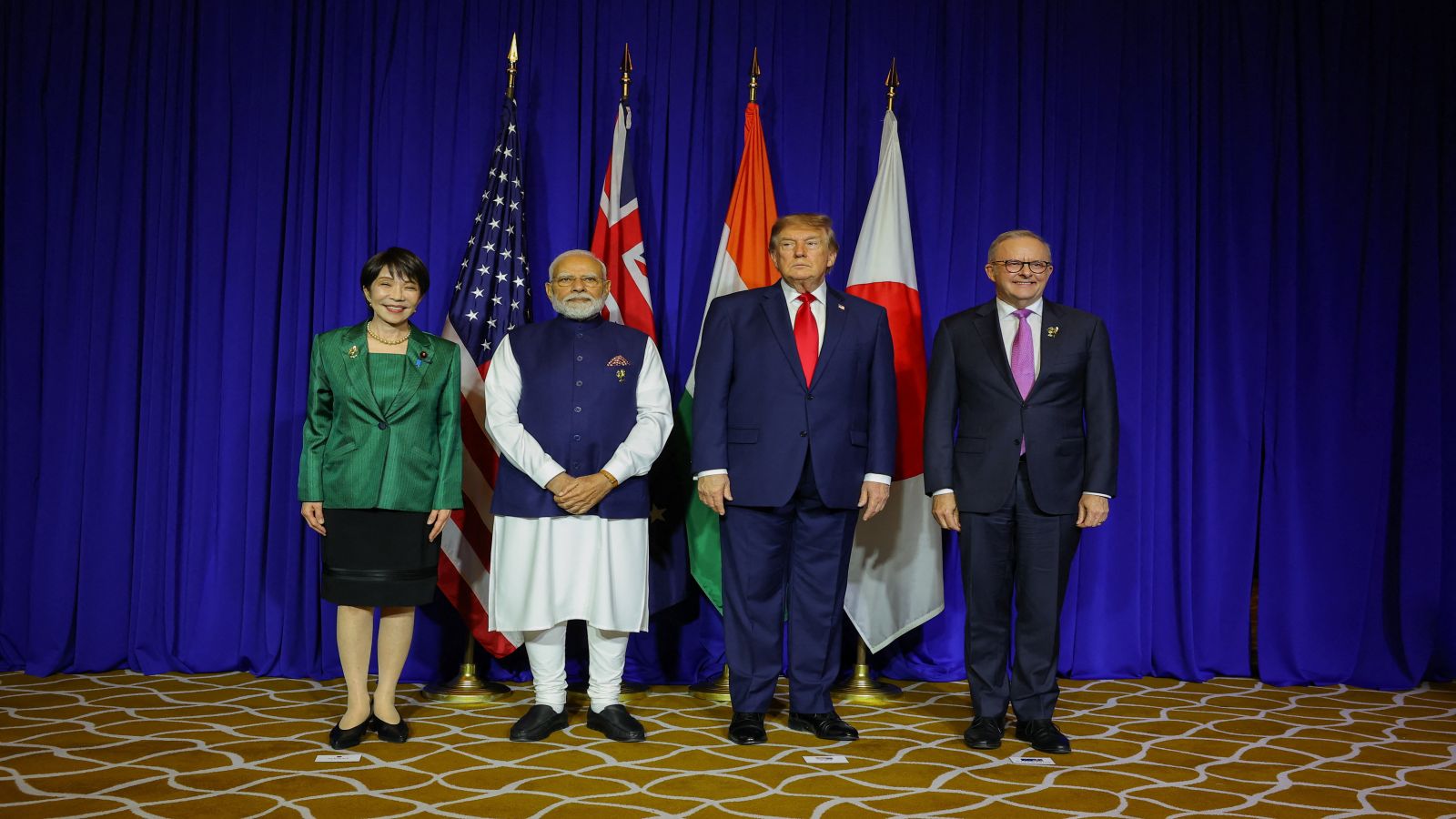
Two years without a leaders' summit had plenty of Washington and New Delhi insiders quietly writing the Quad's obituary. When President Donald Trump, Prime Minister Narendra Modi, Prime Minister Anthony Albanese, and Prime Minister Sanae Takaichi finally sat down in Manila on November 17, 2026, they didn't just revive the group. They wired it directly into corporate balance sheets, submarine power cables, and airborne maritime patrols.
Most coverage treats the Quad Business Leaders' Forum, expanded maritime surveillance, and new cybersecurity commitments as routine diplomatic boilerplate. That reading misses the entire plot. For nearly two decades after its 2004 tsunami-relief origins, the Quadrilateral Security Dialogue struggled with a chronic credibility gap—plenty of high-minded communiqués about a "free and open Indo-Pacific," very few binding contracts. By locking in an early 2027 Mumbai summit for private-sector executives alongside joint P-8 and P-3C patrol flights, the four democracies just shifted from diplomatic signaling to operational execution.
Why the Quad Business Leaders Forum Matters More Than Naval Drills
Naval exercises grab headlines, yet supply chains decide who wins long-term geopolitical contests. During the Manila meeting, the four leaders explicitly condemned "economic coercion" and "arbitrary export restrictions"—diplomatic shorthand for sudden mineral and technology chokeholds.
Politicians can't build alternative supply chains by decree. Companies do. That's the real logic behind launching the inaugural Quad Business Leaders' Forum in Mumbai in early 2027. Proposed by India and backed by Washington, Tokyo, and Canberra, the forum puts corporate executives, government officials, and policy specialists in the same room to hammer out commercial deals across critical minerals, semiconductor manufacturing, clean energy, and emerging tech.
Look at how the four economies actually fit together when you strip away the speeches:
- Australia holds massive reserves of lithium, rare earths, and critical raw materials.
- Japan brings advanced refining, industrial recycling, and precision hardware manufacturing.
- The United States supplies frontier artificial intelligence, chip design, and deep capital pools.
- India offers engineering scale, pharmaceutical capacity, and a rapidly expanding manufacturing base.
Until now, those four pieces operated mostly through bilateral deals or loose working groups. Creating a dedicated Mumbai forum gives private capital an institutional bridge across all four markets. If you're running a mid-sized defense supplier, a clean-tech startup, or a telecommunications contractor in any of these four nations, this is the first Quad mechanism designed to turn policy alignment into actual procurement contracts.
The Catch Nobody Mentions
Don't mistake a scheduled forum for guaranteed capital flow. The Quad still has no permanent secretariat and no treaty-backed enforcement mechanism. Regulatory friction between New Delhi and Washington—especially around data localization, tariff schedules, and technology transfer rules—has stalled plenty of promising joint ventures before. Even with President Trump praising Modi as a close partner in Manila and signaling progress toward bilateral trade alignment, corporate boards won't move factories out of entrenched Asian hubs unless the Mumbai forum produces concrete financing guarantees and standardized compliance rules.
Skies Over the Indo-Pacific Get Crowded in 2027
While executives prepare for Mumbai, military planners have their own 2027 deadline. Under the newly launched Indo-Pacific Maritime Surveillance Collaboration, Quad nations are scheduling their first-ever joint maritime patrol aircraft exercise using P-8 and P-3C planes.
This builds directly on the Indo-Pacific Partnership for Maritime Domain Awareness (IPMDA) launched back in 2022. IPMDA gave smaller Pacific Island and Southeast Asian nations commercial satellite data to track illegal fishing and "dark" vessels turning off their transponders. Satellite imagery, however, has latency. You see where a ship was hours ago, not necessarily what it's doing right this second.
Putting American, Indian, and Australian P-8 Poseidons alongside Japanese P-3C Orions in a coordinated Quad framework closes that gap.
- Real-time sensor fusion: P-8 and P-3C aircraft carry synthetic aperture radar, electro-optical cameras, and acoustic sensors capable of tracking surface vessels and submarines across vast ocean corridors.
- Chokepoint coverage: With maritime tensions flaring near the South China Sea, the Strait of Malacca, and the Indian Ocean seabed, coordinated aerial patrols allow the four navies to stitch together continuous surveillance without stretching any single fleet past its breaking point.
- Interoperability without a formal treaty: China regularly accuses the Quad of building an "Asian NATO." By framing the 2027 flights around maritime domain awareness, seafarer safety, and disaster response rather than a mutual defense pact, the four governments get practical military interoperability while respecting India's commitment to strategic autonomy and ASEAN centrality.
What the Manila joint statement smartly left unspecified are the exact bases, flight corridors, and participating squadrons. Watch the upcoming defense ministry orders closely. Whether those aircraft operate out of bases in Guam, Okinawa, northern Australia, or India's Andaman and Nicobar Islands will tell you immediately how aggressive the operational posture really is.
Cybersecurity Moves Underwater and Into AI
Most people hear "cybersecurity cooperation" and picture analysts trading malware signatures in a windowless room. The Manila agreements go way deeper into physical infrastructure.
Over 95 percent of international internet traffic travels through fiber-optic cables resting on the ocean floor. When those cables get severed—whether by accidental ship anchors or deliberate gray-zone sabotage—financial markets, cloud networks, and military communications grind to a halt. In Manila, the four leaders upgraded the Quad Partnership for Cable Connectivity and Resilience, welcoming new undersea cable projects across the Indian Ocean.
Even more telling is Australia's expanded commitment to integrate electricity cables into that resilience framework. Cross-border subsea power grids are becoming essential for regional energy security, yet they're notoriously hard to patrol. Treating subsea power and telecom lines as a single protected infrastructure class shows how seriously the four governments take hybrid threats.
Alongside physical cables, the leaders rolled out Enhanced Quad Cybersecurity Cooperation and reaffirmed over $85 million in backing for the AI Accelerator (referred to in the joint text as the Super Intelligence Accelerator in Australia, India, and Japan). Here's why those two initiatives belong in the same breath:
- Securing the AI stack: As governments and banks across the Indo-Pacific deploy artificial intelligence models, poisoned training data and compromised cloud infrastructure become massive national security liabilities. The Accelerator funds trusted AI deployment and technical assistance so developing nations in the region aren't forced to rely on single-vendor, state-subsidized tech stacks from authoritarian suppliers.
- Transnational cybercrime and state-backed intrusions: Cyber incidents across Asia-Pacific networks have surged in both volume and sophistication. Enhanced Quad cooperation targets joint incident response, threat intelligence sharing, and law enforcement coordination against cross-border cyber syndicates and state-affiliated hackers alike.
Why Manila Was Chosen for the Reset
Geography isn't an accident in diplomacy. Hosting this summit in Manila on November 17, 2026—right alongside ASEAN-related meetings—carried unmistakable symbolism. Manila was where Quad officials first met in 2007 and where the grouping was resurrected in 2017 after a ten-year freeze.
Meeting in the Philippine capital in late 2026, amid persistent maritime standoffs in the South China Sea and questions over whether the second Trump administration would prioritize Indo-Pacific alliances, sent a blunt message. Washington wasn't walking away, and Southeast Asian nations didn't have to choose between ASEAN unity and Quad backing. As the official joint release noted, the four nations reaffirmed "unwavering support for ASEAN centrality" while drawing a clear line against unilateral attempts to alter the regional status quo by force.
How Businesses and Policy Analysts Should Track What Comes Next
Diplomatic summits produce press releases; follow-through produces leverage. If you're evaluating whether the Manila commitments will actually reshape Indo-Pacific trade and security over the next twelve months, ignore the speeches and track four concrete benchmarks:
- Watch the Mumbai delegate list and deal pipeline: When the Quad Business Leaders' Forum convenes in early 2027, look past the keynote speakers. Check whether major sovereign wealth funds, export-import banks (like US EXIM, JBIC, Export Finance Australia, and India's Exim Bank), and tier-one semiconductor or mineral firms sign binding co-financing agreements.
- Monitor the 2027 P-8 and P-3C exercise orders: Pay attention to the official defense ministry announcements specifying the host airbases and sea zones for the joint patrol flights. Integration of acoustic and radar data feeds across all four platforms will prove whether real-time intelligence sharing is genuinely operational.
- Track Indian Ocean cable tenders: Follow procurement notices under the Quad Partnership for Cable Connectivity and Resilience to see which telecommunications and subsea power operators win contracts for the new Indian Ocean routes.
- Audit your supply chain exposure to export curbs: If your business relies on single-country processing for critical minerals, telecom hardware, or cloud AI infrastructure, use the Quad's new policy frameworks and trade financing initiatives to qualify secondary suppliers across Australia, India, Japan, and the United States before the next export restriction hits.